
SEO & AI Search
Zero-Click Search Strategy 2026: How to Earn Value When 68% of Searches Never Click
By Bibek Thapa · Updated · 16 min read
Quick Answer
A zero-click search strategy accepts that most searches now end on the results page and shifts the goal from earning the click to earning the citation, the mention, and the return visit. In 2026, 68% of US Google searches send no click anywhere. Fix ranking first, write answer-first pages an AI answer can lift, keep brand facts consistent, and measure impressions, branded search and AI visibility.

Table of ContentsOn this page
- What zero-click search means in 2026
- How the number reached 68%
- Where clicks still happen
- Why a zero-click search strategy is the second problem, not the first
- The ANCHOR framework for zero-click search strategy
- Should you opt out of AI features?
- What CTAs work in a zero-click search strategy
- How to measure a zero-click search strategy without clicks
- A 30-day zero-click search strategy checklist for a small site
- Bottom line
- Frequently Asked Questions
- Sources and References
Key Takeaways
- 68.01% of US Google searches ended without a click in January–April 2026, up from 60.45% in 2024 (SparkToro / Similarweb).
- With an AI Overview on the page, users click a traditional result 8% of the time versus 15% without one, and a source inside the summary 1% of the time (Pew).
- Google AI Mode is more extreme: 92–94% of AI Mode sessions on US desktop ended without an external click (Semrush).
- Sites that kept traffic through 2024–2026 mostly let a visitor complete a task, offer a product, or own data Google cannot reproduce.
- Brands cited inside AI Overviews saw 35% higher organic CTR on the same queries, though citation and authority are hard to separate (Seer).
- Search Console's Generative AI performance report, worldwide since 31 August 2026, shows AI Overview and AI Mode impressions but no clicks or queries yet.
The first version of this zero-click search strategy guide went up earlier in 2026. Since then, the headline number has moved. Also, Google has shipped a report that changes how zero-click visibility can be measured. Meanwhile, Search Console has handed me an unflattering data point about this very page. All three are in this update.
What zero-click search means in 2026
A zero-click search is a search that resolves on the results page. The person types a question. Google answers it through an AI Overview, a featured snippet, a knowledge panel, or a direct answer, and the session ends. Consequently, there is no visit, no click, and no row in your analytics.
The current figure comes from SparkToro's analysis of Similarweb clickstream data. Between January and April 2026, 68.01% of US Google searches ended without a click to any destination, up from 60.45% in 2024 [1]. Thus the share of searches producing at least one click fell 9.51 percentage points in two years. Google's own properties, paid ads, and the open web split what remains.
Two caveats before you apply that number to your own site. First, the data covers browser searches only. Searches inside the Google mobile app are excluded, and SparkToro notes that zero-click behaviour there may be higher still [1]. Second, the 68% is a blended figure. It rests on a two-thirds mobile, one-third desktop weighting. Coverage of the study puts mobile zero-click near 77% and desktop near 50% [1]. Because most publishing niches have phone-first readers, the number you live with is closer to the mobile figure.
| Search surface | Share ending without a click | Source and window |
|---|---|---|
| All US Google searches (browser) | 68.01% | SparkToro / Similarweb, Jan–Apr 2026 [1] |
| Searches showing an AI Overview | Traditional-result clicks fall from 15% to 8% of searches | Pew Research, March 2025 [2] |
| Google AI Mode sessions (US desktop) | 92–94% | Semrush / Datos, May–Jul 2025 [3] |
These are US figures. Search from Nepal, India, or any market where AI Overviews cover fewer query types and you will see fewer AI answers than a US searcher typing the same English query. The gap is closing, but it is real. Therefore, check your own results pages before assuming the US average describes them.
How the number reached 68%
AI Overviews are the steepest part of the curve, not the whole curve.
Featured snippets arrived in 2014. Knowledge panels came earlier still. By 2016, roughly 45% of Google searches already ended without a click; by 2019 the figure was around 49% [1]. The 2024 baseline of 60.45% predates the wide rollout of AI Overviews. But AI Overviews then scaled through 2024 and 2025. As a result, a slow ten-year climb turned into a 7.56-point jump in two years, the fastest movement this metric has shown since SparkToro began measuring it [1].
| Year | Zero-click share (US Google) | Main driver |
|---|---|---|
| 2016 | ~45% | Featured snippets, knowledge panels |
| 2019 | ~49% | People Also Ask, local packs |
| 2024 | 60.45% | Pre-AI-Overview baseline |
| 2026 (Jan–Apr) | 68.01% | AI Overviews on 20%+ of queries |

Figures from SparkToro's 2026 study and its earlier clickstream work [1][4].
AI Mode, Google's conversational search tab, has barely registered in these numbers yet. Similarweb's panel put it at 0.34% of Google searches in the same January–April 2026 window [4]. Meanwhile, Google reported more than a billion monthly AI Mode users at I/O 2026 [4]. When AI Mode sessions do happen, they rarely leave Google. However, that phase has not started in earnest.
In practice, the tactics that worked against featured snippets in 2019 are a reasonable starting point for a zero-click search strategy now. Both reward a page that states a clear answer a machine can lift. What is new is the scale. Also, the answer is now assembled from several sources rather than quoted from one.
Where clicks still happen
Not every search stopped clicking. Two sets of evidence show where the remaining clicks go, and they agree.
Cyrus Shepard examined 400 websites whose traffic held or grew through the 2024–2026 decline. Rand Fishkin published the findings on SparkToro in April 2026 [5]. Five features separated winners from losers. The site offers a product or service. It lets the visitor complete a task. Proprietary assets, such as user-generated data, belong to it. Its topical focus is tight. And it carries a recognisable brand. Task completion was the sharpest divider: 83% of winning sites let a visitor finish what they came to do, whether that meant checking a lottery ticket, running a calculator, or booking a slot. Of sites with proprietary assets, 92% went up. Tight topical focus was common among winners. However, it was common among losers too, so on its own it predicts little.
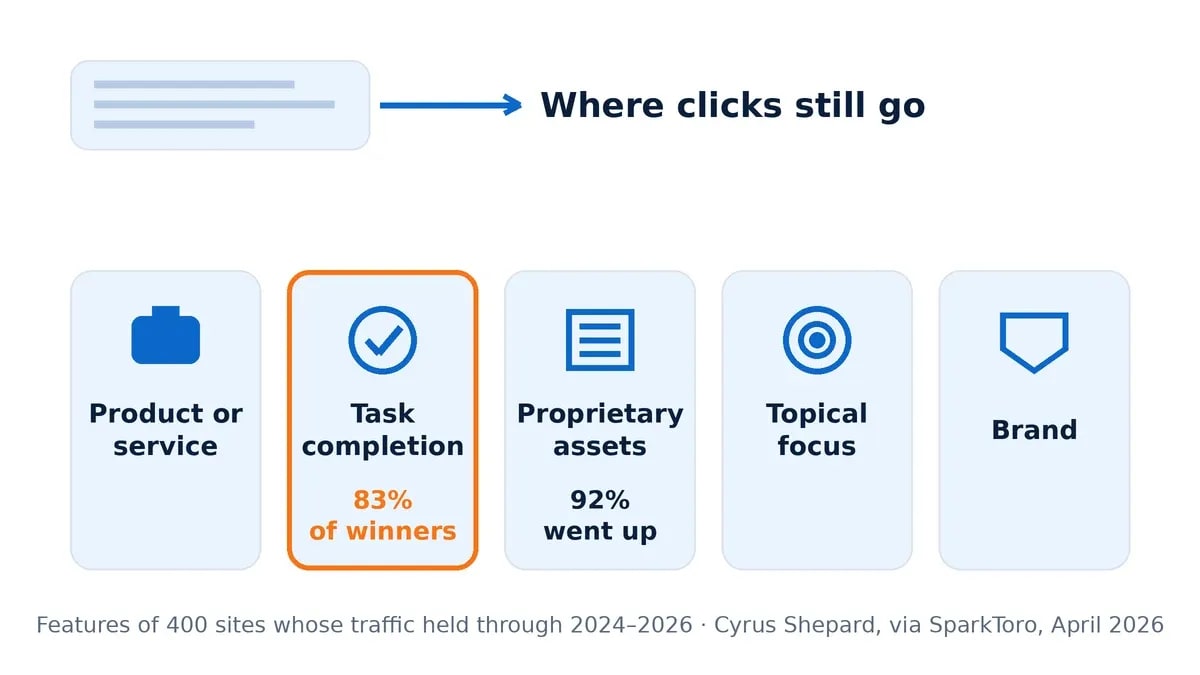
The second line is query type. Branded searches make up roughly 44% of Google searches and still send clicks reliably, as do local and transactional queries [6]. Informational queries are where zero-click behaviour concentrates. After all, an informational question is exactly what an AI Overview is built to answer.
For a small publisher this is uncomfortable, because a page that explains a concept competes with the AI Overview on its own ground. By contrast, a page that lets someone do something, compare real data, or download a working template competes on ground the Overview cannot occupy. This article is the first kind. The checklist near the end is my attempt to make it a little more of the second.
Why a zero-click search strategy is the second problem, not the first
Most content reporting still boils success down to one number: organic clicks. But that number now misleads in both directions. If you want the fuller argument, see how to prove content ROI without click data.
Seer Interactive's September 2025 analysis covered 3,119 informational queries across 42 organisations. Brands cited inside an AI Overview earned a 35% higher organic CTR and a 91% higher paid CTR than uncited brands on the same queries [7]. The same dataset shows organic CTR on queries with an AI Overview falling 61%, from 1.76% in June 2024 to 0.61% in September 2025. However, Seer is careful to say it cannot prove citation causes the higher CTR; brands with stronger authority may simply be cited more often. Either way, the citation is worth tracking, and a click count will not reveal it.
Pew's finding sharpens the point. Only 1% of visits to a results page with an AI summary included a click on a link inside that summary [2]. Therefore, most of the value of being cited happens inside the reader's head, before any click, and often without one.
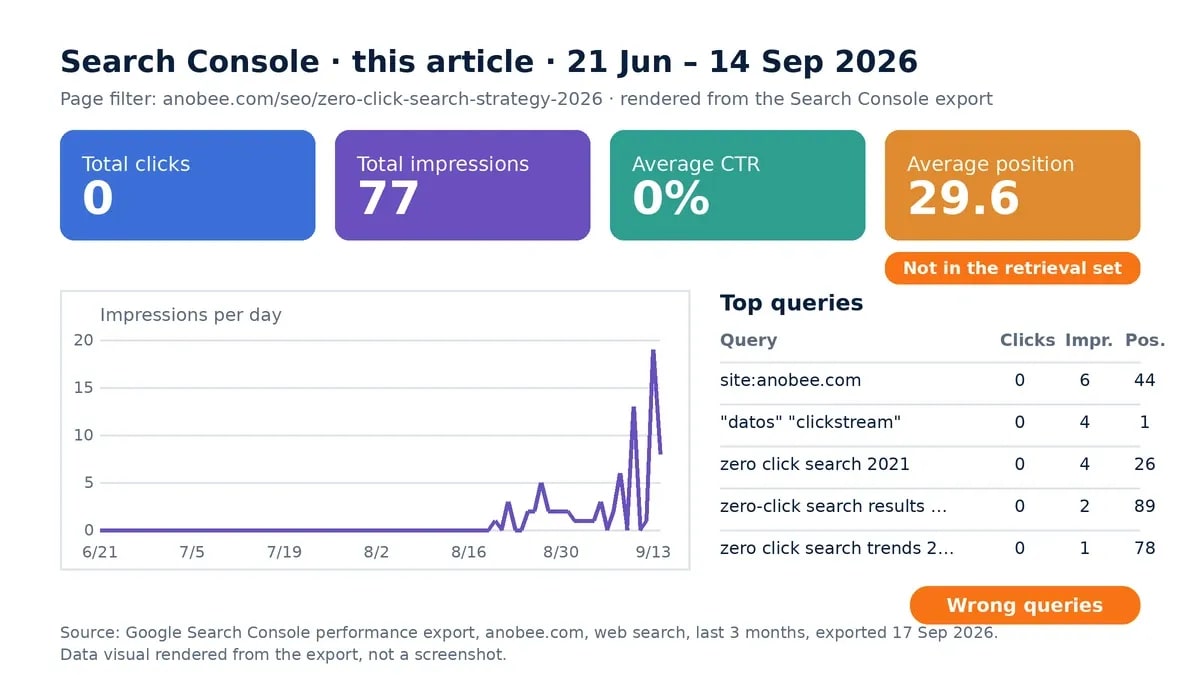
Most guides skip a step here. When I pulled Search Console for anobee.com in July 2026, the site-wide average position was 59.9 over the trailing three months. Click-through rate was 0.8% on 5.16K impressions. That is not a zero-click story. Instead, at page six, low clicks are explained by weak ranking, not by AI Overviews absorbing them.
This page is the sharper example. Between 21 June and 14 September 2026, the earlier version of this article recorded 77 impressions and zero clicks in Search Console. Its average position was 29.6. The queries that surfaced it were mostly the wrong ones: "zero click search 2021", a Spanish-language clickstream query, a site: search. A page at position 30 for the wrong queries is not losing to AI Overviews. It has not yet earned the right to be summarised, because it is not in the retrieval set at all. That is why this refresh starts with intent and ranking. It is also why the zero-click search strategy below treats citation as a second-stage goal.
The ANCHOR framework for zero-click search strategy
Optimising harder for clicks that are structurally not coming does not work. Instead, what works is a set of habits that earn citation and recall while the ranking work continues. I call it ANCHOR: Answer-first structure, Named authorship, Corroborated claims, Homepage-level entity consistency, Original data, and Repeat brand exposure.

A framing note. Google's guidance for generative AI features says the best practices for SEO "continue to be relevant" because AI Overviews and AI Mode are rooted in core Search ranking systems [8]. It also lists the tactics it does not use: llms.txt files, special markup, content chunking, and rewriting for AI systems [8]. ANCHOR is not a workaround for that guidance. Rather, it is a way of doing ordinary good publishing in an order that suits how answers are now assembled. The difference between SEO, AEO, and GEO is covered separately.
A — Answer-first structure
Open every major section with a direct, self-contained answer to the question in the heading, in the first sentence or two. Then earn the detail. Retrieval systems lift these passages. Bury the answer three paragraphs down and a competitor's cleaner passage gets used instead, even when your page is deeper overall. This is not chunking, because a full article with clear openings reads better for people too.
N — Named authorship
Google's people-first content guidance asks whether it is "self-evident to your visitors who authored your content", whether pages carry a byline where one is expected, and whether that byline leads to background about the author [9]. A bylined page from a verifiable person is easier for a reader, and for a retrieval system, to place and trust than an anonymous one. Every Anobee article carries a byline linked to an author page. So the work here is keeping that consistent, then pairing it with the tactics that make a page citable by ChatGPT.
C — Corroborated claims
AI systems weigh consensus over confidence. When the same fact about your brand, your data, or your claims appears independently across your own site, third-party mentions, and community discussion, it is more likely to be surfaced. In short, consistency across sources does the work that confidence on one page cannot. However, Google draws the line at inauthentic mentions, which it says are not helpful [8]. The version that works is the slow one: publish something specific enough that other people repeat it with your name attached. This is the same principle as entity optimisation for AI search.
H — Homepage-level entity consistency
Your brand name, author name, and core facts need to match exactly across your site, your About page, your social profiles, and any third-party listings. For Anobee, a small but real problem: the bare word "Anobee" collides with unrelated personal accounts on several platforms and with Amobee, an ad-tech company one letter away. Accordingly, the site anchors every entity signal to the domain and the author name together. The earlier version of this article flagged a broken url field in the site's Organization schema. That has since been fixed, and the structured data guide for bloggers walks through the check.
O — Original data
Primary data, whether a benchmark, a survey, or an observed result, gets cited far more often than commentary that repeats someone else's numbers. The same Google guide says creating content people find "unique, compelling, and useful" will likely influence presence in generative AI search more than any other suggestion it makes [8]. The Search Console figures two sections up are original data. They are small and unflattering. Nevertheless, they are the most citable thing on this page, because nobody else has them.
R — Repeat brand exposure
Zero-click value builds up over time rather than landing in one shot. A reader who sees your name inside three different AI answers over a month is more likely to search for you directly later. That branded-search lift is one of the few measurable proxies for zero-click influence a small site has. For that reason, it sits at the centre of the measurement section below.
Should you opt out of AI features?
You now can. But for most publishers, you should not.
Alongside the reporting rollout on 31 August 2026, Google added a property-level Search generative AI control in Search Console settings. It removes a site's links and content from AI Overviews, AI Mode, and generative AI features in Discover, the same three surfaces the new report measures [10]. Google states the setting is not used as a ranking signal elsewhere in Search. It also has no effect on AI training, which is governed by the separate Google-Extended control [10]. A UK regulator has required page-level controls by March 2027, so expect finer options.
The tradeoff is simple. The query still gets answered. Instead, opting out means someone else answers it, and you keep neither the click you were not getting nor the mention you were. The narrow case for opting out is a site whose value is entirely in the visit, such as a tool or a paywalled archive. There, being summarised genuinely substitutes for being used. For a publisher whose goal is to be known for a subject, however, the mention is the asset.
What CTAs work in a zero-click search strategy
A CTA on a page most people will never visit has a different job: to be remembered, not only clicked.
Three CTA types hold up better than "read more":
- Brand-recall CTAs. "Search anobee.com for the ANCHOR checklist" gives a reader something to re-search later. "Click here to learn more" does not.
- Named-resource CTAs. Pointing to a specific, distinctly named tool, template, or framework gives the reader a handle, even if they never click.
- Community and list CTAs placed early. A specific invitation to a newsletter, a forum thread, or a discussion, placed in the first few hundred words, gets seen. Nobody reaches a closing pitch on a page they did not open. SparkToro's advice to own your audience data through email and community rather than rented reach is the same idea [6]. The email list building guide covers the mechanics.
One pushback on my own advice. Do not swing so far toward brand-recall CTAs that you strip out every functional link. Readers who do click still need a clear next step. Otherwise, the page rewards recall and punishes action. The shift is not "remove CTAs" but "stop designing every CTA as if the click is guaranteed."
How to measure a zero-click search strategy without clicks
Clicks alone will keep understating performance as this trend continues. But four measurements close the gap. Also, all four live in tools you probably already run.
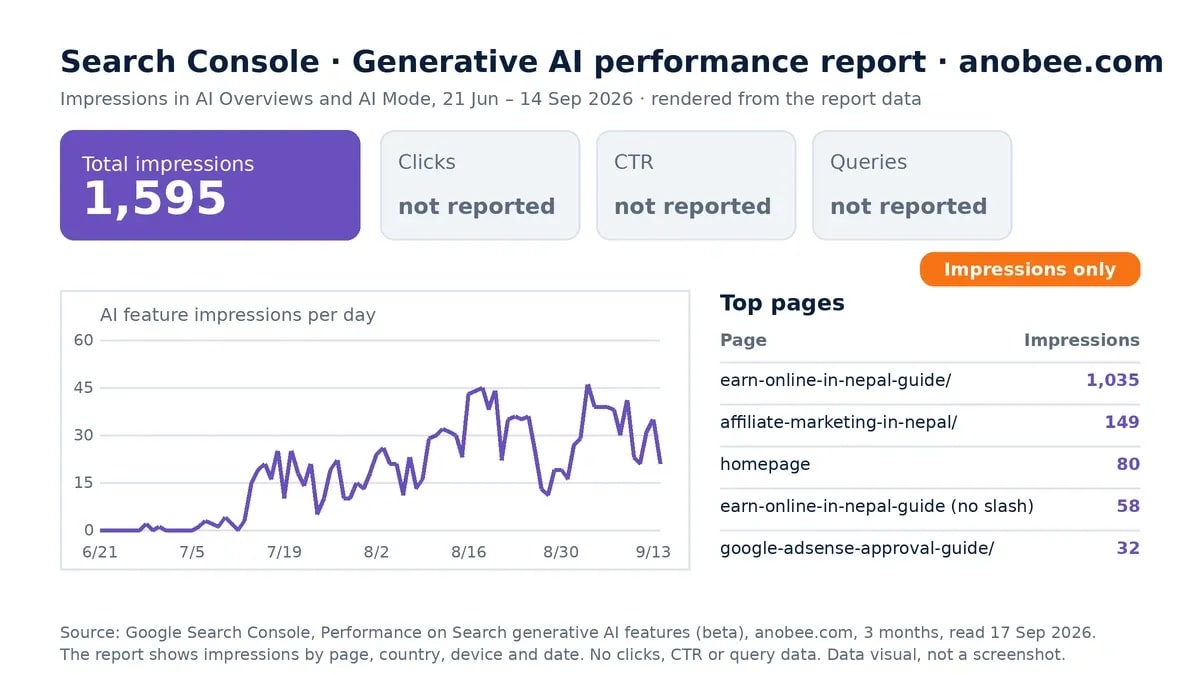
1. Impressions in Search Console, including the Generative AI performance report. Google announced dedicated Generative AI performance reports on 3 June 2026 with a small group of UK properties. It then rolled them out to all properties worldwide on 31 August 2026 [10]. The Search report shows how many times links to your site appeared in AI Overviews and AI Mode, broken down by page, country, device, and date [11]. It does not show clicks, CTR, or queries. It also needs a minimum impression threshold before data appears [11]. Therefore, treat it as a visibility gauge. In the main Performance report, track impressions on informational queries separately from clicks. A widening gap between the two is the zero-click signature. If you have not set the property up cleanly, the Search Console setup guide comes first.
2. Branded search volume, also in Search Console. Filter the Performance report by your brand name, paired with a qualifier if your name is ambiguous. Rising branded search after publishing zero-click-prone content is a reasonable proxy for recall built inside AI answers, because Pew's 1% figure means most of that influence never registers as a click [2].
3. GA4 direct and branded-organic sessions. A rise in direct-entry traffic or branded organic sessions, without a matching rise in standard organic referrals, often reflects a reader who saw your name in an answer and came back another way. A behaviour tool such as the one covered in the Microsoft Clarity guide helps confirm those visitors engage rather than bounce.
4. Manual AI platform checks against a fixed prompt set. Once a month, run the same ten to twenty questions through ChatGPT, Perplexity, Gemini, and Claude. Record whether your site is cited or your brand is named. Keep the prompts stable so the trend means something. The check AI citations guide has a repeatable method, and the AI Citation Index for November 2026 shows what a repeated test looks like in practice. Perplexity's freshness-weighted behaviour is worth checking on its own.
| Question you are really asking | Old signal | Better signal in 2026 |
|---|---|---|
| Is this page being seen? | Clicks | Total impressions plus Generative AI report impressions |
| Is it shaping decisions? | CTR | Branded search volume, direct sessions |
| Is it being used as a source? | Referral traffic | Citation rate across a fixed prompt set |
| Is the article working? | Sessions | All four together, judged against ranking position |
How the four fit together: suppose a GEO-category post shows 4,000 impressions and 90 clicks in a month, a 2.25% CTR that looks weak in isolation. Next, pull branded search for the same period. If searches for your name rose after the publish date and direct GA4 sessions ticked up alongside, the post is probably doing real work in AI answers. Judged by clicks alone it looks like a failure. However, judged by the full picture it may be your best-performing article. The reverse is also true, and my own numbers above are the reverse: low clicks at position 30 mean the page needs ranking work, not a new dashboard.
A 30-day zero-click search strategy checklist for a small site
This is the sequence I am running on Anobee. The order matters, because each step depends on the one before it.
- Capture a baseline before changing anything. Export the last three months of Search Console data for the page, and note the Generative AI report figures. Otherwise, the before-and-after is unmeasurable.
- Check ranking and intent first. If the page sits past position 20, or surfaces for the wrong queries, fix the title, opening, and headings to match the query you actually want. No zero-click search strategy can rescue a page that is not in the retrieval set.
- Rewrite section openings answer-first. One clear sentence under each heading that could stand alone if quoted.
- Audit the byline and entity facts. Same author name, same brand string, same About-page facts across the site and every profile.
- Add one piece of original data. A Search Console before-and-after, a small test, a real number nobody else has. Label it honestly, including when it is small.
- Rewrite the CTAs. One memorable brand or resource prompt near the top, one functional link further down.
- Fix a monthly prompt set of ten to twenty questions and record AI citations and mentions.
- Review at day 30 against the baseline. Compare the same market and device, and allow for normal volatility before drawing a conclusion.
Search "anobee.com ANCHOR checklist" if you want to find this list again without bookmarking it. That sentence is a brand-recall CTA doing its job.
Bottom line
Sixty-eight percent of US Google searches now end without a click [1]. Meanwhile, AI Mode, where 92–94% of sessions never leave Google, has barely begun to shift that average [3]. Optimising harder for clicks that are not coming is a losing strategy. But a zero-click search strategy is the second problem, not the first. Ranking and intent come first. Ultimately, everything in ANCHOR builds on them.
Fix entity gaps early, because they undercut everything else. Then measure impressions, branded search, direct sessions, and AI citations alongside clicks, not instead of them. If it has been a while since you looked at older articles through this lens, the content audit guide is a reasonable next stop. Finally, give the change time to show up in the same market and device before judging it. None of this means clicks stop mattering. Instead, it means they stop being the only number that tells you whether an article did its job.
Frequently Asked Questions
What percentage of searches are zero-click in 2026?
About 68% of US Google browser searches ended without a click to any destination between January and April 2026, according to SparkToro's analysis of Similarweb clickstream data. That is up from roughly 60% in 2024. The figure excludes the Google mobile app, so real-world behaviour may be higher.
How do AI Overviews affect clicks?
Pew Research found that users clicked a traditional result on 8% of searches that showed an AI summary, compared with 15% of searches without one. Only 1% of visits included a click on a link inside the summary itself. Separate Semrush data puts AI Mode at 92–94% zero-click on US desktop.
Is SEO still worth doing if most searches never click?
Yes, because zero-click value only reaches pages that already rank or get retrieved. A page at position 40 loses nothing to AI Overviews; it was never in the running. Ranking work comes first, then citation and brand work builds on it.
Should you block your site from AI Overviews?
Search Console now offers a property-level Search generative AI control that removes your links from AI Overviews, AI Mode, and AI features in Discover. Google says it is not a ranking signal elsewhere. For most publishers the tradeoff is poor: you lose the mentions and citations that still drive branded search, while the query still gets answered by someone else.
How do you measure zero-click performance?
Track four things together: impressions in Search Console (including the new Generative AI performance report), branded search volume, direct and branded organic sessions in GA4, and a monthly manual check of a fixed prompt set in ChatGPT, Perplexity, Gemini, and Claude. Judge a page by all four, not by clicks alone.
Sources and References
- SparkToro — In 2026, Less than One Third of Google Searches Still Send a Click ↩
- Pew Research Center — Google users are less likely to click on links when an AI summary appears in the results ↩
- Semrush — Google AI Mode's Early Adoption and SEO Impact ↩
- Similarweb — Zero-Click Marketing: What the 2026 Data Means ↩
- SparkToro — 5 Strategic Features that Predict Survival in the Zero-Click Era ↩
- SparkToro — When Google Stops Sending Clicks, What Still Works? ↩
- Seer Interactive — AIO Impact on Google CTR: September 2025 Update ↩
- Google Search Central — Optimizing your website for generative AI features on Google Search ↩
- Google Search Central — Creating helpful, reliable, people-first content ↩
- Search Engine Journal — Google Search Console AI Reports Rolled Out Worldwide ↩
- Google Search Console Help — Generative AI performance report (Search) ↩
Was this guide helpful?
Your answer helps Anobee improve future updates.

Written by
Bibek Thapa
AI-Powered Digital Growth Strategist
Bibek Thapa works across AI workflows, SEO, AI search optimization, content strategy, website growth, and productivity systems. Anobee documents practical lessons, tools, experiments, and systems for improving digital presence.
- AI workflows
- Digital growth
- SEO
- GEO
- AEO
- Content strategy
- Website growth


