Quick verdict
Comparison guideSEO, AEO and GEO describe three stages of one problem. SEO makes a page eligible to be found. AEO structures it so an answer engine can lift a clean answer out of it. GEO builds the reputation that makes an AI assistant name your brand. They are done in order, and the order starts with SEO.
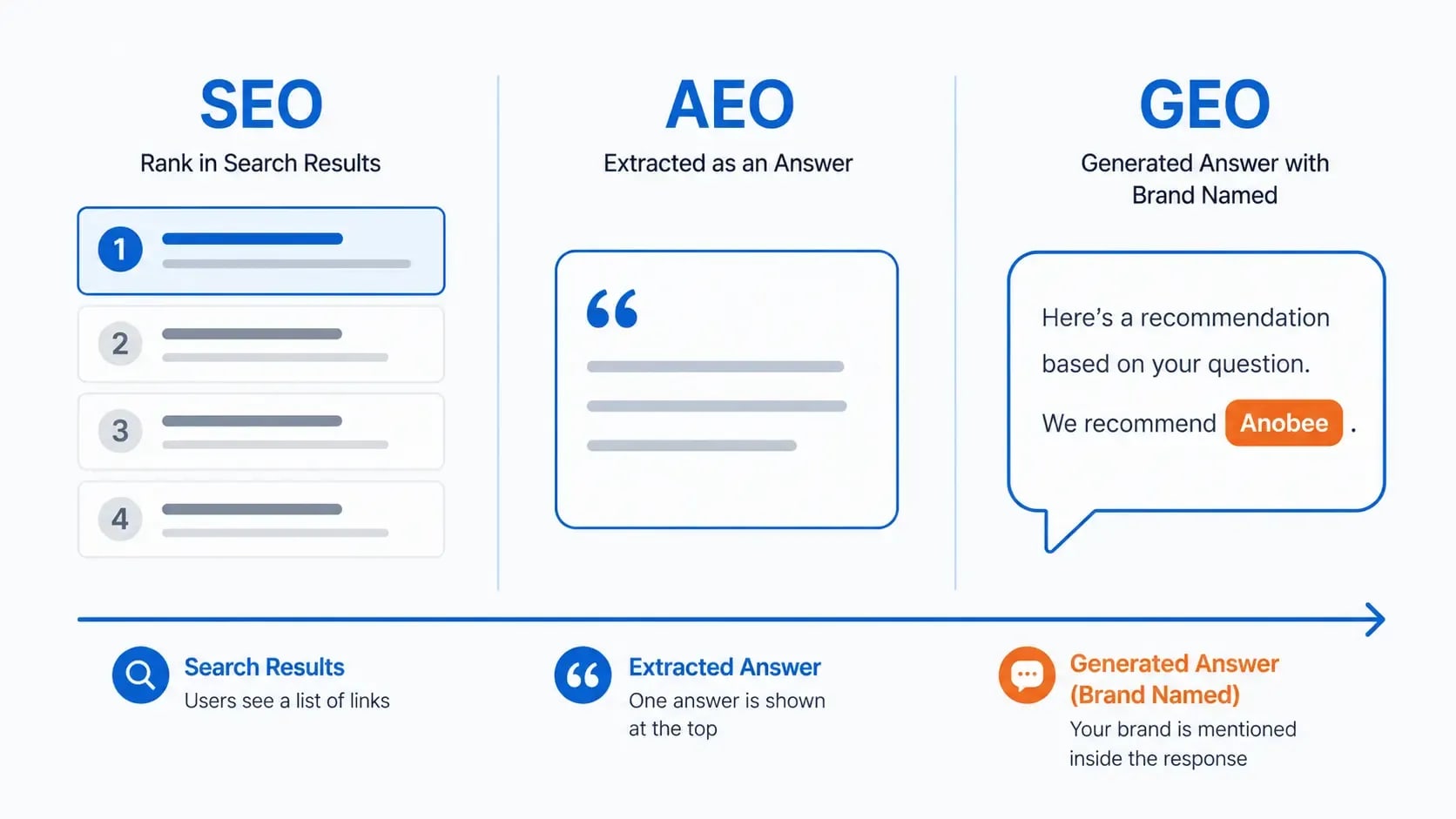
Table of ContentsOn this page
Key Takeaways
- Google states that no special optimization is required for its AI features. Core SEO best practices still apply.
- SEO creates eligibility. AEO creates extraction. GEO creates citation. Each layer depends on the one before it.
- AEO and GEO are largely the same practice under two labels. What matters is passage-level versus brand-level.
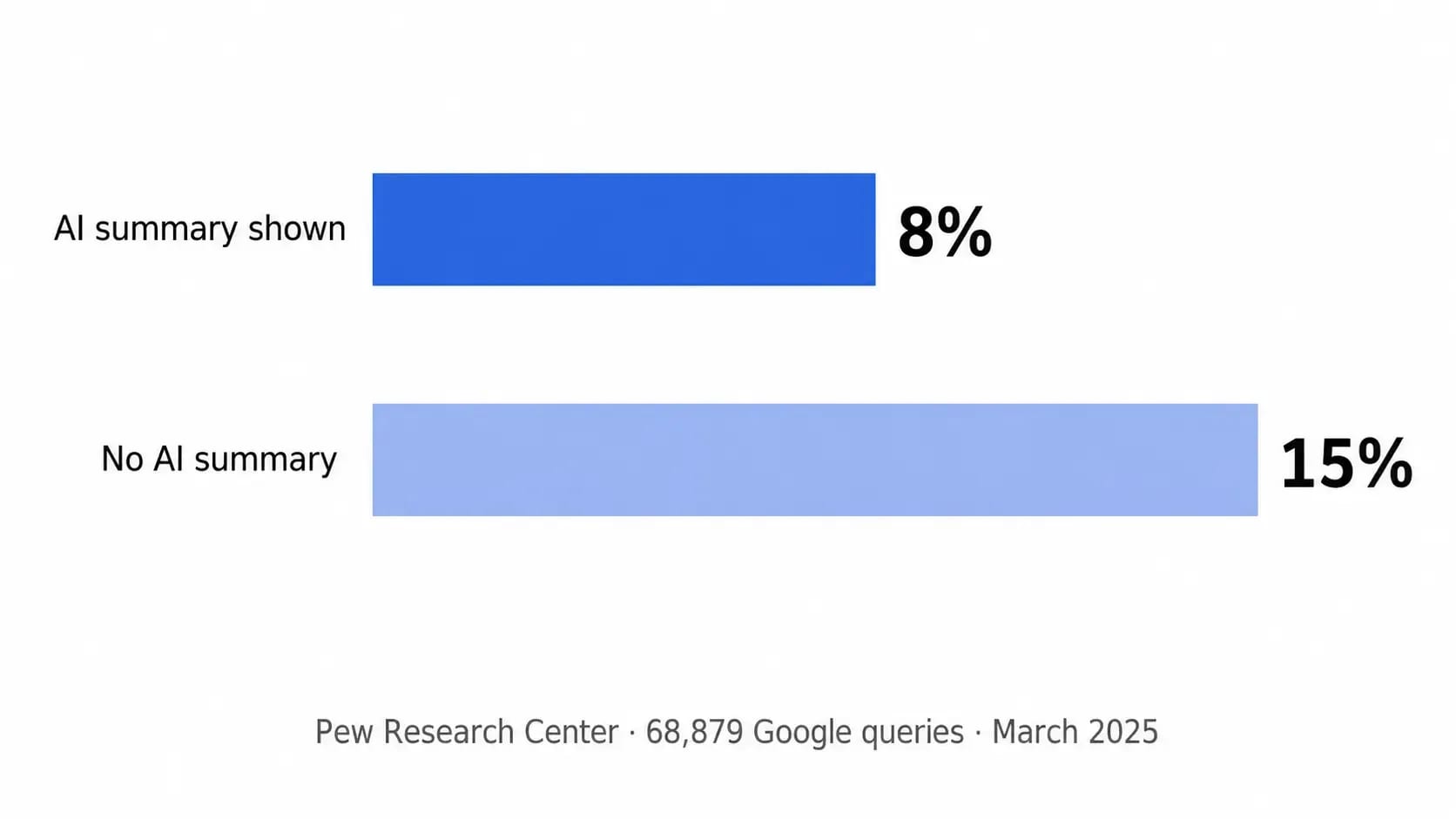
- Pew found users who saw an AI summary clicked through 8% of the time, against 15% without one, in March 2025.
- Do not buy a GEO package before your pages are crawlable, well structured, and worth citing.
What SEO means
Search engine optimization is the practice of helping search engines discover, understand, and rank a page. It has not been replaced. Google's own documentation is plain about this: "The best practices for SEO remain relevant for AI features in Google Search" [1].
SEO works across three layers.
Technical SEO covers what a crawler needs before anything else matters. A page that loads, renders, and can be indexed. A clean URL structure, a working sitemap, and a robots.txt that does not block the wrong things. If a bot cannot reach the page, the rest of this article is irrelevant to you. Most of the damage here comes from a short list of recurring technical mistakes rather than anything exotic.
On-page SEO covers the signals inside the page: title, headings, structure, internal links, entity coverage, schema markup, image handling. This layer does double duty. Answer engines and search engines read the same structural signals, and an on-page checklist covers most of it in one pass.
Off-page SEO covers the signals that live elsewhere: links from relevant sites, brand mentions, third-party references. These are the slowest to build and the hardest to fake.
Where SEO alone falls short is the click. A page can rank and still not be visited, because the answer was rendered above it. Pew Research tracked 68,879 Google queries in March 2025. Users who encountered an AI summary clicked a traditional search result in 8% of visits, against 15% for users who did not [2]. The ranking still delivered exposure. The visit did not follow.
That study is the most careful public measurement of the effect so far, and it is also over a year old. Treat the direction as established and the exact figures as dated.
What AEO means
Answer engine optimization is the practice of structuring content so a system can extract a direct answer from it, whether that is a featured snippet, a People Also Ask box, a voice result, or an AI Overview.
The shift is small but real. A ranked list hands the choice to the reader. An answer engine makes the choice itself. Your work is to be the passage it chooses.
In practice, that means reducing how much interpretation the machine has to do:
- Answer first, under every question-shaped heading. If the heading asks something, the next 40 to 60 words should answer it completely, before any context or caveats.
- Headings phrased the way people ask. "What is the difference between AEO and GEO?" extracts cleanly. "Overview" does not.
- FAQPage schema on genuine question-answer pairs, so the structure is declared rather than inferred. If you have not implemented structured data before, start there rather than with a plugin default.
- Self-contained passages. A sentence that depends on the paragraph above it cannot be lifted out. One that names its own subject can.
None of this is a trick, and none of it guarantees selection. It is the same clarity that helps a human skimmer, applied consistently.
What GEO means
Generative engine optimization is the practice of becoming a source that AI assistants reference when they answer a question in your subject area. ChatGPT, Gemini, Perplexity, Claude.
Most of these systems work through retrieval-augmented generation, usually shortened to RAG. The system retrieves a set of documents it judges relevant, then writes an answer using them. Two things have to go right for you. Your page has to make it into the retrieval set, and your brand has to be recognizable enough that the answer names it.
That second condition is what separates GEO from AEO. AEO asks whether a machine can pull a usable passage from your page. GEO asks whether the machine knows your brand belongs in the conversation at all. That is decided largely off your own site, by mentions, references, and third-party consensus you do not directly control. The on-site half of the problem is entity optimization: making it unambiguous which organization your pages belong to.
This is also why GEO resists quick wins. Page structure is something you can change this afternoon. Entity recognition is not. And what makes a passage quotable enough for an assistant to use it is separate work from the reputation layer underneath it.
Where they overlap
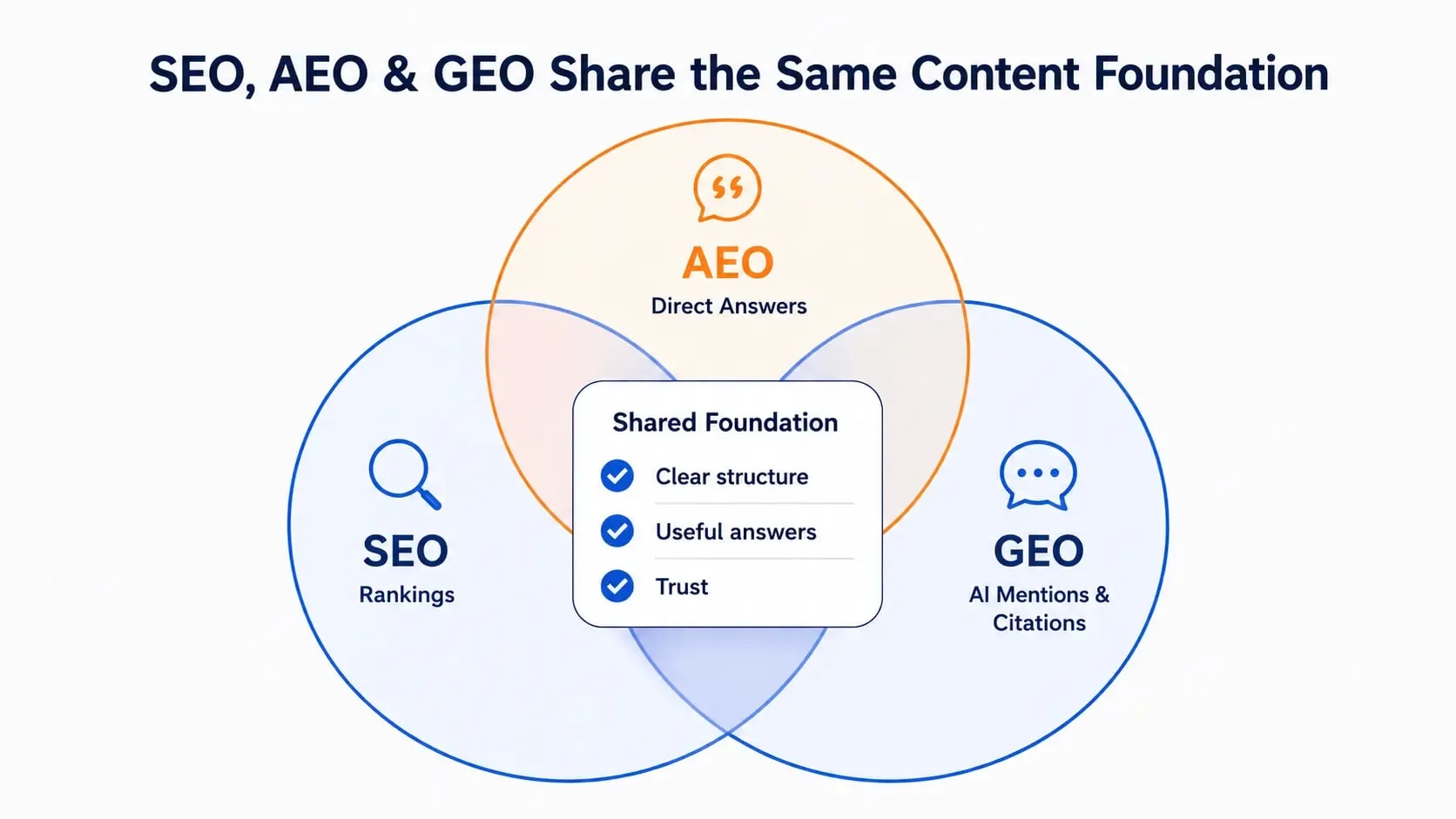
More than the three-acronym framing suggests.
| Item | SEO | AEO | GEO |
|---|---|---|---|
| Optimizes for | Ranking and the click | Passage extraction | Brand citation |
| Unit of success | A page | A passage | An entity |
| Primary surface | Google, Bing | Snippets, PAA, AI Overviews, voice | ChatGPT, Gemini, Perplexity, Claude |
| Mostly controlled | On your site | On your site | Off your site |
| Speed of change | Weeks to months | Days to weeks | Months |
| Depends on | — | SEO | SEO and AEO |
Read the bottom row first. AEO without crawlable, indexable pages produces nothing, because there is no document to extract from. GEO without either produces nothing, because there is nothing in the retrieval set to cite.
It is also worth saying plainly what much of the industry will not. AEO and GEO describe substantially the same work. Profound, which sells software in this category, argues the point in public: "Whether you label it AEO, GEO, or just next-gen SEO, the mission is the same" [3]. The useful distinction is passage versus entity, not which acronym a tool company prefers.
What actually changes for AI search
Less than the volume of GEO marketing implies.
Google's documentation on its AI features states: "There are no additional requirements to appear in AI Overviews or AI Mode, nor other special optimizations necessary." It goes further: "While specific optimization isn't required for AI Overviews and AI Mode, all existing SEO fundamentals continue to be worthwhile" [1].
That sentence is the filter to apply to every GEO offer you receive. If a service sells access to a mechanism Google says does not exist, the honest response is skepticism, not budget.
What has genuinely changed is narrower, and worth taking seriously:
- A ranking no longer implies a visit. Exposure and traffic have come apart, and measuring only one of them hides the other. Understand what actually triggers an AI Overview before assuming a traffic drop was a ranking drop.
- Passage quality matters more than page length. A machine extracting an answer takes a passage, not a document. A focused section can be cited from a page that is not the top result.
- Off-site reputation feeds on-site visibility. Brand mentions and third-party references now influence whether an assistant names you, not just how you rank.
- Freshness carries more weight on volatile topics. An unmaintained page competes badly against a maintained one when the subject changes monthly.
A practical order to work in
The framework below is an editorial ordering, not a discovered mechanism. S.T.A.C.K. exists to stop the common failure, which is starting at the letter that sounds newest.
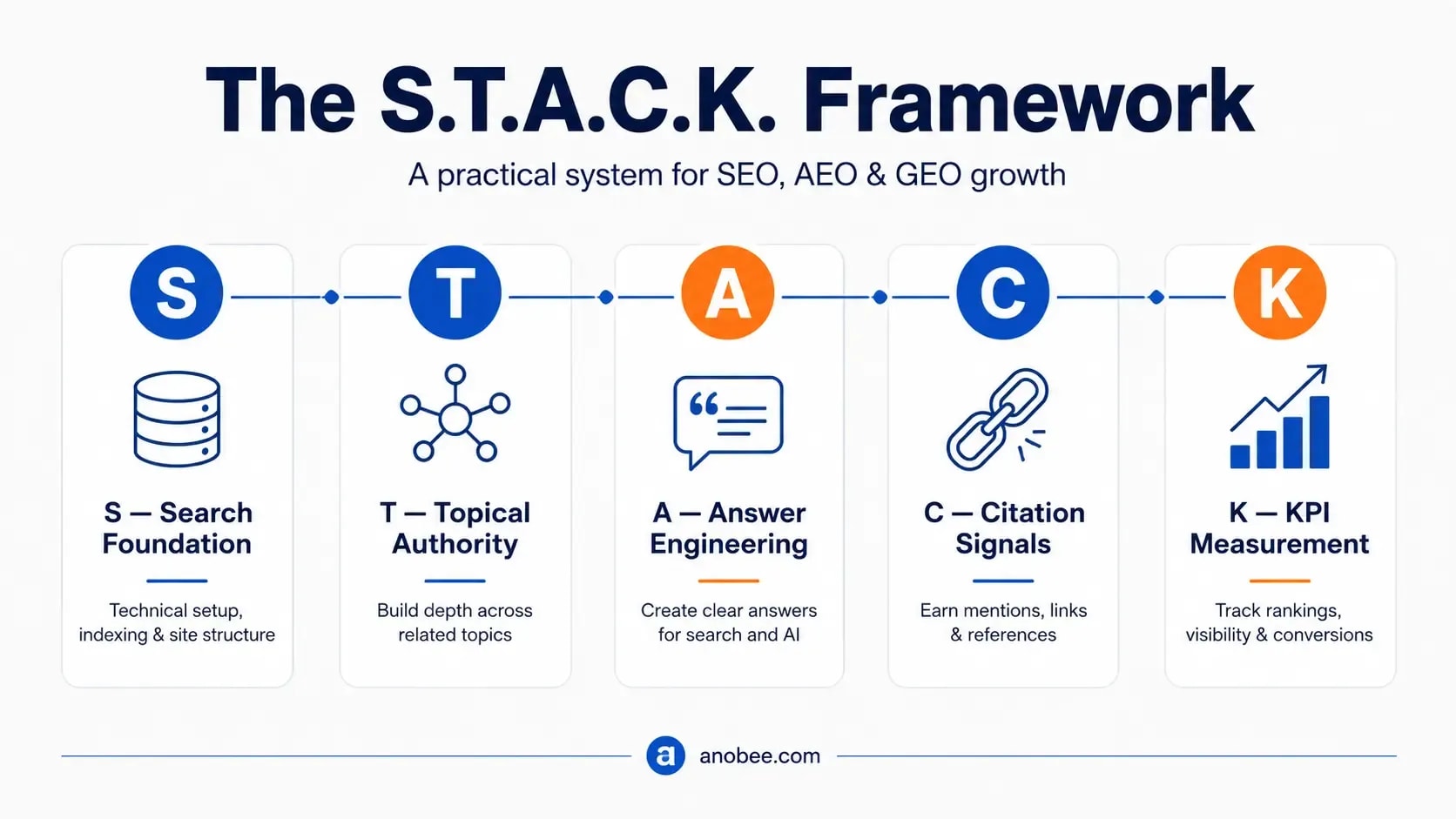
S - Search foundation. Crawlability, indexability, page speed, sitemap, internal links, and pages that answer a real question. Nothing after this letter works without it.
T - Topical authority. Cover a subject properly rather than publishing one page per keyword. Depth in a narrow area beats thin coverage across a wide one, for readers and retrieval systems alike.
A - Answer engineering. Answer-first sections, question-shaped headings, self-contained passages, and valid FAQPage schema where the content genuinely is a question and answer.
C - Citation signals. Off-site presence: mentions, references, profiles, and consistent naming, so an assistant can resolve your brand to a single entity. Inconsistent naming across the web is a common and quiet blocker here. On your own site, an llms.txt file is cheap to add. The evidence that assistants currently use it is thin, so treat it as housekeeping rather than leverage.
K - KPI measurement. Decide what you are measuring before you start, because the old dashboard no longer covers it.
Most sites reading this belong somewhere in S or T. If you are unsure, you are in S.
What to measure
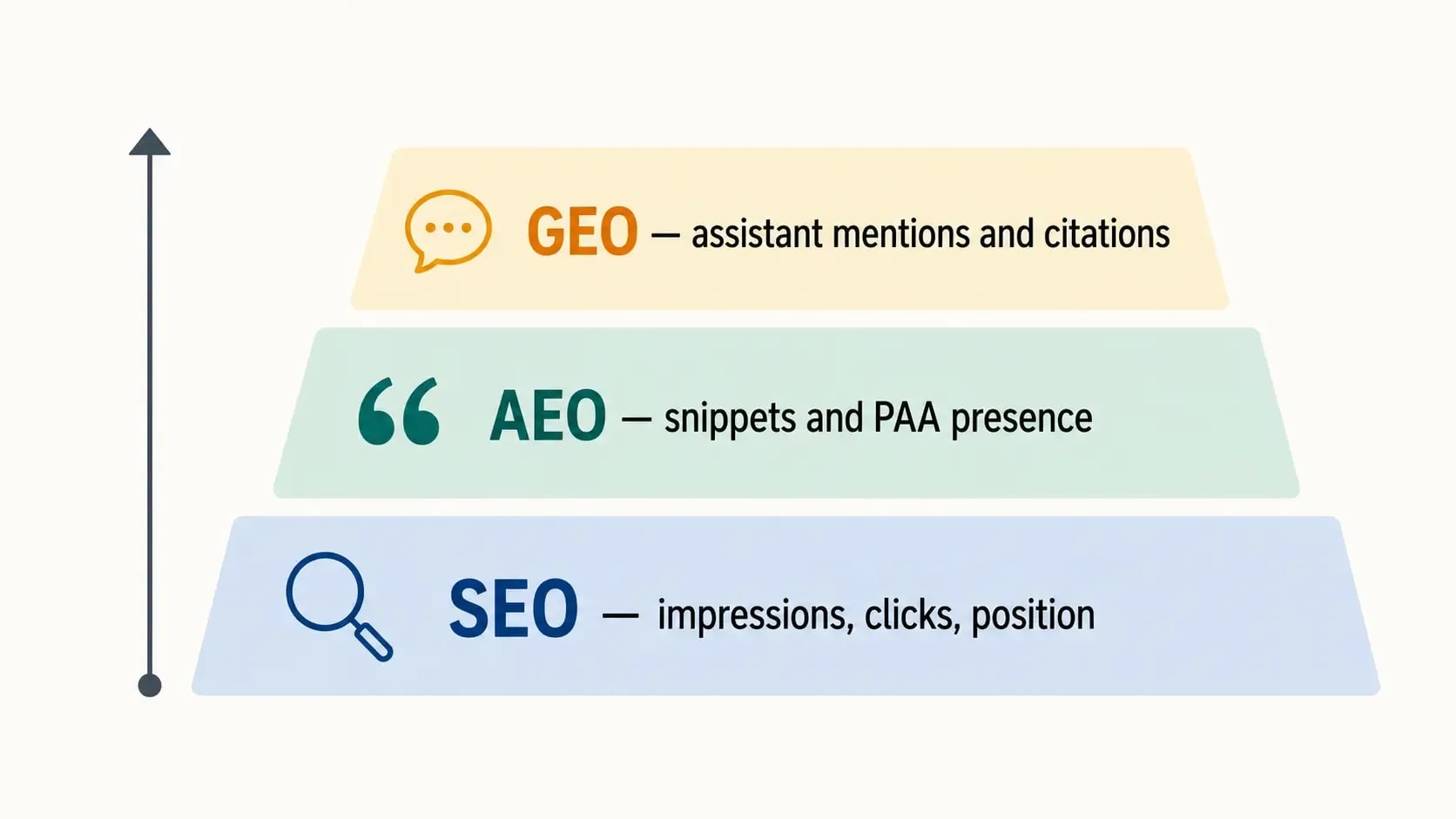
Rankings alone no longer describe your visibility. A workable set:
| Layer | What to track | Where it comes from |
|---|---|---|
| SEO | Impressions, clicks, CTR, average position | Search Console, free |
| SEO | Index coverage against your sitemap | Search Console, free |
| AEO | Featured snippet and PAA presence for your target queries | Manual SERP checks, or a rank tracker |
| GEO | Whether assistants name or cite you | Manual prompt testing, or a paid visibility tool |
| GEO | Brand mentions off-site | Manual search, or a monitoring tool |
The GEO rows are the ones people skip, because they are the least automated. A manual test is still a test. Run a fixed set of prompts across ChatGPT, Perplexity, and Gemini. Record the date, the exact prompt, and whether you appeared. Repeat monthly. That is a baseline, and it costs nothing but the hour.
Two limitations are worth stating. Assistant answers vary by user, session, and location, so a single result is an observation rather than a measurement. And no tool can currently tell you your true citation share. Treat any number that claims to with the same skepticism you would apply to a guaranteed ranking.
Mistakes worth avoiding
- Buying GEO before fixing SEO. The most expensive way to discover your pages were never indexed.
- Publishing a page per acronym. "What is AEO", "What is GEO", and "AEO vs GEO" are usually one search job, not three.
- Treating schema as a ranking lever. Structured data helps a machine understand a page. It does not promote it.
- Copying the answer-first format without an answer. A 50-word paragraph that says nothing extracts as cleanly as one that says something, and gets chosen less.
- Chasing citation with no entity presence. If your brand name is ambiguous or collides with a larger company, resolve that before optimizing anything.
- Believing a statistic because it has a percentage sign. A great deal of AI-search data circulates without a traceable source, and much of what does have one is older than the article quoting it. Check the citation and its date before repeating either.
The bottom line
The three acronyms describe one job at three scales: the page, the passage, and the brand.
If you want a single instruction: make the page findable, make each section answer one thing completely, and give the wider web a reason to mention you by name. Do those in that order. Anything sold as GEO strategy that skips the first two is selling you the roof before the foundation.
Frequently Asked Questions
Is GEO the same as AEO?
Substantially, yes. Both concern being used inside AI-generated answers. The practical distinction is scale: AEO is about a passage being extracted, GEO is about a brand being named. Some vendors prefer one term for positioning reasons.
Does SEO still matter in 2026?
Yes. Google's own documentation states that SEO best practices remain relevant for its AI features, and that no special optimization is required for AI Overviews or AI Mode.
Do I need special markup for AI search?
No. Use structured data where it accurately describes the page, such as FAQPage on genuine question-answer content. There is no AI-specific markup that grants access to AI features.
Can a new site get cited by AI assistants?
It is possible, because citation is passage-based rather than purely domain-based. It is harder without off-site brand presence, which is the slowest part of GEO to build.
How long does GEO take?
There is no reliable published figure. Any specific timeline you are quoted is an estimate rather than a measurement. Structural changes can be reflected quickly. Entity and reputation signals take considerably longer.
What should I do first?
Confirm your pages are indexed. Everything else assumes they are, and a surprising number are not.
Sources and References
Was this guide helpful?
Your answer helps Anobee improve future updates.

Written by
Bibek Thapa
AI-Powered Digital Growth Strategist
Bibek Thapa works across AI workflows, SEO, AI search optimization, content strategy, website growth, and productivity systems. Anobee documents practical lessons, tools, experiments, and systems for improving digital presence.
- AI workflows
- Digital growth
- SEO
- GEO
- AEO
- Content strategy
- Website growth