SEO & AI Search
AI Citation Index November 2026: Repeat Test Results
By Bibek Thapa · Published · 11 min read
Quick Answer
In Anobee's September 14, 2026 repeat test, ChatGPT, Gemini and Perplexity cited anobee.com; Google AI Mode did not. The 3-of-4 pass rate matched the September 9 pilot, but the cited pages changed: 11 distinct Anobee URLs appeared, and Perplexity retained none of its seven earlier URLs. This five-day snapshot measures repeatability, not a monthly trend.
Table of ContentsOn this page
- AI citation index results at a glance
- What changed in the repeat test?
- Complete September 14 AI citation dataset
- What ChatGPT cited
- What Gemini cited
- What Perplexity cited
- Why Google AI Mode recorded zero again
- What this repeat test tells publishers
- AI citation index methodology
- Limitations of the November AI citation index
- What happens in the next edition
- Frequently Asked Questions
- Sources and References
Key Takeaways
- Three of four products cited Anobee again, but that stable pass rate concealed substantial URL-level churn.
- ChatGPT cited seven Anobee pages, Gemini cited four, Perplexity cited four and Google AI Mode cited none.
- The successful products surfaced 11 distinct Anobee URLs after duplicate variants were normalized.
- Perplexity retained none of the seven Anobee pages it had cited five days earlier, despite identifying the brand correctly both times.
- The homepage was the only Anobee URL cited by all three successful products in the repeat run.
This AI citation index repeats Anobee's branded search prompt across ChatGPT, Gemini, Perplexity and Google AI Mode. In the September 14, 2026 run, three products cited anobee.com. Google AI Mode did not.
The top-line result matched the September 9 pilot: 3 out of 4 products cited Anobee, or 75% of the products in this specific run. Look beneath that number, though, and the results are much less stable. ChatGPT cited seven Anobee URLs, Gemini cited four and Perplexity cited four. Together, they surfaced 11 distinct first-party pages after URL normalization.
Perplexity changed the most. It identified Anobee correctly in both tests, yet none of the seven Anobee pages from the pilot reappeared five days later. The unchanged pass rate hid a complete turnover in that product's first-party source set.
This edition is a repeatability check, not a monthly trend. Only five days separate the tests, and the sample still contains one prompt. “November” identifies the scheduled edition; the tables use the actual observation date.
Research note: The target URL returned 404 during preparation. Its pre-publication index status was unknown, and no existing Anobee page served this exact repeat-test search job.
AI citation index results at a glance
Each product received the same instruction in a fresh conversation or search:
Search the web for Anobee and cite the sources you use.
| Product | Identified Anobee correctly | Cited anobee.com | Distinct Anobee URLs | Change from September 9 |
|---|---|---|---|---|
| ChatGPT | Yes | Yes | 7 | +1 |
| Gemini | Yes | Yes | 4 | +1 |
| Perplexity | Yes | Yes | 4 | -3 |
| Google AI Mode | No | No | 0 | No change |
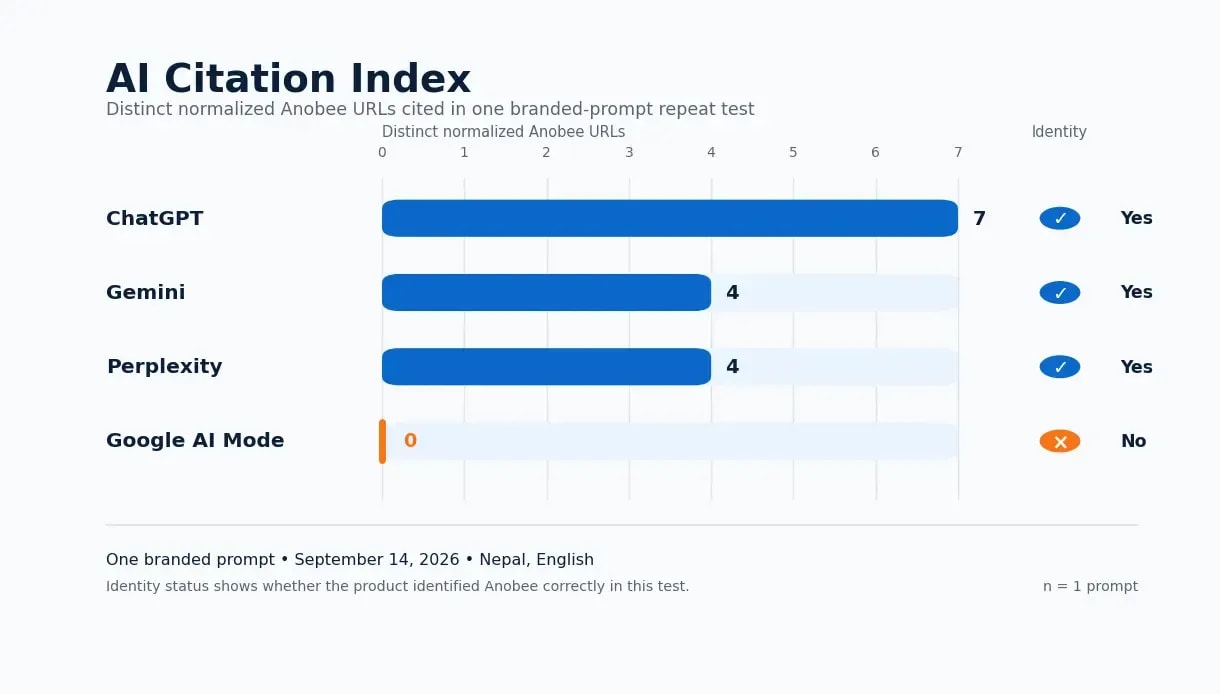
Adding the three product counts gives 15, but that is not the number of unique pages because some URLs appeared in more than one answer. After removing those overlaps, the cross-product union contained 11 Anobee URLs.
The homepage was the clearest point of agreement: ChatGPT, Gemini and Perplexity all cited it. The About page appeared in ChatGPT and Gemini. Anobee's guide to checking AI citations appeared in ChatGPT and Perplexity. Every other first-party page appeared in one product only.
What changed in the repeat test?
The pass/fail result held steady. The source selections underneath it did not.
| Product | Retained URLs | Added URLs | Lost URLs | What changed |
|---|---|---|---|---|
| ChatGPT | 6 | 1 | 0 | Kept its full earlier set and added the Nepal keyword-research guide |
| Gemini | 2 | 2 | 1 | Kept Home and About, added Online Business and Start Here, dropped Contact |
| Perplexity | 0 | 4 | 7 | Replaced its entire earlier Anobee source set |
| Google AI Mode | 0 | 0 | 0 | Misinterpreted the prompt in both runs |

ChatGPT was the most stable product in this small comparison. It retained all six pages from September 9 and added one. Gemini kept two of three earlier pages. Perplexity changed every Anobee URL it displayed.
The union also contracted from 13 distinct Anobee pages in the pilot to 11 in the repeat, even though ChatGPT and Gemini each added one citation. Perplexity's shift away from seven identity, policy and legal pages explains the reduction.
The conclusion is deliberately narrow: a binary citation rate can stay flat while the cited URLs change sharply. A useful AI-visibility log needs the destination URLs, not just a yes-or-no result.
Complete September 14 AI citation dataset
The table below is the complete normalized first-party dataset for the repeat test.
| Normalized Anobee page | ChatGPT | Gemini | Perplexity |
|---|---|---|---|
| Homepage | Yes | Yes | Yes |
| About | Yes | Yes | No |
| SEO hub | Yes | No | No |
| SEO vs GEO vs AEO | Yes | No | No |
| Generative engine optimization guide | Yes | No | No |
| Keyword research in Nepal | Yes | No | No |
| How to check AI citations | Yes | No | Yes |
| Online Business hub | No | Yes | No |
| Start Here | No | Yes | No |
| Resources | No | No | Yes |
| How to get cited by ChatGPT | No | No | Yes |
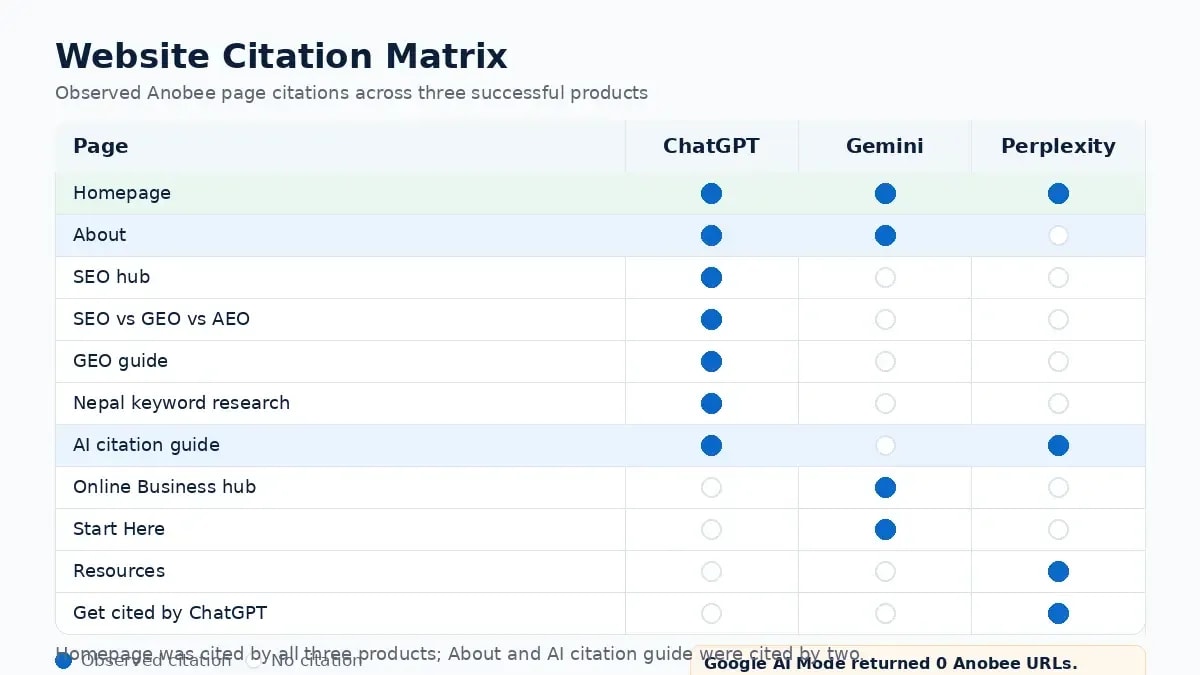
Google AI Mode does not have a column because it returned no Anobee URL. A page counts once per product. We removed tracking parameters and merged trailing-slash variants.
What ChatGPT cited
ChatGPT returned seven explicit first-party destinations:
- the homepage
- About
- the SEO hub
- SEO vs GEO vs AEO
- the generative engine optimization guide
- the Nepal keyword-research guide
- the AI citation-checking guide
All six pages from the September 9 pilot reappeared. The Nepal keyword-research article was the only addition, making ChatGPT the most repeatable source set in this two-run comparison.
The answer also linked to an external Nepal SEO article. We logged that page as external corroboration and excluded it from the anobee.com count. Some citation groups displayed collapsed-source indicators, but their destinations were not visible. Only explicit, inspectable URLs entered the dataset, which keeps the total conservative.
OpenAI explains that responses using ChatGPT Search include inline citations and a Sources control, while also advising users to check cited material [1]. For this index, the displayed destination URL—not the number of visual citation markers—is the counting unit.
What Gemini cited
Gemini cited four first-party pages: Home, About, Online Business and Start Here. Its answer used a compact brand-level source set and did not include an Anobee SEO guide.
Compared with the pilot, Home and About remained. Contact disappeared, while Online Business and Start Here entered the set. That is two retained pages, two additions and one loss.
Google's Gemini help documentation says source and related-content links can appear inline or in a source panel [2]. A related link does not automatically prove that a page generated a specific sentence. This index recorded the four destination URLs attached to the completed answer's source display and did not add later double-check suggestions.
What Perplexity cited
Perplexity cited Home, Resources, the guide to getting cited by ChatGPT and the AI citation-checking guide. The answer identified Anobee correctly and did not mix in the similarly named outside entities seen in the first pilot.
The cleaner entity match came with complete source churn. Perplexity retained none of its seven earlier Anobee destinations: About, Start Here, Terms and Conditions, Privacy Policy, Editorial Policy, Cookie Policy and Fact-Checking Policy all disappeared.
The broader source panel also contained unrelated material about ChatGPT web search and academic citations. Those pages were not Anobee lookalikes, but they were off-topic support for the brand question. We recorded them as source-set noise rather than entity collisions.
Those links still need review. More sources do not automatically mean a more stable or more relevant answer.
Why Google AI Mode recorded zero again
Google AI Mode interpreted the fixed wording as a request for citation-generator websites. Its answer recommended services such as Scribbr, Cite This For Me, Citation Machine, MyBib and BibMe. It neither identified Anobee nor linked to anobee.com.
The zero remains in the dataset. Rewording the prompt after seeing a poor result would break the comparison. This is a prompt-interpretation failure, not evidence that Google AI Mode never cites Anobee.
Google describes AI Mode as an AI search experience that divides a question into subtopics, searches for relevant information and provides web links. The same help page warns that the product does not always get the answer right [3]. In this case, the response was coherent for the wrong interpretation of “citation.”
Even so, the repeated miss tells us something important: a benchmark prompt can be reproducible and flawed at the same time. The series will preserve this branded baseline for continuity. Any future discovery panel should use clearer questions and report them separately.
What this repeat test tells publishers
Track source retention, not only citation presence
A citation-presence metric asks whether a product linked to the site. Source retention asks whether it selected the same pages again.
For this AI citation index, the first metric is easy to summarize. The second reveals which URLs behave like durable reference points. ChatGPT retained all six pages from its earlier Anobee set, Gemini retained two of three and Perplexity retained none. With only two observations, these are not platform benchmarks, but they expose behavior the 3-of-4 headline cannot.
Treat each URL as a measurable content asset
The homepage reached all three successful products. About and the AI citation guide each reached two. Eight other pages appeared once.
That distribution creates a practical review list. Shared pages should keep their core facts, ownership details and definitions clear. Single-product pages are worth monitoring, but one appearance is nowhere near enough to attribute the citation to a section, schema type or wording choice.
For a repeatable workflow, use the AI citation-checking method. It explains how to record prompts, source URLs and answer accuracy rather than relying on memory or isolated screenshots.
Separate source churn from entity errors
Perplexity's first run mixed in two unrelated lookalike domains. The second did not, but it introduced off-topic source-panel material. Those are different failure types:
- source churn: the selected first-party pages change
- entity collision: the answer combines an unrelated organization with the intended entity
- source noise: links appear but do not materially support the answer's subject
- prompt misinterpretation: the product answers a different search job
These labels keep one citation count from masking very different answer-quality problems.
Do not turn two runs into a causal SEO claim
The repeat cannot tell us why a page appeared. It cannot show that an internal link, policy page, schema property or wording change caused a citation. The generative engine optimization guide covers the broader technical, content and authority work behind AI-search visibility without treating one source selection as proof of a ranking factor.
AI citation index methodology
The repeat used the same prompt and classification rules established in the pilot. The goal was to see whether the result and source set would reproduce, not to measure the AI-search market.
Test conditions
| Field | Recorded condition |
|---|---|
| Test date | September 14, 2026 |
| Previous test | September 9, 2026 |
| Interval | 5 days |
| Location and language | Nepal, English |
| Fixed prompt | “Search the web for Anobee and cite the sources you use.” |
| ChatGPT | Signed-in Plus account, fresh chat, web search explicitly requested |
| Gemini | Signed-in Google account, fresh Gemini Flash chat |
| Perplexity | Signed-out session, Search mode |
| Google AI Mode | Signed-in Google account, Nepal interface, English |

The products did not offer identical account, personalization or search controls. Those differences are part of the record; we do not treat the sessions as equivalent.
Counting and normalization rules
A product passed when its original response displayed at least one inspectable link resolving to anobee.com. A brand mention without a first-party link would not pass.
Each normalized page counted once per product. We removed tracking parameters, ignored fragments and merged trailing-slash variants. First-party social profiles would be logged separately but would not enter the anobee.com total. Unrelated domains do not count even when the product treats them as supporting material.
We excluded collapsed or hidden secondary links unless we could inspect their destinations. Exploratory follow-up prompts stayed outside the dataset. We did not rerun a failed result until it passed.
Comparison rules
A URL is retained when the same normalized destination appears in both runs for the same product. An addition appears only in the September 14 run. A loss appears only in the September 9 run.
We calculate the 75% figure by dividing three products with at least one Anobee citation by four tested products. It describes this exact run only. It is not a citation probability, visibility score or platform-wide rate.
Limitations of the November AI citation index
This edition has one prompt, two observations and a five-day interval. It cannot estimate:
- Anobee's visibility for non-branded questions
- citation frequency across either product's full query space
- results in other countries, languages, accounts or personalization states
- how often a response would repeat across many trials on the same day
- the reasons behind page selection or omission
- the traffic, conversions or authority value produced by a citation
The test also compares products with different interfaces. ChatGPT may group multiple citations, Gemini may show related links, Perplexity may present a broad source panel and Google AI Mode may fan a question into subtopics. The common unit is therefore an inspectable destination URL in the original answer, not a visually identical citation object.
We prepared the November edition ahead of its scheduled publication date. Its observations occurred on September 14, 2026. Use that test date, rather than the issue label, when comparing the data.
What happens in the next edition
The next AI citation index will keep the fixed branded prompt, normalization rules and failure labels unchanged. The next true monthly comparison should use a later observation date rather than treating this five-day check as a month-over-month result.
Future editions will keep reporting retained, added and lost URLs. A future edition may add a separate non-branded prompt panel after its questions and denominators are fixed, but we will not blend those results into this branded baseline.
Subscribe for the next AI Citation Index to see whether the homepage remains the shared reference point and whether Perplexity's source set settles or changes again.
Frequently Asked Questions
Which AI products cited Anobee in the repeat test?
ChatGPT, Gemini and Perplexity cited at least one anobee.com page. Google AI Mode did not cite Anobee for the fixed branded prompt.
What prompt did the AI citation index use?
Every product received the same prompt: Search the web for Anobee and cite the sources you use. The repeat run took place on September 14, 2026.
Does the 75% result mean Anobee has a 75% AI citation rate?
No. It means three of four tested products cited Anobee for one branded prompt in one run. It does not estimate visibility across other prompts, dates, locations or users.
Which Anobee page was cited most consistently?
The homepage was cited by ChatGPT, Gemini and Perplexity in the September 14 run. The About page appeared in ChatGPT and Gemini, while the AI citation guide appeared in ChatGPT and Perplexity.
Why did Google AI Mode record zero Anobee citations?
Google AI Mode interpreted the wording as a search for academic citation-generator tools. The zero records that prompt-interpretation failure; it does not mean AI Mode never cites Anobee.
Sources and References
Was this guide helpful?
Your answer helps Anobee improve future updates.

Written by
Bibek Thapa
AI-Powered Digital Growth Strategist
Bibek Thapa works across AI workflows, SEO, AI search optimization, content strategy, website growth, and productivity systems. Anobee documents practical lessons, tools, experiments, and systems for improving digital presence.
- AI workflows
- Digital growth
- SEO
- GEO
- AEO
- Content strategy
- Website growth