SEO & AI Search
Entity Optimization for AI Search: How to Make Your Brand and Author Unambiguous to AI Systems (2026)
By Bibek Thapa · Updated · 13 min read
Quick Answer
Entity optimization for AI search means making one clear, consistent answer to "who is behind this content" available everywhere an AI system might look: About and author pages, structured data, profiles and third-party mentions. It needs no special AI markup. It needs the same name and facts in every place, an author page a system can resolve, and evidence that others describe you the same way.
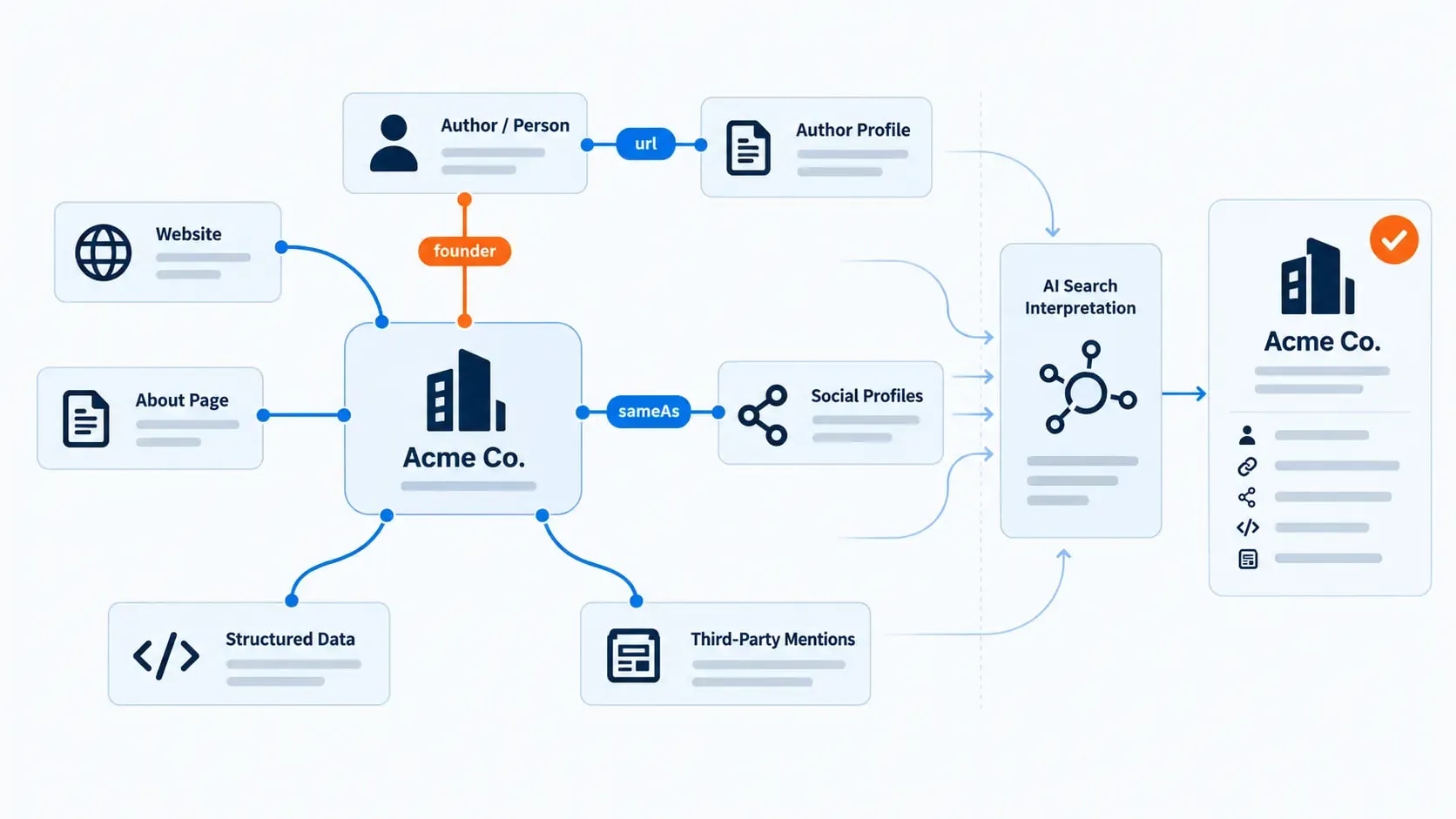
Table of ContentsOn this page
- What entity optimization for AI search is
- What Google's documentation says about entity optimization for AI search
- How AI systems resolve an entity in practice
- The CLEAR framework for entity optimization for AI search
- How to do entity optimization for AI search, step by step
- Entity optimization for AI search checklist
- What Anobee's own audit found
- Common entity optimization mistakes
- Bottom line on entity optimization for AI search
- Frequently Asked Questions
- Sources and References
Key Takeaways
- An entity is a nameable thing an AI system can resolve independently of any one page: your brand, author or product. Ambiguity is what gets a source skipped.
- Google says no special markup is needed for AI features and that inauthentic mentions do not help; ordinary SEO, structured data and consistency do the work.
- Organization, Article author and ProfilePage structured data are the three Google-documented ways to state who you are in machine-readable form.
- Anobee's own audit found its Organization and Person schema nodes unlinked and its name colliding with Amobee; Gemini disambiguated the two unprompted.
- In three citation runs, Perplexity kept returning Anobee's entity pages: homepage, About, Contact and author page. Keep those pages accurate first.
- The CLEAR framework (Clarify, Link, Evidence, Align, Reinforce) is a checklist for consistency, not a ranking formula.
This is a refreshed version of Anobee's guide to entity optimization for AI search. The earlier version carried a case study that did not hold up, an empty tools section, and platform claims nobody could source. They are gone. What replaces them is narrower and more useful: what Google's own documentation says entity signals do, a framework you can run, and what turned up when that framework was run on Anobee itself and checked against three AI citation runs.
What entity optimization for AI search is
An entity is a distinct, nameable thing: a brand, a person, a product, a topic. AI systems reason about entities independently of the words on any one page. When ChatGPT or Gemini answers "who is Anobee", it is not matching a keyword. Instead, it is trying to resolve a name to one thing, decide whether the sources it found describe the same thing, and judge whether that thing is credible enough to cite.
Entity optimization is the work of making that resolution easy: one name, one description, one canonical page, and a web of signals, on your site and off it, that all agree. A page is a unit of content. An entity is a unit of trust.
How it differs from keyword SEO, and from GEO
Keyword SEO asks whether a page contains what someone searched for. Entity optimization asks whether the source behind the page is identifiable and consistent. The two are not in competition. Moreover, Google says the best practices for SEO "continue to be relevant" for its AI features because those features run on its core ranking systems [1]. Entity work sits underneath. A page can rank with weak entity signals. However, it is harder for a generative system to cite a source it cannot confidently identify.
Generative engine optimization (GEO) and answer engine optimization (AEO) are the layers above: getting cited, and getting a passage extracted. The SEO vs GEO vs AEO guide separates them. This article stays on the foundation.
What Google's documentation says about entity optimization for AI search
Most entity optimization advice is inference. Some of it is documented. Therefore, it helps to know which is which.
| Claim | Status | Source |
|---|---|---|
| Organization structured data helps Google "better understand your organization's administrative details and disambiguate your organization in search results" | Documented | [2] |
name, logo, url, sameAs and contact properties can influence what appears in results and a knowledge panel | Documented, not guaranteed | [2] |
Article structured data takes an author with a name and a url that "uniquely identifies the author"; Google recommends ProfilePage markup on that page | Documented | [3][4] |
ProfilePage markup helps Google "understand the creators" behind content, with a Person or Organization as mainEntity | Documented | [4] |
| Bylines that lead to background about the author are a people-first content signal | Documented | [5] |
| No special AI markup, llms.txt or chunking is needed for Google's AI features | Documented | [1] |
| Seeking "inauthentic mentions across the web" helps AI visibility | Contradicted by Google | [1] |
| Specific weightings for how ChatGPT, Claude or Copilot score entities | Undocumented | — |
Two things follow. First, the three schema types Google documents for identity, Organization, Article author and ProfilePage, are the ones worth implementing correctly. Second, the earlier version of this guide described how Claude and Copilot weigh entity clarity. No platform has published that. Consequently, it is not repeated here.
How AI systems resolve an entity in practice
Anobee has a useful test case: its own name. "Anobee" is one letter away from Amobee, an ad-tech company. Also, the bare word is used by unrelated personal accounts on several platforms. A system resolving the name has to decide which Anobee is meant.
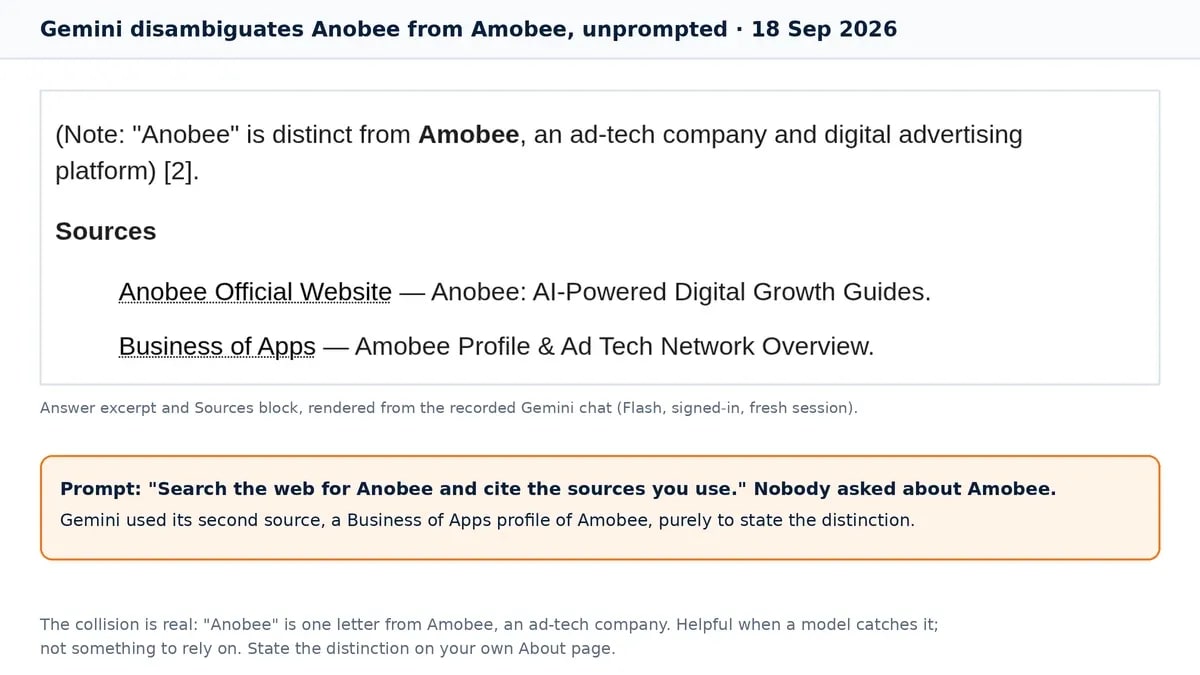
In Anobee's September 2026 fixed-prompt runs, published as the AI Citation Index, all three products that cited the site identified it correctly. Gemini went further. It added a note that "Anobee is distinct from Amobee, an ad-tech company", citing a third-party profile of Amobee to do so. Nobody asked it to. Meanwhile, Perplexity's answer described the site accurately every run, even when its source panel carried unrelated pages.
What the systems leaned on is visible in what they cited. Across three Perplexity runs, the pages that kept returning were the homepage, About, Contact and the author page. ChatGPT cited About in every run. Those are the entity pages, the ones whose only job is to say who runs the site and how to reach them. They were doing that job. That is the most concrete evidence in this article that entity pages matter.
The CLEAR framework for entity optimization for AI search
CLEAR is Anobee's checklist for making an entity consistent. It is an order of operations, not a scoring model.
| Step | What it means | Where it shows |
|---|---|---|
| Clarify | One unambiguous definition of the entity, used everywhere | About page, meta description, Organization description |
| Link | Connect the entity to its parts: author to articles, brand to profiles, pages to the entity home | Internal links, sameAs, author.url, founder |
| Evidence | Back the expertise claim with something checkable | Original data, documented method, dated observations |
| Align | Same name, description and facts across site, schema, profiles and directories | Every surface, audited periodically |
| Reinforce | Keep it current, earn genuine mentions, re-test | Updates, PR that is real, monthly citation checks |

Clarify
Write one sentence that says what the entity is, and use it everywhere. Anobee's is "an independent publication run by Bibek Thapa from Nepal, covering AI tools, SEO and AI search, website growth and productivity." If your About page says "a digital solutions company" and your schema says "a marketing agency", you have introduced ambiguity a system has to resolve. Ambiguity is what gets a source passed over.
Link
Connect the entity to its parts in ways a machine can follow. Article markup should carry an author with a url pointing at the author page [3]. The author page should carry ProfilePage markup with the person as mainEntity [4]. The Organization node should link to the site's profiles through sameAs [2]. Finally, the organization and the person should be connected to each other.
That last link is the one Anobee's own audit found missing. The homepage carries an Organization node and a Person node in the same JSON-LD graph. However, nothing joins them: no founder, no publisher, no author edge. A system reading the graph sees two facts and has to guess that they are related. Adding a founder property that points at the author page is a one-line fix. It was still open when this refresh was written.

Evidence
Claims without evidence are what these systems are trained to discount. "We are SEO experts" is a claim. A published, dated citation test with its method and dataset is evidence. It does not need to be large. It needs to be real, specific and checkable. Similarly, that is what Google's guidance means when it asks whether content demonstrates first-hand expertise [5].
Align
Names and facts drift. A rebrand touches the site but not a directory listing; a new social handle is created and the old one never updated. For Anobee the drift is structural: the brand's handles are @anobeegrowth on every platform because @anobee was taken elsewhere. Accordingly, every entity signal is anchored to the domain and the author name together rather than to the bare brand string. Whatever your situation, audit the surfaces on a schedule. A mismatch reads as a trust gap to a system that cannot ask you which version is right.
Reinforce
Trust decays when a site goes quiet. Update the pages that carry your facts, earn mentions that are genuinely about you, and re-run the identity check. Google's line on mentions is worth keeping in view: seeking inauthentic mentions across the web "isn't as helpful" [1]. Thus a mention you paid for or planted is not corroboration.
How to do entity optimization for AI search, step by step
Step 1: Pick the entity home page
For a brand it is usually the About page; for a single-author site it may be the author page. Make it state the one-sentence definition, the founder or author, the contact route, and the focus areas. Also, make sure the navigation links to it. Anobee's About page and author page both exist and agree with each other. However, the audit found that the schema did not yet say so.
Step 2: Implement the three documented schema types
- Organization on the site (usually the homepage or every page):
name,url,logo,sameAsto the profiles you control, and contact details if you publish them [2]. - Article on each post, with
authoras aPersonwhoseurlis the author page [3]. - ProfilePage on the author page, with the
PersonasmainEntity[4].
These three are the schema types that carry entity optimization for AI search; everything else is optional. Validate each in Google's Rich Results Test. Also, remember Google's caveat that structured data does not guarantee any feature will appear [2]. The structured data guide for bloggers walks through the implementation.

Step 3: Connect the organization to the person
Add founder (or publisher and author where appropriate) so the Organization node points at the Person node. This is the gap most single-author sites have, Anobee included. Site builders tend to emit the two nodes separately.

Step 4: Build entity-based internal links
Link every article to its author page, link supporting articles to the pillar they support, and link the About page from the places a reader would look for it. The internal linking guide covers anchor choices. The entity rule is simpler: a system following links from any page should reach the entity home page in one or two hops.
Step 5: Create supporting topic clusters
An entity is known for something. Several articles on adjacent questions, linked to each other and to a pillar, say what that something is more convincingly than one article that ranked. This is topical authority in the ordinary sense. Additionally, it doubles as an entity signal.
Step 6: Earn mentions that are actually about you
Directory listings, guest contributions, interviews and citations from other publishers give a system a second source for who you are. Keep the facts in those mentions identical to your own. Do not buy them, and do not plant them. Google has said the inauthentic kind does not help [1].
Step 7: Test your entity optimization for AI search on a schedule
Run a fixed prompt, "Search the web for [brand] and cite the sources you use", in fresh sessions of ChatGPT, Gemini, Perplexity and Google AI Mode. Record three things per product: did it identify the right entity, which pages did it cite, and did it confuse you with anyone. Then repeat monthly with the same prompt. The method for checking AI citations has the recording template, and Anobee's monthly runs show what the log looks like over time.
Crawler access belongs in this step too. Confirm that OAI-SearchBot (ChatGPT's search crawler, separate from GPTBot for training) and PerplexityBot are not blocked in robots.txt or by your CDN [6][7]. Otherwise, an entity that cannot be fetched cannot be resolved.
Entity optimization for AI search checklist
What Anobee's own audit found
Refreshing this guide meant running CLEAR on the site that published it. Three findings are worth sharing, because they are common.
The schema nodes were not linked. Organization and Person sat side by side in the homepage graph with no edge between them. The fix is a founder property. It is small. Nevertheless, it had been missed since launch.
The brand name collides with another company's. "Anobee" versus "Amobee" is the kind of near-duplicate a retrieval system can substitute silently. The mitigation is to state the distinction on your own pages, keep the domain and the author name together in every signal, and watch for the substitution in the monthly check. In September 2026 Gemini made the distinction for us. That is encouraging, and also not something to rely on.
The entity pages were already doing the work. About, Contact and the author page were the pages AI products kept citing for the brand query. Consequently, the priority list changed: those pages need to be accurate and consistent before any article does.
Common entity optimization mistakes
Treating it as a schema-only task. Schema describes the page; it does not create the clarity. A perfect Organization block above an About page that contradicts it is worse than no schema at all. Entity optimization for AI search starts with the words on the page.
Letting details drift. Rebrands, new hires and new profiles introduce variants. Audit the surfaces on a schedule rather than once.
Blocking the crawler that would cite you. robots.txt rules written to stop scrapers often catch OAI-SearchBot and PerplexityBot too. Check by name.
Chasing llms.txt as an entity signal. Google says it does not use the file [1], and Anobee's own llms.txt test reached the same verdict. Keep it if you like; do not count on it.
Buying corroboration. Planted mentions are the one tactic Google has named as unhelpful for its AI features [1]. Genuine mentions are slower and are the only kind that count.
Bottom line on entity optimization for AI search
Entity optimization for AI search is consistency, made machine-readable, backed by evidence, and tested. Pick the entity home page, implement the three documented schema types and connect them, keep every surface saying the same thing, and earn mentions that are real. Then ask the AI products themselves, on a schedule, whether they know who you are. Anobee's own audit found the gaps that most small sites have. Its citation runs showed that the entity pages are where the systems look first.
Frequently Asked Questions
What is entity optimization for AI search?
Entity optimization for AI search is the practice of making your brand, author and content unambiguous to AI systems: the same name and description everywhere, an author page and About page a system can resolve, structured data that states the relationships, and third-party mentions that corroborate them. The goal is to be identified and trusted, not just matched to keywords.
Does schema markup help with AI search visibility?
It helps Google understand and disambiguate your organization and identify authors, according to Google's own structured-data documentation. Google also says no special markup is required for its AI features and does not guarantee that features using structured data will appear. Use Organization, Article author and ProfilePage markup because they describe the page accurately, not as a shortcut.
What is an entity home page?
It is the one page that states definitively who or what the entity is, usually the About page for a brand or the author page for a person. Structured data, internal links and external profiles should all point back to it, so that a system resolving your name lands on one consistent answer.
Do I need llms.txt for entity optimization?
No. Google states plainly that it does not use llms.txt files or other special AI markup. It is a harmless index of your important pages, but it is not an entity signal and no major AI platform has documented using it for that purpose.
How do I know if AI systems identify my brand correctly?
Ask them. Run a fixed prompt such as "Search the web for [brand] and cite the sources you use" in ChatGPT, Gemini, Perplexity and Google AI Mode, in fresh sessions, and record whether the answer describes the right entity and which pages it cites. Repeat on a schedule; Anobee publishes its runs as a monthly index.
Sources and References
- Google Search Central — Optimizing your website for generative AI features on Google Search ↩
- Google Search Central — Organization (Organization) structured data ↩
- Google Search Central — Article (Article, NewsArticle, BlogPosting) structured data ↩
- Google Search Central — Profile page (ProfilePage) structured data ↩
- Google Search Central — Creating helpful, reliable, people-first content ↩
- OpenAI — Overview of OpenAI crawlers ↩
- Perplexity — Perplexity Crawlers (developer documentation) ↩
Was this guide helpful?
Your answer helps Anobee improve future updates.

Written by
Bibek Thapa
AI-Powered Digital Growth Strategist
Bibek Thapa works across AI workflows, SEO, AI search optimization, content strategy, website growth, and productivity systems. Anobee documents practical lessons, tools, experiments, and systems for improving digital presence.
- AI workflows
- Digital growth
- SEO
- GEO
- AEO
- Content strategy
- Website growth