SEO & AI Search
Generative Engine Optimization: A Working Guide for Solo Publishers
By Bibek Thapa · Updated · 14 min read
Quick Answer
Generative engine optimization (GEO) improves the chance that your content appears accurately in generative search answers. Start with indexable pages, useful answers, original evidence, clear authorship and a repeatable citation-tracking routine. GEO does not replace SEO, and no schema type, llms.txt file or paragraph format guarantees inclusion.

Table of ContentsOn this page
- What is generative engine optimization?
- GEO vs SEO vs AEO
- A solo-publisher GEO framework
- Step 1: make important pages eligible
- Step 2: publish information worth citing
- Step 3: make identity and evidence easy to verify
- Step 4: earn real corroboration
- Step 5: measure GEO without inventing a rank
- A 30-day GEO plan for solo publishers
- GEO mistakes that waste a solo publisher's time
- The bottom line: where to start
- Frequently Asked Questions
- Sources and References
Key Takeaways
- Google treats optimization for its generative AI features as SEO, not a separate system with secret GEO requirements.
- Technical eligibility comes first: important pages must be crawlable, indexable, canonical and eligible to appear with a snippet.
- Original evidence, clear sourcing and accurate authorship give a page a stronger reason to be referenced than formatting tricks.
- OAI-SearchBot controls ChatGPT Search discovery; GPTBot is a separate control for potential model training.
- Measure mentions, citations and referral visits separately across a fixed prompt set instead of relying on one screenshot.
Generative engine optimization sounds like a new discipline with a new set of rules. For a solo publisher, the work is much more familiar.
GEO is about improving the chance that your content or brand appears accurately in an AI-generated answer. A system still needs to access the page, understand what it adds, trust the evidence and decide that it belongs in the answer.
SEO remains the foundation. Google says its generative AI features use the same Search ranking and quality systems, and it treats optimization for those experiences as SEO [1].
In practice, your GEO work comes down to five jobs:
- Make important pages eligible to be found.
- Publish information worth retrieving.
- Show who created it and how the claims can be checked.
- Earn genuine corroboration beyond your own website.
- Measure mentions, citations and visits over time.
No paragraph template, schema type or AI text file can guarantee a citation. Your time is better spent on the parts you can control and the results you can measure.
Method note: This guide was checked against official Google and OpenAI documentation on September 1, 2026, along with the original GEO research paper. Anobee does not yet have enough longitudinal citation data to report a before-and-after result. The measurement process is ready, but the findings should wait until the same prompts have been tracked over time.
What is generative engine optimization?
Generative engine optimization is the practice of making a website and its information easier for generative search systems to find, evaluate and represent accurately. You may see the result as a linked citation, a brand mention, a product recommendation or a visit from an AI search answer.
The term became prominent after researchers proposed GEO as a framework for improving and measuring source visibility in generative-engine responses. Their paper introduced a benchmark and reported that the effectiveness of different content changes varied by domain [2].
The research gave the discipline a name and a way to study it. It did not produce a permanent recipe for Google AI Overviews, ChatGPT, Gemini, Claude or Perplexity. These products change. Their source-selection systems differ. Vendors do not publish their complete ranking formulas.
A useful working definition is:
GEO applies SEO, publishing, entity and measurement practices to the specific goal of being represented accurately in generative answers.
Think of GEO as an operating model, not a guaranteed ranking method.
GEO vs SEO vs AEO
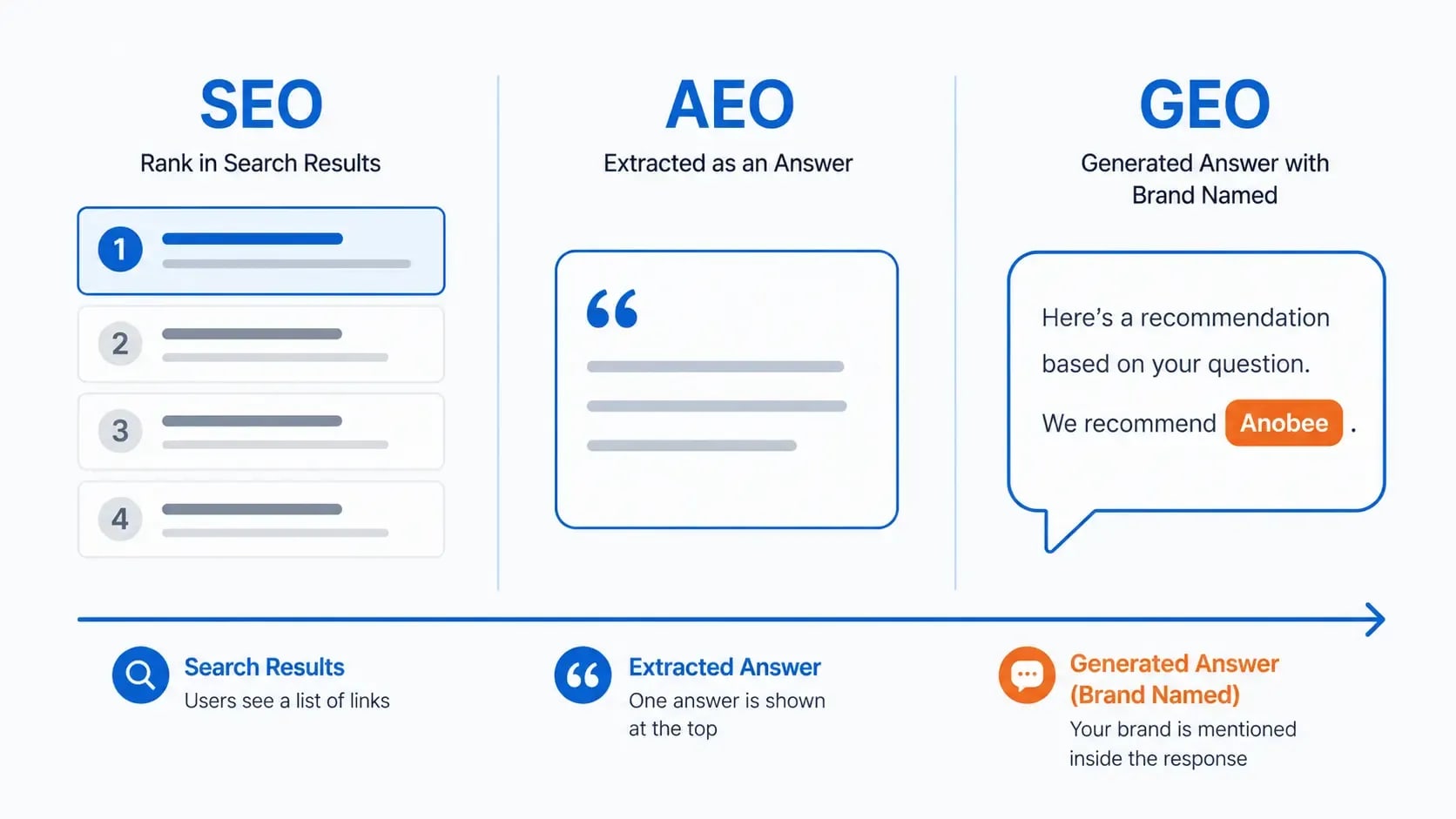
SEO, answer engine optimization (AEO) and GEO overlap. The labels mainly describe the outcome you are watching.
| Practice | Main question | Observable outcome |
|---|---|---|
| SEO | Can the page be discovered, understood and ranked? | Search impressions, rankings, clicks and conversions |
| AEO | Can the page supply a direct answer? | Featured answers, snippets and extracted passages |
| GEO | Is the page or brand represented in a generated response? | Mentions, linked citations, recommendations and AI referrals |
For Google Search, the foundation remains SEO. Google says its generative AI features use content from the Search index and may run related searches through query fan-out to gather supporting information [1].
The labels help when you are planning or measuring work. They stop helping when they turn into three checklists for three sets of pages. Anobee's SEO vs GEO vs AEO comparison explains the overlap in more detail.
A solo-publisher GEO framework
Large brands can buy monitoring platforms, commission research and run digital PR at scale. If you work alone, you need a system that fits into the publishing work you already do.
Use five layers:
| Layer | What you control | What success looks like |
|---|---|---|
| Eligibility | Crawling, indexability, canonicals, rendering and internal links | The intended page can enter the candidate pool |
| Information value | Clear answers, complete context, current facts and original evidence | The page contributes something useful to the answer |
| Identity and trust | Authorship, sourcing, consistent entity details and editorial transparency | A reader can identify and verify the source |
| Corroboration | Earned mentions, references and links from relevant third parties | Claims do not exist only on your own domain |
| Measurement | Fixed prompts, cited URLs, referral data and change logs | You can distinguish progress from a one-off answer |

Work from the top down. An AI visibility dashboard will not solve a wrong canonical or give another source a reason to cite a generic page.
Step 1: make important pages eligible
Eligibility is not the exciting part of GEO. It is still the first dependency.
For Google's generative AI features, a page must be indexed and eligible to appear in Search with a snippet [1]. Existing technical SEO work still applies: return a successful status, avoid accidental noindex directives, declare the intended canonical and link important pages into the site.
For ChatGPT Search, OpenAI tells publishers not to block OAI-SearchBot. OpenAI also recommends allowing requests from its published search-bot IP ranges [4][5].
Do not confuse OAI-SearchBot with GPTBot. OpenAI describes OAI-SearchBot as the control for search visibility and GPTBot as a separate control for content that may be used to improve and train foundation models [4]. A publisher can make an independent decision about each.
Run this technical baseline
Check every page you hope to monitor:
- It returns 200 without an unnecessary redirect.
- The declared canonical points to the intended URL.
- Neither the HTML nor the response header contains noindex.
- The main answer is present in crawlable page content.
- The page is linked from a relevant hub or article.
- The XML sitemap includes the canonical URL when the page should be indexed.
- Important images have descriptive alt text and can be crawled.
- Analytics can identify referral visits from AI products.
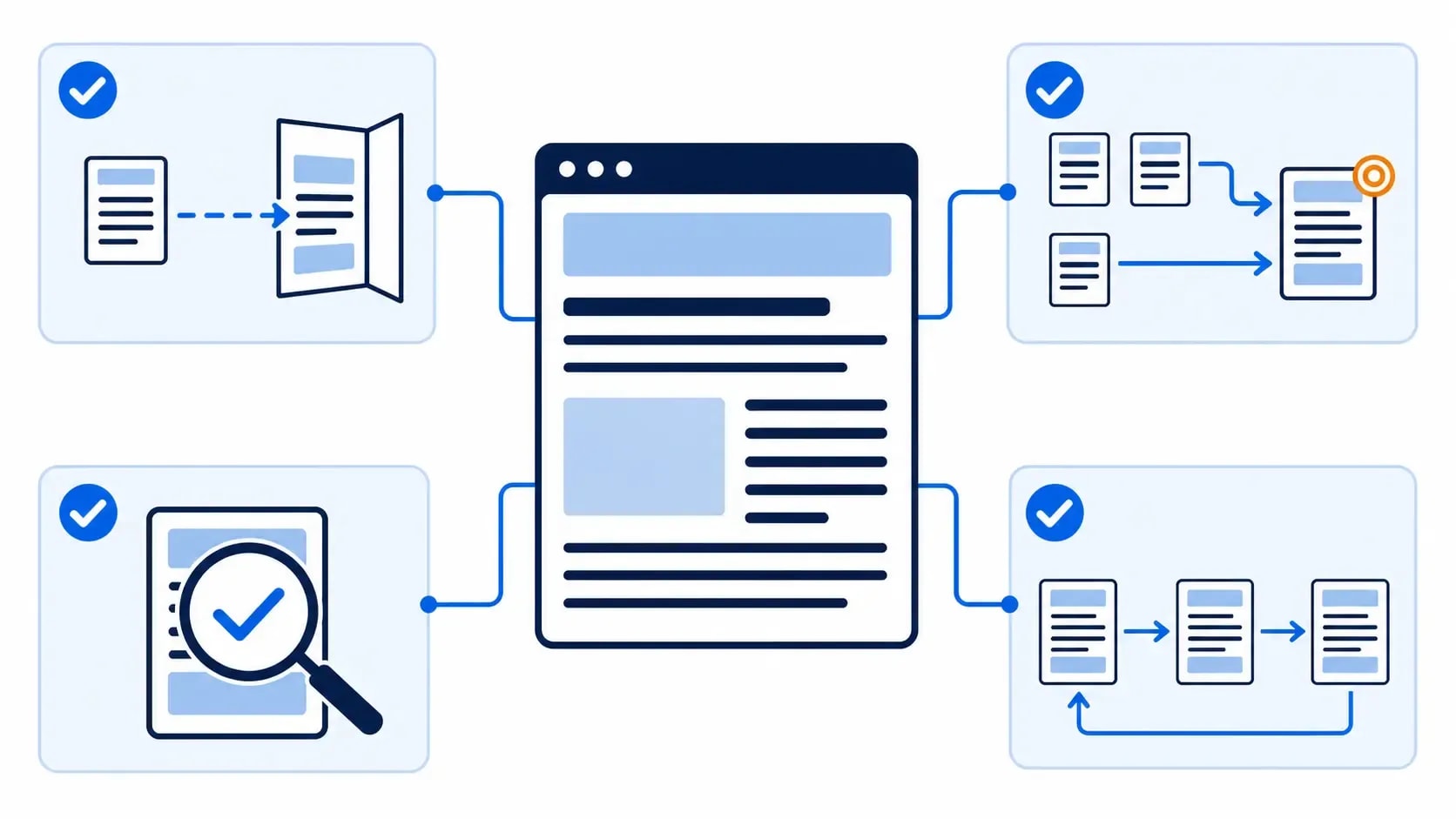
Passing this check will not earn a citation. It removes preventable reasons your page might be excluded.
What about llms.txt?
Do not make llms.txt your first GEO project. Google says it does not use the file and that adding one neither helps nor harms visibility in Google Search [1].
Another service may support the format. Maintain it when you have a specific use for it and somebody responsible for updates. Otherwise, put the time into a clean sitemap, accurate robots rules and useful HTML pages.
Step 2: publish information worth citing
Once the page is eligible, ask the harder question: what would an answer system gain by using your source instead of ten similar pages?
Formatting alone is rarely the answer. A clear definition helps, but a page becomes more useful when it adds evidence, a decision framework, a process, a calculation or a first-hand observation that is not available everywhere else.
Google's people-first guidance asks whether content demonstrates first-hand expertise, makes its sourcing and authorship clear, and leaves the reader able to achieve a goal [3]. Those questions are also a strong editorial filter for GEO work.
For a solo publisher, source-worthy additions can include:
- a controlled test with the date, setup and limitations documented
- a small dataset published with definitions and collection methods
- an annotated template readers can reuse
- a calculation based on current primary-source data
- a comparison that explains who should choose each option
- a correction to common advice, supported by official documentation
- screenshots that prove a process or observed product behavior
The evidence can be small. It still needs to be real, useful and open to inspection.
Write clear passages without writing for a robot
Answer the question near the start of the section. Then add the context and limitations a reader needs. Name the subject clearly, and place each citation beside the claim it supports.
You do not need to force every paragraph into the same shape. Google says there is no required “chunking” method, no ideal page length and no special writing style for generative AI search [1].
Clarity helps a human reader and may make a passage easier to reuse. It is not proof that a system will select it.
Use AI assistance without creating commodity pages
AI can help organize notes, compare documents or draft from verified sources. The publishing responsibility remains with the site.
Google says generative AI can be useful for research and structuring original content, but generating many pages without adding user value may violate its scaled-content-abuse policy. It recommends focusing on accuracy, quality and relevance, including in titles, descriptions, structured data and image alt text [6].
For a solo publisher, the practical line is simple: automation should reduce production work, not manufacture expertise or evidence.
Step 3: make identity and evidence easy to verify
Good prose is not enough when a reader cannot tell who published the page, when it changed or where its facts came from.
Strengthen the verification path:
- Use a real byline that links to a useful author page.
- Describe relevant experience accurately; do not inflate credentials.
- Explain the methodology when an article reports a test or comparison.
- Cite primary documentation beside volatile or contestable claims.
- Keep organization names, descriptions and profile links consistent.
- Show a genuine modified date only after substantive changes.
- Correct errors visibly when they affect the reader's decision.
Google recommends making the “Who, How and Why” of content clear, including accurate authorship and useful context about how a piece was produced [3].
Does schema markup help GEO?
Use structured data for its documented search purpose, and keep it consistent with the visible page. It is not an AI-citation switch.
Google says structured data is not required for generative AI search and there is no special schema.org markup to add for those features [1]. Article, Breadcrumb, Organization and other supported types can still be useful for ordinary Search features when they are valid and appropriate.
Anobee already generates structured data from CMS fields. The editorial job is to keep the title, author, dates, FAQs and visible article consistent with that markup.
Step 4: earn real corroboration
Some GEO work happens away from your website. When every claim comes from the brand itself, an answer system has fewer independent sources to compare.
That is not a reason to manufacture mentions. Google specifically warns against seeking inauthentic mentions for its generative AI features [1].
Build something worth referring to instead:
- Publish one narrow original asset: a dataset, benchmark, calculator, template or documented experiment.
- Explain the method and limitations before promoting the result.
- Identify writers, communities and publications already covering the exact problem.
- Share the useful finding, not a generic request for a link.
- Update the asset on a schedule only when new observations exist.
For this guide, Anobee's missing asset is longitudinal citation data. The next step is to run the same measurement over time and publish the results when the sample is useful. Until then, there is no basis for claiming that this framework improved visibility.
Step 5: measure GEO without inventing a rank
GEO measurement should separate three outcomes:
- Mention: the answer names the brand.
- Citation: the answer links to a specific page.
- Visit: a person follows the link to the site.

These outcomes do not always travel together. A brand mention does not prove that your page was used as a source. A citation does not guarantee a click.
Google now directs site owners to the Generative AI performance report in Search Console for visibility in its generative AI features [1]. OpenAI says ChatGPT referral URLs include utm_source=chatgpt.com, which allows publishers to identify those visits in analytics [4].
For platforms where you are checking answers directly, use a fixed prompt log.
| Field | What to record |
|---|---|
| Prompt | Exact wording, unchanged between comparison periods |
| Engine and mode | Product, model or search mode when visible |
| Context | Date, market, language, account state and location |
| Brand outcome | Absent, mentioned or recommended |
| Citation outcome | Exact URL cited and the claim it supports |
| Accuracy | Correct, incomplete or materially wrong |
| Competitors | Brands and domains that appeared instead |
| Evidence | Saved raw answer or screenshot |
| Action | Page, source or entity gap to investigate |
Start with a monthly check. Ten prompts tied to real audience decisions will teach you more than a hundred vague variations.
Anobee's guide to checking AI citations provides the full testing workflow. When the manual process becomes too slow, compare AI visibility tracking tools by prompt coverage, engines and access to raw answers.
Track claims, not only brand visibility
A citation log becomes more useful when it records what the source was used to support. If an AI answer cites your pricing table for a definition, or cites an old URL for a product limit, the brand may be visible while the underlying representation is wrong.
Add these review questions:
- Which sentence or claim appears to rely on the citation?
- Is the cited page still the best canonical source?
- Does the answer describe the brand accurately?
- Did a competitor earn the citation with evidence you lack?
- Is the problem discoverability, content value, authority or freshness?
The answers point to the next useful change. A single visibility score rarely does.
A 30-day GEO plan for solo publishers
You will not “win AI search” in the first month. The useful outcome is a trustworthy baseline and a better group of closely related pages.

Week 1: establish eligibility
Choose five to ten pages connected to one topic and business goal.
- Check status, canonical, robots directives and sitemap inclusion.
- Confirm each page is internally linked from the topic hub.
- Review Search Console indexing and the generative AI performance report.
- Check OAI-SearchBot access and server or CDN blocks.
- Record current ChatGPT referral traffic in analytics.
Fix exclusions before rewriting content.
Week 2: improve information value
Audit each page against one real audience question.
- Put a direct, qualified answer near the start.
- Replace stale secondary citations with current primary sources.
- Remove unsupported claims and generic summaries.
- Add one useful original element where evidence exists.
- Link related pages only when they help the reader take a next step.
Do not create ten new fan-out pages. Google warns that producing separate pages for query variations mainly to manipulate generative results can violate its spam policies [1].
Week 3: strengthen identity and corroboration
- Connect bylines to accurate author profiles.
- Align organization details across important profiles.
- Document the production method for tests and comparisons.
- Create one small reference-worthy asset.
- Share that asset with people already covering the specific problem.
Avoid manufactured mentions, mass guest-post pitches and claims that have not been measured.
Week 4: run the baseline
- Finalize 10 to 20 audience prompts.
- Record mentions and citations separately.
- Save exact cited URLs and raw answers.
- Compare the observations with Search Console and analytics.
- Choose the next action for each gap.
Repeat on the same schedule. Change the prompt set only when the audience or product genuinely changes, and record the revision so you do not compare two different tests as one trend.
GEO mistakes that waste a solo publisher's time
Treating GEO as a separate replacement for SEO
Google's generative features depend on Search eligibility and core ranking systems. Skipping indexing, internal links and page quality to chase AI-only tactics reverses the dependency.
Publishing a page for every prompt variation
Query fan-out explains why one question may trigger related searches. It is not permission to mass-produce a page for every imagined query. One strong resource can answer a connected set of needs.
Rewriting everything into tiny answer blocks
Use short answers when the reader benefits from them. Keep longer explanations when nuance matters. Google says there is no required chunking method for its generative search features [1].
Claiming schema, llms.txt or a heading pattern guarantees citations
Structured data supports documented search features. llms.txt is ignored by Google. Headings improve navigation. None of them creates a guaranteed placement.
Measuring one screenshot
Generated answers can change across time and context. A single answer is an observation. A fixed prompt set, recorded repeatedly, is a measurement process.
Buying tools before defining the questions
Software automates a measurement design; it does not create one. Start manually, learn which prompts matter, then pay to repeat the work.
The bottom line: where to start
Start with one topic cluster and one business outcome. Make those pages technically eligible. Replace commodity summaries with evidence. Show who created the work, then track the same prompts for several months.
If ChatGPT citations are the immediate priority, use Anobee's evidence-led ChatGPT citation guide for the platform-specific controls. Keep this guide as the hub for the wider GEO system.
GEO is not about making prose look machine-friendly. It is about publishing information people can use, systems can retrieve and readers can verify.
Frequently Asked Questions
What is generative engine optimization?
Generative engine optimization is the practice of improving how eligible, useful and credible your content is when generative search systems retrieve sources and compose answers. It combines SEO fundamentals, original information, clear entity signals, genuine authority and repeatable measurement.
Is GEO replacing SEO?
No. Google explicitly treats optimization for its generative AI search features as SEO. GEO is a useful operating label for citation and mention visibility across AI products, but it does not replace crawling, indexing, relevance or quality.
Does schema markup improve GEO?
Structured data remains useful for ordinary search features when it matches visible page content, but Google says there is no special schema required for generative AI search. Schema alone does not earn an AI citation.
Do I need an llms.txt file for GEO?
Not for Google Search. Google says it ignores llms.txt for ranking and visibility. You may maintain the file for another service that supports it, but treat it as optional infrastructure rather than a proven GEO lever.
How can a solo publisher measure GEO?
Track a fixed set of real audience prompts on a consistent schedule. Record the engine, date, market, brand mention, exact cited URL, answer accuracy and competitors. Pair that log with Search Console and referral analytics.
Sources and References
- Google Search Central - Optimizing Your Website for Generative AI Features on Google Search ↩
- Aggarwal et al. - GEO: Generative Engine Optimization ↩
- Google Search Central - Creating Helpful, Reliable, People-First Content ↩
- OpenAI Help Center - Publishers and Developers FAQ ↩
- OpenAI Help Center - Searching the Web with ChatGPT ↩
- Google Search Central - Guidance on Generative AI Content ↩
Was this guide helpful?
Your answer helps Anobee improve future updates.

Written by
Bibek Thapa
AI-Powered Digital Growth Strategist
Bibek Thapa works across AI workflows, SEO, AI search optimization, content strategy, website growth, and productivity systems. Anobee documents practical lessons, tools, experiments, and systems for improving digital presence.
- AI workflows
- Digital growth
- SEO
- GEO
- AEO
- Content strategy
- Website growth