Freelancing & Online Business
How to Build a Freelance Client Pipeline: The SIGNAL Framework for Consistent High-Paying Clients
Build a freelance client pipeline with the SIGNAL Framework - a 6-stage system to attract, convert, and retain high-paying clients through social media.

By Bibek Thapa · Published May 13, 2026 · Updated Jul 14, 2026 · 16 min read
Quick Answer
Quick Answer: A freelance client pipeline is a structured process that moves social media contacts from "never heard of you" to paying client through defined stages. You build one by picking a platform, publishing content that demonstrates expertise, engaging with the right people, reaching out with a specific purpose, and following up until they're ready to talk money.
Table of Contents
- What Is a Freelance Client Pipeline?
- Pipeline vs. Hustle: Why the Distinction Matters
- Why Social Media Is the Most Efficient Client Acquisition Channel for Freelancers
- The Buyer Psychology of High-Paying Clients on Social Media
- The SIGNAL Framework: A 6-Stage Freelance Pipeline System
- Stage 1 - Select Your Platform and Niche
- Stage 2 - Ignite Visibility Through Authority Content
- Stage 3 - Generate Conversations Through Strategic Engagement
- Stage 4 - Nurture Leads Through Direct, Non-Spammy Outreach
- Stage 5 - Anchor Relationships Through Value Delivery
- Stage 6 - Leverage Social Proof and Referral Loops
- Platform Playbooks: Where to Build Your Pipeline
- LinkedIn Pipeline Strategy
- Twitter/X Pipeline Strategy
- Instagram Pipeline Strategy
- Facebook Groups Pipeline Strategy
- The Content That Actually Attracts High-Paying Freelance Clients
- The 3 Content Pillars Every Freelancer Needs
- The Cold Outreach Formula: Turning Strangers into Warm Leads
- The 4-Part DM Formula
- Follow-Up Sequence: What to Say and When
- How to Measure Your Freelance Pipeline Health
- The 4 Pipeline KPIs Every Freelancer Should Track
- Common Freelance Pipeline Mistakes (And How to Fix Them)
- Advanced Pipeline Tactics Most Freelancers Never Try
Quick Answer: A freelance client pipeline is a structured process that moves social media contacts from "never heard of you" to paying client through defined stages. You build one by picking a platform, publishing content that demonstrates expertise, engaging with the right people, reaching out with a specific purpose, and following up until they're ready to talk money.
Most freelancers treat client acquisition like fishing in a random lake with no bait. They post something on LinkedIn, wait a few days, get silence, post again, and wonder why income spikes and crashes with no pattern they can control. The problem isn't effort. It's that they're doing marketing without a system.
A client pipeline gives your business a backbone. Instead of reacting to opportunities that randomly show up, you build something that produces leads even while you're neck-deep in existing projects.
This guide covers exactly how to build that system using social media, from choosing the right platform to closing high-paying clients and getting referrals that keep coming.
What Is a Freelance Client Pipeline?
A freelance client pipeline is a defined sequence of stages that moves a prospect, someone who doesn't know you exist, through awareness, trust, and eventually a signed contract.
Think of it as a moving walkway, not a lottery. People who encounter your content enter at Stage 1. Your job is to create the conditions that carry them forward through value, relevance, and timely follow-up. Some will convert. Others will drop off. A pipeline lets you tell the difference and respond accordingly.
The word "pipeline" does a lot of work here. It implies flow, pressure, and maintenance. When a pipe clogs, flow stops. When it cracks, you lose leads before they ever convert. Thinking in pipeline terms forces you to figure out where you're losing people, instead of just posting more and hoping something sticks.
Pipeline vs. Hustle: Why the Distinction Matters
Having a social media presence is not the same as having a client pipeline. A freelancer who posts daily on LinkedIn but never moves anyone into an actual conversation has marketing activity. That's it.
A pipeline requires intentional stages, movement between those stages, and consistent follow-through. Here's what that looks like in practice:
Why Social Media Is the Most Efficient Client Acquisition Channel for Freelancers
Social media compresses the trust-building timeline from months to weeks. A prospect can consume 20 pieces of your content and arrive at a discovery call already half-convinced you're the right person, before you've spent a single hour talking to them.
Traditional routes, cold email, conference networking, waiting on referrals, are slow and unpredictable. Social media, done with intent, lets you demonstrate expertise publicly at scale, build familiarity before first contact, attract inbound messages from people who've already pre-screened themselves, stay visible to past clients who might need you again, and leave a searchable trail of evidence that shows you know what you're doing.
The compounding part matters too. A LinkedIn post from eight months ago can still generate a message from a qualified prospect today. A paid ad stops the moment the budget does.
The Buyer Psychology of High-Paying Clients on Social Media
High-paying clients don't scroll social media looking for the cheapest option. They're looking for confidence. Before hiring a freelancer at premium rates, they typically need to observe four things: that you understand their problem at depth, that you've solved it for someone else, that you communicate clearly, and that working with you won't be a headache.
Content built around those four signals does the pre-selling for you. By the time a high-budget client reaches out, they've already made roughly 80% of their decision.
The SIGNAL Framework: A 6-Stage Freelance Pipeline System
The SIGNAL Framework is a 6-stage system for building a freelance client pipeline on social media: Select your platform and niche, Ignite visibility through content, Generate conversations through engagement, Nurture leads through outreach, Anchor client relationships, and Leverage referrals for growth that compounds.
Most freelancers operate in Stages 1 and 2 only, they select a platform and publish content, and then wonder why the followers never become clients. The pipeline only works when all six stages are running at the same time. You can't just post and wait.
Stage 1 - Select Your Platform and Niche
Before creating a single piece of content, answer two questions with real specificity:
Who is your ideal client? (Job title, company size, industry, budget range, and, most importantly, the specific problem they're paying someone to fix.)
Where does that person actually spend time online? Not where you're comfortable. Where they are.
Trying to build a pipeline on every platform produces diluted attention and no traction anywhere. One platform done well beats three platforms done poorly, every time.
Platform Selection Guide:

Niche specificity also matters more than most freelancers admit. A "freelance copywriter" takes much longer to build a pipeline than a "SaaS onboarding email specialist." The narrower your positioning, the more instantly relevant you become to the right client, and the more invisible you become to the wrong one. That's a feature, not a bug.
Stage 2 - Ignite Visibility Through Authority Content
Content is the engine of an inbound pipeline. But most freelance content doesn't drive clients, it drives likes from other freelancers. There are three types that actually work.
Authority Content draws on real client work. Frameworks, strategies, analyses, and observations from projects you've actually run. This positions you above the average service provider who just describes what they do.
Example: "Here's the exact onboarding sequence I used to reduce churn for a SaaS client from 34% to 12% in 90 days."
Proof Content reduces risk in the prospect's mind. Client outcomes, before/after scenarios, case study snapshots, testimonials. People pay premium prices for certainty. Proof content sells certainty.
Example: "The landing page we rebuilt went from 1.2% to 4.7% conversion in 6 weeks. Here's what changed and why."
Problem Content names the exact frustrations your ideal clients are dealing with. These posts generate high engagement from the right audience because the reader feels personally understood, which is the first step toward trusting you enough to reach out.
Example: "Most SaaS founders don't have a traffic problem. They have a messaging problem. Here's how to tell the difference."
Stage 3 - Generate Conversations Through Strategic Engagement
Comments are the highest-ROI activity on most social platforms because they put you in front of your ideal client's audience, not just your own.
Most freelancers obsess over their own content and forget that pipeline activity happens in other people's comment sections too. If you leave a genuinely useful comment on a post that your ideal client follows, you've just introduced yourself to their entire audience without paying for an ad.
The approach that works: identify 10-15 accounts whose audience matches your ideal client profile. Spend 15-20 minutes daily leaving substantive, specific comments on their posts. Never write "great post!" - add a real extension, a counterpoint, a personal example. When your comment is good, the post author's audience sees it. Those readers become your warmest possible cold leads.
This is borrowed audience engagement, and it dramatically accelerates pipeline-building for accounts that don't yet have large followings of their own.
Stage 4 - Nurture Leads Through Direct, Non-Spammy Outreach
Effective outreach on social media is not cold pitching. It's opening a relevant conversation with someone who has already shown a signal that they might need what you do.
The goal of Stage 4 is not to close a deal in a DM. It's to earn the right to a 20-minute discovery call.
Lead signals worth paying attention to: someone who engaged with your content, someone whose posts describe a problem you solve, a connection who viewed your profile multiple times, someone who asked a question in a group that your services directly answer, someone who followed you after consuming several posts.
These are warm contacts. They've already expressed some interest. Your outreach is a next step, not an unsolicited interruption.
(The full outreach formula is in its own section below.)
Stage 5 - Anchor Relationships Through Value Delivery
A pipeline doesn't end at a signed contract. The most efficient pipelines are the ones where existing clients eventually become new pipeline sources.
The Anchor stage is about delivering work at a level that creates genuine loyalty. That means communicating progress before clients have to ask, sharing insights beyond the immediate scope of the project, framing results in terms of what actually changed for the client rather than what tasks got completed, and checking in 30 and 60 days after a project wraps with a short "how is it performing?" message.
These touchpoints cost almost nothing. They substantially increase the odds of repeat work and referrals, and if you haven't built a portfolio that supports that credibility yet, how to build a freelance portfolio is worth reading before Stage 5.
Stage 6 - Leverage Social Proof and Referral Loops
A referral from a satisfied client converts far faster than any cold prospect because the trust transfer is instant. Building referral mechanics into your pipeline is among the highest-ROI activities a freelancer can take once the first 90 days are behind them.
The referral loop requires you to ask for testimonials within 72 hours of project completion, when the result is still fresh and the client's excitement is highest. Make referring you effortless by giving clients a shareable profile link or a single sentence describing who you help. Publish testimonials publicly so your pipeline partly fuels itself.
Platform Playbooks: Where to Build Your Pipeline
LinkedIn Pipeline Strategy
LinkedIn is the single most effective platform for freelance client acquisition in professional services. The organic reach available to individual creators there is extraordinary, particularly for text posts and document carousels, something LinkedIn's own creator research consistently confirms.
Weekly Content Cadence:
- Monday: Authority post (framework, insight, or analysis from client work)
- Wednesday: Proof post (client result, case study, testimonial)
- Friday: Problem post (pain point your clients are actually dealing with)
- Tuesday/Thursday: Substantive comments on 5+ target accounts
Your LinkedIn headline should not say "Freelance [Job Title]." It should say what you do and who you do it for.
Wrong: Freelance Copywriter Right: I help B2B SaaS companies reduce churn through conversion-focused email sequences
Your About section should open with the problem you solve, not your career history. Clients are not interested in where you studied until after they've already decided they want to hire you. If you're still building that foundation, the personal brand strategy section of our digital marketing basics guide covers the positioning fundamentals.
Twitter/X Pipeline Strategy
Twitter/X rewards volume and specificity. The freelancers gaining traction there share detailed, genuinely useful information in threads and short takes, not promotional content about their availability.
Formats that work: process threads (step-by-step breakdowns of real client work), direct opinions on industry trends, public work breakdowns with client permission, and replies to high-traffic posts in your niche.
The pipeline mechanic on Twitter is link-in-bio conversion, moving interested followers to a scheduling page, newsletter, or portfolio where they can take a next step on their own terms.
Instagram Pipeline Strategy
Instagram works best for visually-oriented freelancers: designers, photographers, brand strategists, video editors, social media managers. Carousel posts are the highest-performing format for pipeline-building here, getting more saves and shares than single images by a significant margin.
Content that works for pipeline-building on Instagram: before/after project transformations, process carousels, testimonial design posts, and results-focused Reels. A prospect who has watched your Stories for four weeks arrives in your DMs already warmed up. For a deeper look at how content builds that trust over time, read our guide on content marketing for freelancers.
Facebook Groups Pipeline Strategy
Facebook Groups are underestimated for freelance client acquisition. The strategy is different from publishing content, it's about being the most helpful person in the room, consistently.
Join 3–5 groups where your ideal clients are active. Answer every relevant question with real, free value and no pitch attached. Post original helpful content a few times a week. After building visible credibility in the group over several weeks, the DMs come naturally.
The conversion rate from genuine Group authority to client inquiry often exceeds LinkedIn because the relationship builds in a community context that feels less transactional. People trust the person who helped them two weeks ago far more than a stranger who slid into their inbox.
The Content That Actually Attracts High-Paying Freelance Clients
High-paying clients respond to content that demonstrates depth and specificity. Not content that promotes your services.
The content that converts is content that makes your ideal client feel understood, and believe you've already solved their exact problem before they've said a word to you.
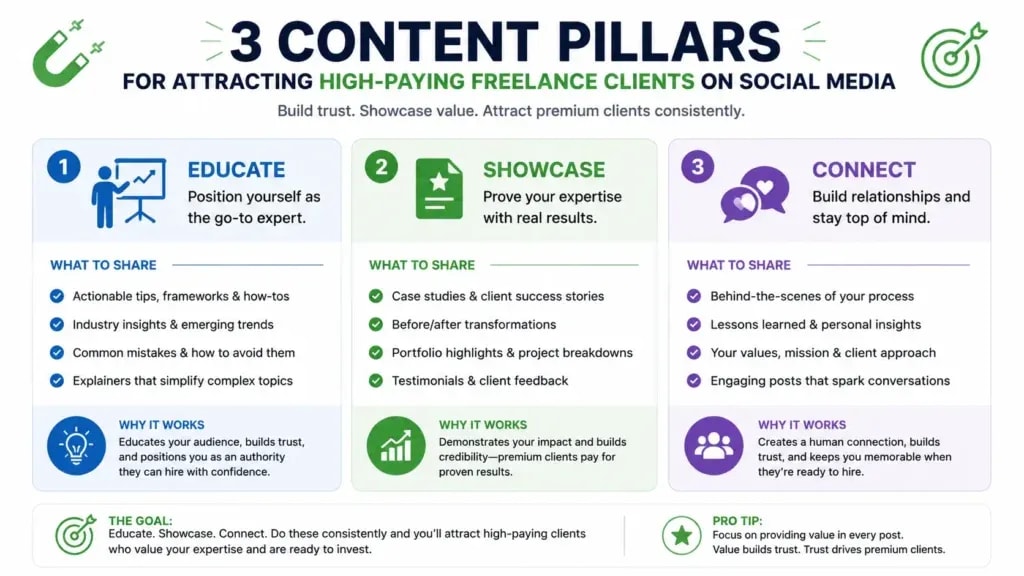
The 3 Content Pillars Every Freelancer Needs
Pillar 1 - Authority: Posts that show how you think, not just what you do. Frameworks, approaches, observations from real client work. This positions you above commodity service providers who just list their skills.
Pillar 2 - Proof: Posts that reduce the risk of hiring you. Results, case studies, testimonials, process documentation. Clients pay premium rates for certainty. Proof content sells exactly that.
Pillar 3 - Problem: Posts that name and articulate your ideal client's real frustrations. When someone reads a post and thinks "this is exactly my situation," you've earned their attention and trust at the same time.
A rotating schedule across all three pillars ensures your pipeline gets what it needs. Authority attracts the right audience. Proof convinces them. Problem content keeps them engaged long enough to convert.
The Cold Outreach Formula: Turning Strangers into Warm Leads
The most effective cold outreach for freelancers is short, specific, and ends with a low-friction question rather than a pitch. The first DM is opening a conversation, not making a sale.
The 4-Part DM Formula
Part 1 - Specific Observation Reference something concrete about their business, content, or a problem they mentioned. Generic openers like "I love your work!" get filtered as spam immediately, and deserve to be.
"I saw your post about struggling to convert trial users to paid, it's one of the most common growth blockers in early-stage SaaS."
Part 2 - Brief Credibility Signal One sentence. Not a resume summary, just enough to make the next part credible.
"I specialize in onboarding email sequences that improve trial-to-paid conversion rates."
Part 3 - Direct Value Statement Tell them what you think the problem is and that you've seen it before.
"Most SaaS onboarding sequences focus on features instead of activation milestones, and that's usually where the conversion drops."
Part 4 - Low-Commitment Question End with something that requires a simple yes or a few words to answer. Not "can we schedule a call?", something with almost zero friction.
"Is improving trial-to-paid conversion something you're actively working on?"

Follow-Up Sequence: What to Say and When
Most pipeline leads are lost not because the prospect said no, but because the freelancer went quiet after one message. A follow-up sequence fixes this:
After Message 4 with no response, move the lead to an inactive list. Don't delete them, circumstances change, and a message sent 60 days later sometimes reopens a conversation you thought was dead.
How to Measure Your Freelance Pipeline Health
A healthy freelance pipeline is measured by four core numbers: active leads, lead-to-call rate, call-to-proposal rate, and proposal-to-close rate. Tracking these weekly tells you exactly where your pipeline is leaking, so you can fix the right thing instead of just posting more content.
The 4 Pipeline KPIs Every Freelancer Should Track

If your lead-to-call rate is below 10%, the outreach message needs work. If call-to-proposal is low, your discovery call structure needs attention. If close rate is low, pricing or proposal framing is the issue. The metrics tell you where to look.
Track these weekly in a simple Notion table or Google Sheet. You don't need a CRM to start, though CRM pipeline management tools become useful once your lead volume grows past 20–30 active contacts, see our list of free tools for freelancers if you want lightweight options.
Common Freelance Pipeline Mistakes (And How to Fix Them)
Pitching before trust exists. Sending a service pitch in the first DM is the fastest route to being ignored. Use the 4-part DM formula. Open with a specific observation, not an offer.
Stopping pipeline activity when you're fully booked. The clients you're working with today came from pipeline work you did 60-90 days ago. If you stop now, revenue dries up the moment current projects finish, it's one of the feast-or-famine patterns freelancers report most consistently. Keep at least 30 minutes a day for pipeline maintenance, regardless of how busy you are.
Posting only promotional content. "I'm available for freelance work" posts convert almost nobody. Apply the 3 Content Pillar framework. Promotional posts can exist, but they should represent no more than 10% of what you publish.
Not following up. Most pipeline leads need 3 or more touchpoints before they're ready to talk. Most freelancers give up after one. The 4-message follow-up sequence with defined timing fixes this.
Ignoring past clients. Your easiest next client is often your last client. Schedule a 30-day and 60-day check-in after every project. Staying in contact costs nothing and keeps you top-of-mind when they next need help.
Advanced Pipeline Tactics Most Freelancers Never Try
Collaborative content. Co-create a post or article with a complementary freelancer, a copywriter teaming up with a web designer, for instance. You each reach the other's audience with zero ad spend.
Lead magnet content. Create one high-value downloadable piece relevant to your ideal client: a template, checklist, or mini-guide. Share it freely. People who download it have pre-qualified themselves as interested in your expertise, which makes any subsequent outreach warm rather than cold.
Comment-to-DM sequences. When someone leaves a substantive comment on your post, that's a pipeline signal worth acting on. Respond publicly in the comments, then send a short DM referencing the exchange. Conversion rates on these messages are significantly higher than cold outreach because you're already in an existing conversation.
Social proof amplification. When a client publicly mentions your work - in a post, a comment, anywhere - reshare it with a brief professional acknowledgment. That's word-of-mouth at scale, and it costs nothing, the same principle as content authority signals working in your favor on-page.
Creator partnerships. Identify newsletters, podcasts, or YouTube channels your ideal clients already consume. Offer a genuinely useful guest contribution, or appear as a subject matter expert. This is the fastest route to borrowed credibility with an audience that's already pre-qualified for you. See our freelance business development guide for how to identify the right partnerships in your niche.
Frequently Asked Questions
What is a freelance client pipeline?
A freelance client pipeline is a structured, repeatable system that moves potential clients through defined stages, from first discovering you on social media to becoming a paying, referring client. It gives you predictability and control over your income instead of leaving it to chance.
How long does it take to build a freelance client pipeline?
A functional pipeline typically shows consistent results after 60-90 days. The first 30 days go toward platform selection and content foundation. Days 31-60 involve active engagement and first outreach. By day 90, you should have 3-5 active leads at different pipeline stages. How quickly it moves depends almost entirely on posting consistency and how specific your niche positioning is.
Which social media platform is best for building a freelance client pipeline?
LinkedIn is strongest for most professional service freelancers - B2B, marketing, writing, development, consulting. Instagram suits designers, photographers, and brand creatives. Twitter/X works for writers, SaaS freelancers, and technical specialists. Pick based on where your ideal client actually spends time, not where you're most comfortable.
How many leads should I have in my pipeline at any given time?
Aim for 10–15 active leads across different stages. If it drops below 5, treat it as a red flag requiring immediate outreach activity - regardless of whether you're currently busy with existing projects.
How do I prevent the feast-or-famine cycle as a freelancer?
Pipeline activity has to happen during busy periods, not just slow ones. The clients you're nurturing today become revenue 60–90 days from now. Stopping outreach when you're fully booked is the primary reason the feast-or-famine cycle keeps repeating.
What should I post on LinkedIn to attract freelance clients?
Post a mix of authority content (insights and frameworks from your work), proof content (client results and testimonials), and problem content (posts addressing pain points your ideal clients experience). Skip the "I'm open to work" posts, clients hire people who show they understand the problem, not people who announce they're available.
Is cold DM outreach still effective for freelancers?
Yes, when done with specificity. Generic "I offer X services" DMs have near-zero conversion rates. Personalized, problem-focused DMs that reference something specific about the prospect's situation convert considerably better. The goal of the first message is a conversation, not a closed deal.
Sources and References

Written by
Bibek Thapa
AI-Powered Digital Growth Strategist
Bibek Thapa works across AI workflows, SEO, AI search optimization, content strategy, website growth, and productivity systems. Anobee documents practical lessons, tools, experiments, and systems for improving digital presence.
- AI workflows
- Digital growth
- SEO
- GEO
- AEO
- Content strategy
- Website growth