
SEO & AI Search
7 Best Keyword Research Tools for Freelancers in 2026 (Compared and Ranked)
The best keyword research tools for freelancers in 2026, compared honestly. Find the right tool for your budget before wasting money on the wrong one.

By Bibek Thapa · Published May 13, 2026 · Updated Jul 7, 2026 · 16 min read
Quick Answer
If you're looking for the best keyword research tools for freelancers, you've probably run into comparisons written for marketing teams with $2,000/month software budgets. This one isn't.
Table of Contents
- How AI search is changing keyword research in 2026
- The Freelancer Tool Selection Framework
- Comparison tables
- Feature comparison
- Pricing comparison (2026)
- Beginner friendliness
- Freelancer ROI comparison
- AI SEO suitability
- Value for money
- Tool reviews
- 1. Ahrefs
- 2. SEMrush
- 3. LowFruits
- 4. KWFinder by Mangools
- 5. Ubersuggest
- 6. Google Keyword Planner
- 7. Keywords Everywhere
- Freelancer scenarios
- Scenario 1: Beginner freelancer, no budget
- Scenario 2: Freelancer with under $30/month
- Scenario 3: Content writer building niche websites
- Scenario 4: SEO consultant managing client campaigns
- Scenario 5: Freelancer growing toward agency
- Tool stacking strategies
- Common mistakes to avoid
- Best keyword research tools for freelancers: our honest picks
If you're looking for the best keyword research tools for freelancers, you've probably run into comparisons written for marketing teams with $2,000/month software budgets. This one isn't.
If you're a freelancer, solo SEO consultant, or content writer trying to figure out whether to pay for Ahrefs or just keep using Google's free tool, you've probably noticed that most "best tools" articles either push the expensive options or just list features without telling you what actually matters.
This comparison covers seven tools: Ahrefs, SEMrush, LowFruits, KWFinder, Ubersuggest, Google Keyword Planner, and Keywords Everywhere.
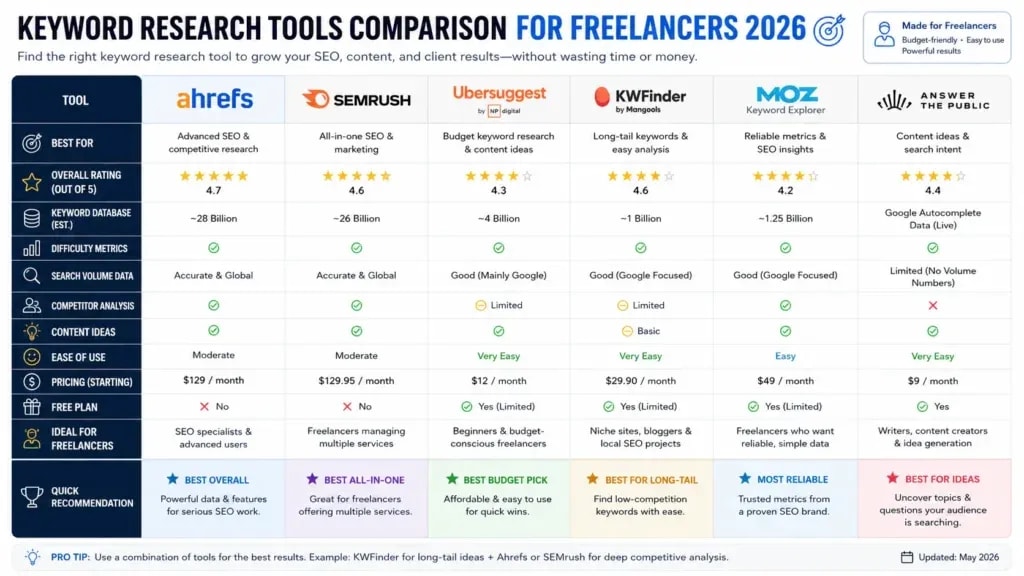
For each one, you'll get a real breakdown of pricing, what it's good at, where it falls short, and who it's actually built for. At the end, there's a simple framework to help you pick based on your budget, client volume, and where you are in your freelance career. If you want the short answer first: the best keyword research tools for freelancers right now are KWFinder, Ahrefs, and LowFruits, depending on budget.
How AI search is changing keyword research in 2026
Before getting into the tool reviews, this matters.
Google's AI Overviews now appear above organic results for roughly 47% of queries, according to data from BrightEdge. ChatGPT's browsing feature, Perplexity, Gemini, and Claude are pulling answers from web sources rather than just indexing pages. What this means practically: a keyword that gets 500 monthly searches might drive far more actual traffic than it used to, if your content gets cited in an AI answer. And a keyword with 10,000 searches might deliver almost nothing if AI Overviews swallow the click.
This doesn't make traditional keyword research useless. Volume, difficulty, and intent still matter. But modern keyword research also needs to think about:
Entity relationships. AI systems answer questions by connecting named entities (tools, brands, concepts, people). If your content treats each keyword as an isolated topic rather than part of a semantic network, you'll rank less well for AI-generated answers.
Topical authority. Google's systems, and the AI pulling from them, favor sites that cover a topic thoroughly rather than targeting isolated high-volume terms. This means keyword research is now partly content architecture planning.
Question-based intent. AI Overviews prioritize content that directly answers specific questions. Long-tail, question-format keywords that a few years ago seemed too small to bother with are now often worth targeting.
None of the seven tools in this comparison were built specifically for GEO or AEO. But Ahrefs and SEMrush have the most useful data for entity-level research, while LowFruits and KWFinder are better suited for the question-based long-tail work that feeds AI answer engines. More on that in each section.
The Freelancer Tool Selection Framework
Pick your tool based on four variables. Don't skip steps.
Step 1: What's your monthly budget for SEO tools (total)?
- $0: Google Keyword Planner. End of discussion.
- Under $15/month: Keywords Everywhere.
- $15 to $35/month: KWFinder (annual plan) or LowFruits.
- $35 to $60/month: Ubersuggest Business or LowFruits + Keywords Everywhere.
- $60 to $150/month: KWFinder Premium or LowFruits + one paid backlink checker.
- $150+/month: Ahrefs Lite or SEMrush Pro.
Step 2: How many active client campaigns are you running?
- 0 to 2 clients: Almost any tool works at the right budget tier.
- 3 to 8 clients: You need a tool with project/workspace features and bulk keyword tracking.
- 8+ clients: Ahrefs or SEMrush. The time savings on reporting alone justify the cost.
Step 3: What's your primary service type?
- Content writing and blog SEO: LowFruits, KWFinder, or Keywords Everywhere.
- Technical SEO audits: SEMrush or Ahrefs (both have site auditing built in).
- Link building: Ahrefs. Its backlink index is the strongest of the seven.
- Local SEO: SEMrush or KWFinder.
- Affiliate/niche sites: LowFruits is genuinely good here. So is KWFinder.
Step 4: Where are you in your freelance career?
- First year, learning: Start free or cheap. Google Keyword Planner + Keywords Everywhere gets you further than most beginners expect.
- Earning $2,000 to $5,000/month: KWFinder or LowFruits. Reinvest into Ahrefs once you clear $5k consistently.
- Established, growing to agency: Ahrefs or SEMrush. You need the data depth and the reporting features.

Comparison tables
Feature comparison
Pricing comparison (2026)
Beginner friendliness
Freelancer ROI comparison
AI SEO suitability
Value for money
Tool reviews
1. Ahrefs
When freelancers ask which are the best keyword research tools for freelancers, Ahrefs is the answer most SEO consultants give first. Whether it's worth the price is a different question. Its keyword index is massive (roughly 29 billion keywords across 170+ countries), its backlink database is the most comprehensive of any tool in this list, and its SERP analysis is accurate enough that you can trust the keyword difficulty scores when planning content.
The problem for freelancers isn't the quality. It's the price. At $129/month for Lite, you're looking at $1,548/year before you've built a single backlink or written a single article. The Lite plan also limits you to one user seat and restricts historical data access.
That said, once you're managing three or more clients at a reasonable retainer, Ahrefs pays for itself fast. The Site Explorer tool alone, which shows any domain's organic traffic and top-ranking pages, is worth most of the cost.
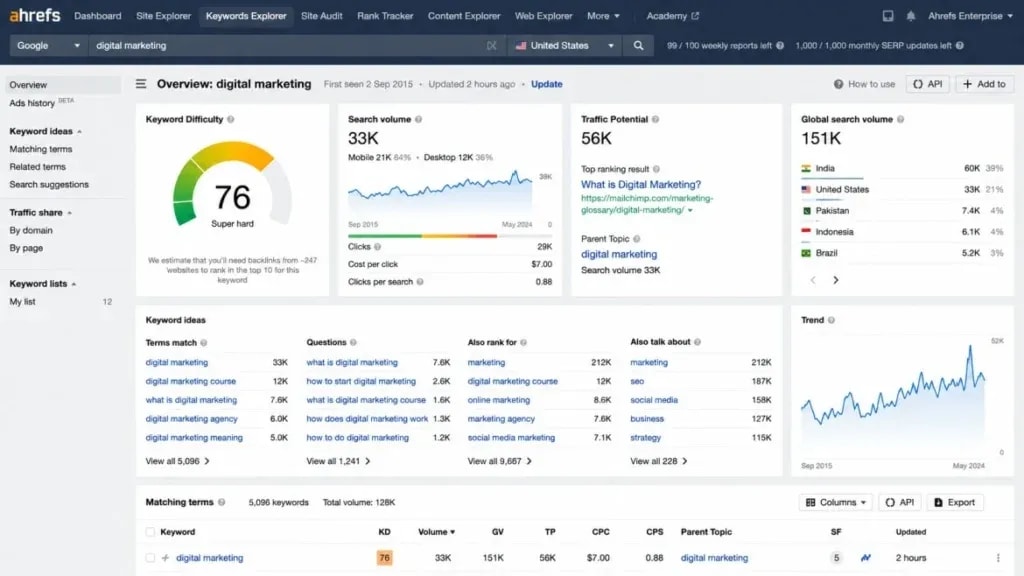
You can do competitor research in five minutes that would take hours manually.
For AI SEO in 2026, Ahrefs is useful for understanding topical authority gaps and building content clusters. It doesn't have AI Overview-specific tracking yet, but you can pull question keywords, analyze SERPs for intent, and map entity relationships through its Content Explorer.
Pricing: Lite at $129/month, Standard at $249/month. Annual billing saves roughly two months. Ease of use: 3/5 (steep learning curve, but the documentation is excellent) Data accuracy: 5/5 Value for money: 3/5 (excellent quality, hard to justify under $5k/month revenue) Best for: SEO consultants managing multiple clients, link builders, agency-track freelancers Skip it if: You're under $3k/month revenue or you only need keyword research (not backlink data)
2. SEMrush
SEMrush is Ahrefs' main competitor, and the comparison mostly comes down to what you actually need.
Ahrefs has a better backlink database. SEMrush has better content tools, more local SEO features, and a more developed suite for things like PPC research, position tracking, content auditing, and on-page SEO checks in one place. For freelancers who offer a broader range of digital marketing services (not just SEO), SEMrush often works better because you're getting more tools for the same general price point.
The Keyword Magic Tool is genuinely good. You can filter by intent (informational, commercial, transactional), question format, keyword difficulty, and language. For building content plans in 2026 where you're thinking about AI Overviews and PAA boxes, this is useful.
SEMrush has also put more investment into AI-adjacent features than Ahrefs. The Topic Research tool and ContentShake AI help with topical mapping, though they're not a substitute for actual strategy. Position tracking also has some AI Overview visibility tracking, which Ahrefs lacks.
Price is nearly identical to Ahrefs. The Pro plan at $139.95/month is slightly more expensive, and the same justification logic applies: you want at least three paying clients before this makes financial sense.
Pricing: Pro at $139.95/month, Guru at $249.95/month. Ease of use: 2/5 (the tool has so many features it's genuinely overwhelming at first) Data accuracy: 5/5 Value for money: 3/5 Best for: Freelancers offering full-service SEO, content strategy + SEO, local SEO, or PPC Skip it if: You only do keyword research and content work. KWFinder or LowFruits will serve you better at a fraction of the cost.
3. LowFruits
LowFruits is the most underrated tool in this list. It does one thing extremely well: it finds low-competition keywords that Ahrefs and SEMrush will flag as "medium" or even ignore entirely.
The approach is different from other tools. Rather than assigning a keyword difficulty score based on domain authority metrics, LowFruits analyzes the actual SERP. It looks at who's ranking: if a keyword's top results include forum posts, Reddit threads, weak affiliate pages, and thin content, LowFruits marks those spots as beatable. This is more useful in practice than a generic KD score.
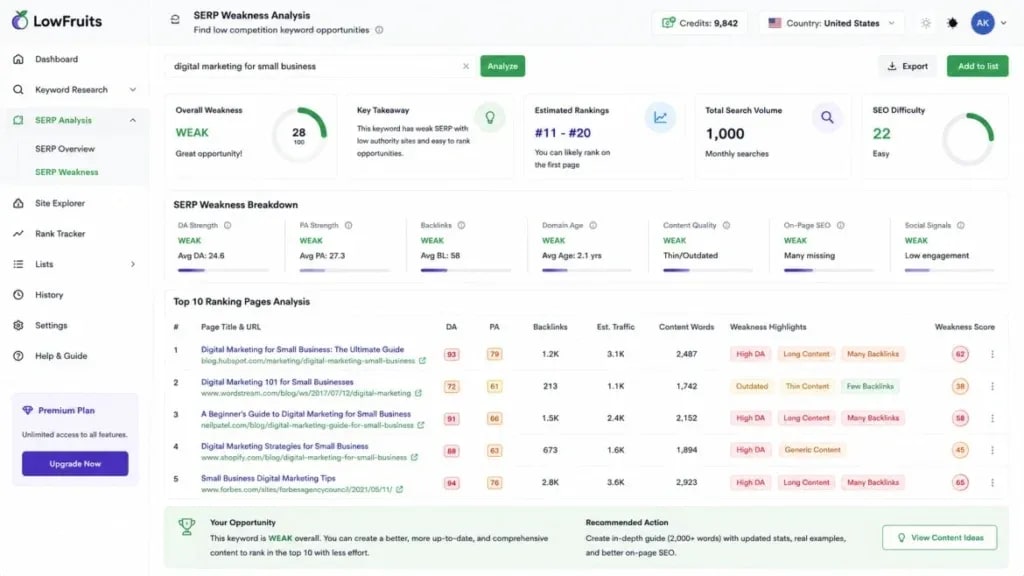
For freelancers building niche sites or writing content for clients in smaller niches, this is exactly the kind of data you need. Finding a keyword where the top three results are Reddit posts and a 2019 blog with no backlinks is worth more than knowing that "project management software" has a KD of 78.
The weakness is breadth. LowFruits doesn't give you backlink data, site audit tools, or any meaningful competitive research beyond keyword SERPs. It's a focused tool, and you'll eventually want to stack it with something else.
At $29.90/month for the Starter plan (or pay-as-you-go credits), the value is strong.
Pricing: Pay-as-you-go credits or $29.90/month Starter. Annual plans available. Ease of use: 3/5 (the concept takes a bit of getting used to, but the interface is clean) Data accuracy: 4/5 for low-competition analysis; limited elsewhere Value for money: 4/5 Best for: Niche site builders, affiliate marketers, content writers targeting low-competition gaps Skip it if: You need backlink research, technical SEO auditing, or broad competitor analysis
4. KWFinder by Mangools
KWFinder is the best mid-range keyword research tool for freelancers who want solid data without paying Ahrefs prices.
The keyword database is large, the difficulty scores are reliable, and the SERP overview on the right side of the results (showing the actual ranking pages with their DA, backlinks, and social shares) is more actionable than most tools at this price point. You can see at a glance whether a keyword is realistically beatable for a new client site.
The Mangools suite also includes SERPChecker, SERPWatcher (rank tracking), LinkMiner (backlink checker), and SiteProfiler. They're not as powerful as Ahrefs equivalents, but for a freelancer managing five to ten client accounts at mid-range retainers, the suite gives you enough to work with.
KWFinder is also genuinely easy to use. New freelancers can get actionable keyword lists within an hour of signing up. That matters when you're learning and don't want to spend half your time decoding dashboards.
The weakest area is volume data accuracy in smaller markets, including South and Southeast Asian markets where Google's actual search volumes are often undercounted. If you're doing keyword research in Nepal, India (smaller niches), or similar markets, validate with Google Keyword Planner before committing.
Pricing: Basic at $29/month (annual), Premium at $44/month (annual), Agency at $89/month (annual). Ease of use: 4/5 Data accuracy: 4/5 for major markets, 3/5 for smaller markets Value for money: 4/5 Best for: Mid-level freelancers managing several clients, beginners ready to pay for a proper tool Skip it if: You primarily need backlink prospecting or technical SEO data
5. Ubersuggest
Ubersuggest gets a lot of hate online and some of it is fair, but let's be specific about what it's actually bad at.
The keyword data quality is inconsistent. Volume figures sometimes differ significantly from what you see in Ahrefs or GKP, and the keyword difficulty scores are optimistic in a way that can send beginners after keywords they can't actually rank for. The backlink data is weak.
What Ubersuggest does reasonably well is give beginners a starting point. The content ideas feature shows you which articles are performing well for competitors, the site audit is functional for basic on-page issues, and the pricing is the lowest of any paid tool here, at $12/month for the Individual plan.
If you're just starting out and you need something cheap to learn the concepts of keyword research before investing in better tools, Ubersuggest isn't a bad first choice. Just don't make business decisions based on its difficulty scores alone.
Neil Patel also offers lifetime deal pricing periodically, which makes it interesting for people who want a low-cost permanent option. The caveat is that lifetime tools sometimes deprioritize updates.
Pricing: Individual at $12/month, Business at $20/month. Lifetime deals available. Ease of use: 4/5 Data accuracy: 2/5 Value for money: 3/5 Best for: Beginners on a tight budget, freelancers who want a cheap starting tool before upgrading Skip it if: You're making real business decisions for paying clients. The data isn't reliable enough.
6. Google Keyword Planner
Google Keyword Planner (GKP) is still useful in 2026, but not in the way most people think.
Its search volume data is the most accurate available, because it comes directly from Google's ad system. The problem is that GKP shows bucketed ranges ("1K-10K") rather than exact numbers unless you're running active Google Ads campaigns. For organic SEO research, those ranges are too imprecise to use for competitive decisions.
What GKP is genuinely good for: validating keywords identified by other tools, finding geographic search data, spotting seasonal trends, and discovering related keywords in markets where paid alternatives have thin data (this is especially relevant for South Asian markets. If you're doing keyword research for Nepali blogs, GKP is often the most reliable volume source.).
It's also free, which changes the ROI calculation entirely. If you're a freelancer just starting out, spend three months with GKP and Keywords Everywhere together before paying for anything else. You'll learn what you actually need.
Pricing: Free (requires a Google Ads account, but you don't need to run ads) Ease of use: 5/5 Data accuracy: 4/5 (best volume data, but ranges only) Value for money: 5/5 (it's free) Best for: Beginners, volume validation, markets with thin third-party data Skip it if: You need keyword difficulty scores, SERP analysis, or competitor research
7. Keywords Everywhere
Keywords Everywhere is a browser extension that shows keyword data (volume, CPC, competition) directly in your Google search results and other platforms including YouTube, Amazon, eBay, and Google Search Console.
At $15 for 100,000 credits (each keyword lookup costs one credit), it's cheap enough that even a heavy user might spend $30 to $50 per year. For that price, you get useful data overlaid directly on your research workflow instead of switching between tabs.
The data quality is decent, not exceptional. Volume figures are sometimes off for niche topics, and there are no difficulty scores or SERP analysis tools. But the workflow advantage is real. When you're doing research inside Google Search Console or checking search volumes while browsing competitor sites, having the data right there saves time.
It pairs well with LowFruits or KWFinder. Use Keywords Everywhere for fast lookups during content planning, and your main tool for deeper research.
Pricing: $15 per 100,000 credits (credits don't expire) Ease of use: 5/5 Data accuracy: 3/5 Value for money: 5/5 Best for: Any freelancer who wants cheap keyword data overlaid on their normal workflow Skip it if: You need deep competitive research or reliable difficulty scores
Freelancer scenarios
Scenario 1: Beginner freelancer, no budget
Use Google Keyword Planner for volume data and Keywords Everywhere for in-browser research. These two together cost nothing ($0 for GKP, and Keywords Everywhere's cheapest credit pack is $15 and will last months at low usage). Focus on learning search intent and building a process before spending money on better data.
Scenario 2: Freelancer with under $30/month
KWFinder's Basic plan on annual billing comes to about $29/month and is the strongest single-tool option at this price. If you're doing niche/affiliate work, swap it for LowFruits at the same price. Add Keywords Everywhere for an extra few dollars a year.
If you're looking for more ways to earn online in Nepal using SEO skills, we've covered that separately.
Scenario 3: Content writer building niche websites
LowFruits is the primary tool for niche builders. The SERP-weakness analysis finds genuinely beatable targets that volume-based tools miss. Stack with Keywords Everywhere for quick volume checks and Google Keyword Planner for validation. Total cost: under $35/month.
Scenario 4: SEO consultant managing client campaigns
At five or more client accounts, Ahrefs or SEMrush makes sense. The reporting tools, rank tracking, and competitive research features save three to five hours per client per month. If you're billing $1,000+ per client, that's a clear return. SEMrush is the better choice if you also help with content strategy; Ahrefs is better if your work centers on technical SEO and link building.
Scenario 5: Freelancer growing toward agency
Before expanding to agency scale, make sure you've first built a strong freelance SEO portfolio to attract higher-retainer clients.
Ahrefs Standard or SEMrush Guru, combined with a rank tracker and a reporting tool. You'll also want to think about white-label reporting at this stage, which SEMrush handles better natively. Budget for $300 to $500/month in tools across your stack once you're running ten or more client accounts.
Tool stacking strategies
No single tool covers everything. These combinations work well at each budget tier.
Tier 1 (Free): Google Keyword Planner + Keywords Everywhere
Tier 2 (Under $35/month): KWFinder + Keywords Everywhere, or LowFruits + Google Keyword Planner
Tier 3 ($50 to $100/month): LowFruits + KWFinder Premium + Keywords Everywhere
Tier 4 ($130 to $160/month): Ahrefs Lite + Keywords Everywhere, or SEMrush Pro + Keywords Everywhere
Tier 5 (Agency-level): SEMrush Guru + Ahrefs Standard + a dedicated rank tracker
Common mistakes to avoid
Paying for Ahrefs or SEMrush when you have no clients yet. These tools are multipliers on work you're already doing. If you're doing three hours of keyword research per month, no tool justifies $130/month.
Trusting one tool's keyword difficulty scores completely. Every tool's KD score is a model, not a measurement. Check actual SERPs before deciding a keyword is too competitive or too easy.
Ignoring search intent. A keyword with 5,000 monthly searches and a mix of transactional and informational intent is harder to rank for and convert on than a 400-search keyword with clear informational intent and weak competitors. Volume alone doesn't tell you this.
Skipping question-format keywords. In 2026, with AI Overviews and PAA boxes capturing clicks, question-based queries are often more valuable per click than head terms. KWFinder and LowFruits both surface these well.
Best keyword research tools for freelancers: our honest picks

Best overall: Ahrefs (for consultants and agency-track freelancers managing multiple clients)
Best budget tool: KWFinder (strong data, reasonable price, easy to use)
Best free tool: Google Keyword Planner (volume data is more accurate than most paid tools, just less convenient)
Best for beginners: KWFinder or Keywords Everywhere (low learning curve, clear interface)
Best for SEO freelancers: Ahrefs Lite (backlink data plus keyword research in one place)
Best for content writers: LowFruits (the SERP-weakness analysis is designed for this use case)
Best for agencies: SEMrush (better reporting, white-label options, broader feature set)
Best for AI SEO in 2026: SEMrush (most developed AI Overview and content tools)
Best value for money: LowFruits or Keywords Everywhere (both punch well above their price points)
Prices and features accurate as of mid-2026. Check each tool's pricing page before purchasing, as these change regularly.
Frequently Asked Questions
What is the best keyword research tool for freelancers?
The best keyword research tools for freelancers depend on budget and client volume. KWFinder is the strongest paid option under $35/month. Ahrefs is the best overall once you're earning enough to justify it.
Is Ahrefs worth the money?
At $129/month, yes, if you're actively managing three or more client campaigns. For solo content work or freelancers under $3k/month, probably not yet.
Is SEMrush better than Ahrefs?
For content tools and all-in-one digital marketing, SEMrush is stronger. For backlink research and pure SEO data quality, Ahrefs has a slight edge. Most working freelancers pick one and learn it well rather than switching between them.
Which keyword tool has the most accurate data?
For volume, Google Keyword Planner (direct from Google's ad data). For keyword difficulty and competitive analysis, Ahrefs.
What should beginners use?
Google Keyword Planner plus Keywords Everywhere. Free or near-free, and you'll understand what you're actually looking for before spending money.
Is LowFruits worth it?
Yes, specifically for niche site builders, affiliate marketers, and content writers targeting low-competition gaps. It's not a replacement for a full SEO tool, but for its use case it's very good.
Which tool is best for finding low-competition keywords?
LowFruits, by design. Its SERP-weakness scoring is more useful for this than Ahrefs' or SEMrush's KD scores for the same purpose.
Which keyword research tool offers the highest ROI?
For new freelancers: Keywords Everywhere (almost free). For established consultants: Ahrefs or SEMrush (time saved on research and reporting across multiple clients outweighs the monthly cost).
Sources and References

Written by
Bibek Thapa
AI-Powered Digital Growth Strategist
Bibek Thapa works across AI workflows, SEO, AI search optimization, content strategy, website growth, and productivity systems. Anobee documents practical lessons, tools, experiments, and systems for improving digital presence.
- AI workflows
- Digital growth
- SEO
- GEO
- AEO
- Content strategy
- Website growth


