

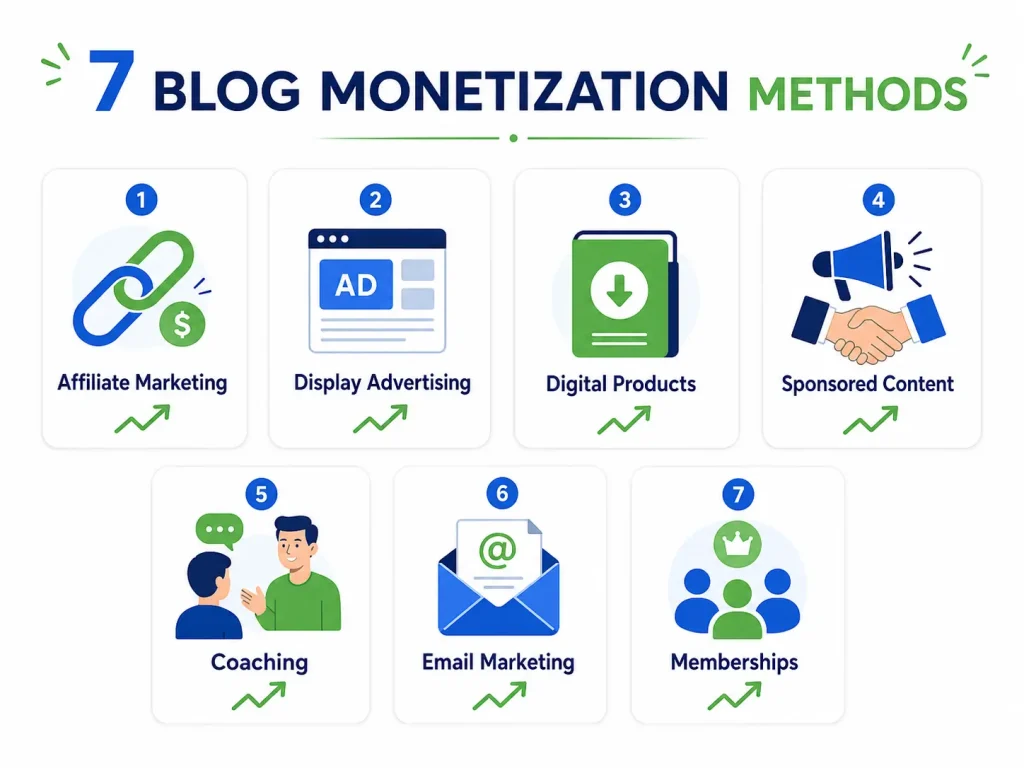
Learning how to make money blogging 2026 comes down to seven proven methods: affiliate marketing, display advertising, digital products, sponsored content, coaching services, email marketing, and paid memberships. Most bloggers earning full-time income combine 2-3 of these streams, not all seven at once. The right method for you depends on your traffic level, audience trust, and how much time you can invest upfront. This guide breaks down each method with realistic income numbers, step-by-step execution, and what actually works in 2026’s search landscape. For a deeper look at the SEO fundamentals behind blog monetization, see our complete guide to SEO for beginner bloggers.
Key Takeaways:
- Affiliate marketing is the fastest monetization method for new bloggers, with software programs paying 30% recurring monthly commissions
- Display advertising requires at least 10,000 monthly sessions to generate meaningful income ($50-150/mo on AdSense), but scales to $2,000-5,000/mo at 100,000 sessions with premium networks
- Digital products offer the highest profit margins and the most control over your income
- Sponsored posts pay approximately $100 per 10,000 monthly pageviews as a baseline rate
- Email lists convert at 3-10x the rate of cold traffic
- Most bloggers see first real income between months 4-6 of consistent publishing
- The bloggers who monetize fastest pick one method and execute it deeply
How to Make Money Blogging 2026: The Honest Answer
Short answer: yes. Many people researching how to make money blogging 2026 want a straight answer, and it depends on your strategy, consistency, and choice of monetization methods.
Blogging as a full-time income source is more accessible today than it was five years ago. The tools are cheaper, the platforms are more mature, and the routes to revenue keep getting clearer. Google’s 2026 AI Optimization Guide now addresses AI-assisted content directly, and AI Overviews are reshaping how traffic flows to blogs.
The bloggers winning in 2026 share one trait: they build their monetization strategy around firsthand experience and audience value rather than content volume alone. Pure AI-generated blogs without human perspective are getting filtered out by Google’s quality systems.
Key Insight: Blogging income in 2026 comes down to one thing: how well your content answers real questions with real experience behind it.
What realistic blogging income looks like. In my experience running Google AdSense on anoopinnovations.com since early 2023, consistent publishing with strategic content structure generates steady earnings. I went from publishing articles without much thought to building content around E-E-A-T principles, and that shift made the difference between sporadic cents and reliable monthly income. Currently that site earns $300-400 per month from AdSense alone. Not life changing, but proof the model works with the right approach at any traffic level.
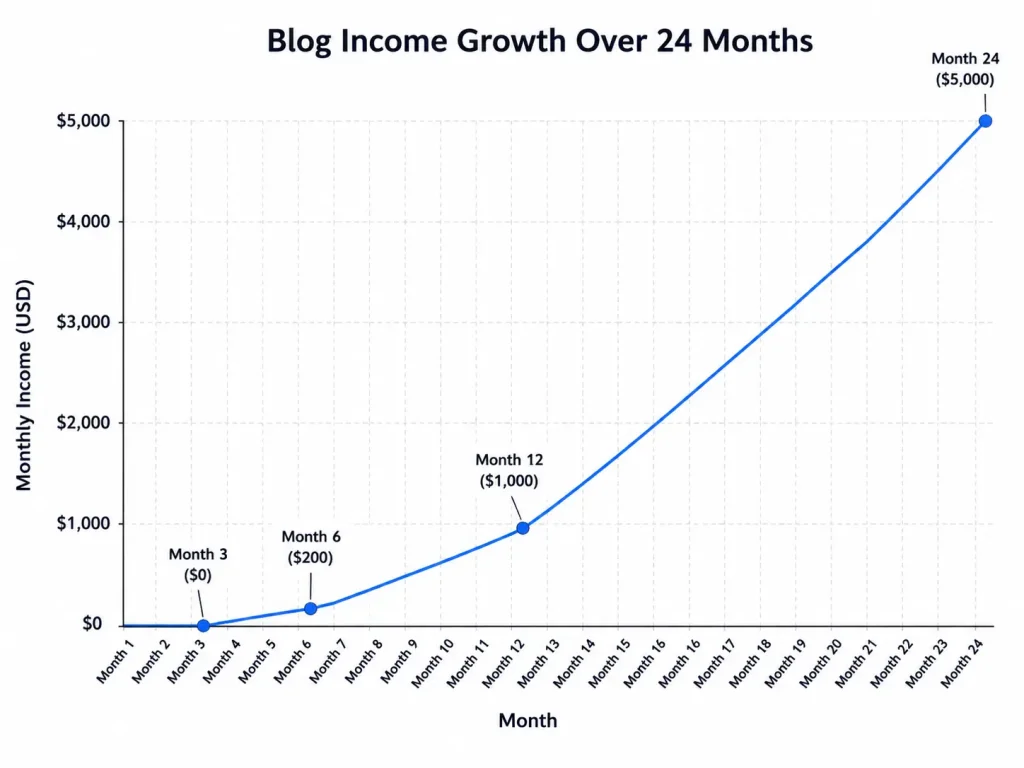
Your first year looks different from year two. Months 1-3: almost zero income while you build infrastructure. Months 4-6: $50-200/month from early affiliate commissions or ad earnings. Months 7-12: $300-1,000/month as content compounds. Year 2: this is where the curve steepens. Bloggers who treat their site like a business, not a hobby, hit $2,000-5,000/month ranges in year two.
Method #1 — Affiliate Marketing for Bloggers
If you are learning how to make money blogging 2026, affiliate marketing is the single best starting point. The model is straightforward: you recommend a product or service using a unique affiliate link. When someone buys through that link, you earn a commission. Commission rates range from 1-4% on Amazon Associates to 30-50% recurring on software platforms.
Why affiliate marketing works for beginners: you don’t need to create a product, handle customer service, or manage inventory. You just need content that helps readers make a purchasing decision.
Key Insight: The bloggers earning the most from affiliate marketing don’t promote everything. They pick 3-5 products they personally use and recommend them obsessively. Focusing on fewer products and promoting them well beats spreading thin across dozens of programs.
How to Choose the Right Affiliate Programs
Not all affiliate programs are equal. The criteria for selection should be:
- Does your audience need this product?
- Would you recommend it without a commission?
- Does the commission rate justify the effort?
High-value programs for bloggers include ConvertKit (30% recurring), Teachable (30% recurring), Bluehost ($65-150 per referral), and niche-specific SaaS tools. Amazon Associates is a fine starting point but the low rates mean you need significant volume to generate real income.
Low-competition affiliate tactic: Find tools your audience uses that few bloggers in your niche are promoting. These are often overlooked opportunities. A finance blogger promoting a budgeting app that few other finance bloggers mention will out-earn the tenth blogger promoting Bluehost. For a full breakdown of affiliate strategies, read our SEO for affiliate marketing guide.
Where to Place Affiliate Links for Maximum Conversions
Affiliate link placement matters more than most bloggers realize. The highest-converting spots are:
- Within the first third of an article, embedded naturally in relevant context
- Product comparison tables
- Tutorials where you demonstrate using the tool
- Email sequences to warm subscribers
Pro tip: Disclose your affiliate relationships clearly. It is legally required in most countries, and transparent disclosure builds trust that increases conversion rates over time.
Method #2 — Display Advertising: Passive Income at Scale
Display advertising is the closest thing to passive income in blogging. You place ad code on your site, ads appear automatically, and you earn money per thousand impressions (CPM) or per click (CPC). No selling required.
Key Insight: Display ads are a volume game. Below 10,000 monthly sessions, the income is negligible. Above 50,000 sessions, premium networks pay dramatically more than AdSense. The jump from AdSense to Mediavine routinely triples or quadruples ad revenue overnight.
AdSense vs Premium Ad Networks: What Actually Changes
| Feature | Google AdSense | Mediavine | Raptive |
|---|---|---|---|
| Minimum Traffic | None | 50,000 sessions/mo | 100,000 pageviews/mo |
| Typical RPM | $5-15 | $15-35 | $25-50 |
| Approval Process | Automatic | Application reviewed | Invitation only |
| Best for | Beginners starting out | Growing sites with steady traffic | Established sites at scale |
Start with AdSense to learn the system and earn while you grow. Once you hit 50,000 monthly sessions, apply for Mediavine. The revenue jump is substantial enough to plan your growth strategy around hitting that threshold.
Method #3 — Selling Digital Products and Courses
Digital products offer the highest income potential because you keep 85-100% of the sale price after platform fees. Unlike affiliate marketing or ads where you earn a fraction of someone else’s revenue, digital products give you full control.
Key Insight: Every other monetization method depends on external factors. Affiliate programs change rates. Ad networks tweak algorithms. With digital products, you set the price and control the terms. One product can sell indefinitely once built.
Which Digital Products Work Best for Bloggers
- Ebooks and PDF guides ($9-49): Low effort, quick to produce, good for testing demand
- Online courses ($97-997+): Higher effort, higher return. Platforms like Teachable and Thinkific handle the technical side
- Templates and tools ($5-47): Notion templates, spreadsheet trackers, content calendars. These are impulse buys with high perceived value
- Printables ($3-19): Strong in parenting, organization, education, and planner niches
Start with what your audience has explicitly asked for. Reader comments like “I wish someone made a guide for…” or “Is there a template for…” are product ideas handed to you for free. Learn more about creating digital products for your blog.
Method #4 — Sponsored Posts and Brand Deals
Brands pay bloggers to write about their products. Sponsored posts are one of the most underused monetization methods because most bloggers think they need a massive audience to attract sponsors.
Key Insight: Micro-influencer marketing is growing faster than celebrity influencer marketing. Brands actively seek bloggers with 5,000-20,000 monthly readers in specific niches because engagement rates are higher and the audience is more targeted.
How to Land Your First Sponsorship Without a Huge Audience
Build a simple one-page media kit: your traffic stats, audience demographics, social following, and 2-3 writing samples. Then pitch brands directly.
The pitch formula: three paragraphs max. Who you are. Who your audience is. Why their product fits naturally. No fluff, no web-speak about “partnership opportunities.”
Pricing formula for beginners: $100 per 10,000 monthly pageviews for a standalone post. Adjust up for social media amplification, email inclusion, or exclusivity terms.
Method #5 — Coaching, Consulting, and Freelance Services
Your blog is a portfolio. A portfolio attracts clients. This is the fastest path to real income because you trade expertise directly for money without waiting for traffic to build.
Key Insight: Services work at any traffic level. A blog with 500 monthly readers in a high-value niche like business consulting can generate more income than a blog with 50,000 readers running display ads. Niche and audience quality matter more than raw numbers.
Using Your Blog as a Client-Attraction Machine
Publish case-study style content that shows your thinking process. A post titled “How I helped a client increase organic traffic by 340% in 6 months” attracts better clients than a generic “SEO tips” article.
Create a dedicated Work With Me page. Include what you offer, who it is for, what results look like, and a clear next step. Check out our guide to creating a services page that converts.
Method #6 — Email Marketing as a Monetization Engine
Email marketing is criminally underrated as a monetization method. Social media algorithms change and Google rankings fluctuate, but your email list is the one channel you fully own.
Key Insight: Bloggers with email lists consistently report 3-10x higher conversion rates than sites relying on cold traffic alone. Someone who has read your emails for three months is far more likely to buy your product or click your affiliate link than a stranger who landed on your site from Google five minutes ago.
How to Build a List That Converts
The lead magnet determines your list quality. A generic “subscribe to my newsletter” opt-in converts poorly. A specific freebie like “Download my 7-day content planning template” or “Get the 30-day blog income tracker” converts consistently.
Once subscribers are on your list, maintain an 80/20 ratio: 80% valuable content, 20% promotions. Teach first, sell second. Lists built on this ratio stay engaged and grow through sharing. See our complete email marketing for bloggers guide.
Method #7 — Paid Memberships and Communities
Paid recurring memberships are the most sustainable monetization method. Instead of one-time purchases, subscribers pay monthly for ongoing access to content, community, or coaching.
Key Insight: A $15/month membership with 200 members generates $3,000/month in predictable recurring revenue. That stability changes everything about how you plan content, invest in growth, and manage your time.
Is a Membership Model Right for Your Blog?
Memberships work when you can offer ongoing value that a one-time product cannot. Think monthly content drops, private community access, live Q&A sessions, or exclusive resources.
Platform options: Patreon (easiest to start), Memberful (WordPress integration), Substack (writing-focused).
The real question: does your audience want a relationship with you, not just occasional content? If your comments section looks like a community, you have the raw material for a membership.
How Long Does It Take to Make Money Blogging?
Here is the realistic timeline that most blogging courses gloss over:
Months 1-3: Zero income. You are building infrastructure: publishing content, learning SEO, setting up email opt-ins. This is normal.
Months 4-6: Early traction. $50-200/month from affiliate commissions or initial ad earnings. Google starts ranking some of your content. Keep going.
Months 7-12: Traffic compounds if you have been consistent. $300-1,000/month. Several posts ranking. This is where most bloggers either break through or quit.
Year 2: Established domain authority, growing email list, brand opportunities. $2,000-5,000/month becomes realistic for a well-built blog.
Key Insight: The bloggers who succeed are the ones who publish consistently for 12 months without stopping, more so than the most talented writers. Consistency matters more than raw skill.
10 Tips to Make Money Blogging Faster
- Start your email list on day one, not after you hit a traffic milestone
- Choose affiliate products you personally use. Authenticity drives conversions
- Write long-form content (1,500-3,000 words) that fully answers specific questions
- Publish consistently for 6 months before judging your results
- Focus on high-intent keywords like “best X for Y” that signal purchase readiness
- Add content upgrades to your best posts for higher email conversion
- Repurpose one blog post into a YouTube video, Pinterest pin, and 5 social posts
- Audit your top 10 posts quarterly: update stats, add fresh links, improve clarity
- Study analytics to find which posts drive the most email signups and affiliate clicks
- Pick one or two monetization methods and master them before adding more
According to Statista, affiliate marketing spending in the US alone exceeded $10 billion in recent years, confirming content creators are capturing a growing share of that spend.
How much do bloggers actually earn?
Beginner bloggers earn $50-200/month in months 4-6. Consistent bloggers at 10,000-25,000 monthly sessions earn $500-2,000/month. Top earners report over $100,000/month at scale.
Which monetization method is best for beginners?
Affiliate marketing. No product creation, no customer service, no minimum traffic threshold. Start with programs matching your niche.
How long until a blog makes money?
4-6 months for first $50-200/month. $1,000+/month typically takes 12-18 months of consistent publishing.
Can AI content blogs make money in 2026?
Yes, but only with human experience and E-E-A-T signals. Google’s 2026 guidance permits AI-assisted content that meets quality standards.
What’s the fastest way to monetize a blog?
Coaching or freelance services through your blog. No traffic needed, immediate income from expertise.
How much traffic do you need to make money blogging?
Depends on method. Affiliate marketing works with 1,000-5,000 targeted visitors. Display ads need 10,000+ sessions for meaningful income.
Do I need an email list to monetize my blog?
Not strictly, but email lists increase conversion rates by 3-10x compared to cold traffic.
Bottom Line: Pick One Method and Go Deep
The strategy for how to make money blogging 2026 is simple. Pick one monetization method that matches your current stage. Execute it well for 90 days, then add a second method only after the first is producing results.
Start with affiliate marketing if you are fresh. Go with digital products if you have an engaged audience. Use services if you need income immediately. And build email marketing alongside everything.
The bloggers who win master one method at a time and stay consistent long enough for the results to compound. They do not need to know all seven methods to succeed.
Start today. Publish that post. Set up that lead magnet. Sign up for that affiliate program. The blogger who starts imperfectly and keeps going will always beat the one who waits for perfect conditions.
Firsthand experience note: This guide draws on my experience running Google AdSense on anoopinnovations.com since early 2023, where consistent E-E-A-T-focused publishing generates $300-400/month. The principle applies across niches: human experience behind the content is what converts readers into revenue.