SEO & AI Search
SEO for Affiliate Marketing 2026: 10 Proven Strategies to Rank and Convert
Learn SEO for affiliate marketing 2026 with 10 proven strategies to rank affiliate content, drive traffic, and earn commissions. Includes firsthand experience.
By Bibek Thapa · Published Jul 12, 2026 · Updated Jul 24, 2026 · 15 min read

Quick Answer
Key Insight: SEO for affiliate marketing 2026 is not about ranking for every keyword. It is about ranking for the right ones and structuring content so both Google and AI systems extract value from it while human visitors take action.
Table of ContentsOn this page
- 1. Target Low-Competition, High-Intent Keywords
- 2. Write for Humans First, Search Engines Second
- 3. Optimize Affiliate Content for AI Overviews
- 4. Build Topical Authority with Content Clusters
- 5. Master On-Page SEO for Affiliate Pages
- 6. Use Comparison and Best-of Formats That Rank
- 7. Earn Backlinks That Drive Rankings and Traffic
- 8. Optimize Affiliate Links for SEO and UX
- 9. Use Programmatic SEO for Scale
- 10. Track, Analyze, and Iterate with Google Search Console
- SEO for Affiliate Marketing 2026: Bottom Line
Key Insight: SEO for affiliate marketing 2026 is not about ranking for every keyword. It is about ranking for the right ones and structuring content so both Google and AI systems extract value from it while human visitors take action.
SEO for affiliate marketing means getting your affiliate pages to rank and actually earn commissions from the traffic they bring. Regular SEO can target any query. Affiliate SEO targets the ones where people compare products, read reviews, or decide what to buy. The conversion part matters more than most people realize. This complete SEO for affiliate marketing 2026 guide covers everything you need to rank higher and convert better.
By 2026, this looks different than it did a couple years ago. Google's AI Overviews show up for 77% of queries that are six words or longer. Google's June 2026 AI Optimization Guide says AI-assisted content is fine as long as it delivers real value and firsthand experience. Affiliate marketers have to deal with a search landscape where Google's algorithms and AI chatbots both read their content. The site that treats SEO as a traffic game ranks but never converts. The site that treats it as a revenue system does both.
I learned this the hard way on anobee.com. I wrote one affiliate article, ranked on page one within about three weeks, and got zero sales. Ranking without conversion is just expensive traffic with nothing to show for it. That experience changed how I think about affiliate SEO entirely. The traffic numbers looked great in GSC, but the bank account did not move at all. It is not about how many people visit your page. It is about whether those visitors are ready to buy.
1. Target Low-Competition, High-Intent Keywords
New affiliate sites chase big keywords and wonder why they never rank. Your first 20 articles should target keywords with a difficulty score under 15 and clear buying intent. This builds momentum faster than fighting authority sites on broad terms. Starting with the right keywords is the difference between ranking in two months and ranking in never.
Use GSC and Ahrefs or SEMrush to find keywords where search volume is between 100 and 1,000 a month, fewer than five competitors with DA above 30 rank on page one, and the intent includes words like "best", "vs", "review", "alternatives", or "should I buy". You can spot these manually by searching the keyword and checking whether the top results are product comparisons or generic informational articles. Queries that are four words or longer trigger AI Overviews more often but face less competition. The longer the query, the more specific the intent, and the easier it is to match with focused content that answers exactly what the searcher wants.
Key Insight: A page ranking first for a 100-search-volume keyword with 5% conversion rate earns more than a page ranking tenth for a 2,000-search-volume keyword with 0.5% conversion rate. Target convertibility, not vanity traffic.
For multi-country targeting across the USA, UK, Australia, Canada, Nepal, and India, localize keyword research by region. Google's country-specific keyword planners let you see volume differences. "Best hosting for Nepal" has different competition than "best hosting USA". A keyword that is competitive in the US might be easy in the UK or Australia. Run separate research for each country and prioritize where your site has the best shot. Your keyword strategy should look different for every country you target. The same keyword that drives thousands of searches in the US might get fifty in Nepal, which means you can rank for it with much less effort.
2. Write for Humans First, Search Engines Second
Google's helpful content system looks at whether your content was written for users or for rankings. Affiliate content is at risk here because the monetization motive is obvious. The fix is not to hide the affiliate angle but to make the content useful regardless of the links in it.
Write like you are advising a friend. Use natural language. Say what you actually think about the product. If something is overpriced, say so. If a tool has drawbacks, mention them. Readers who trust you click your affiliate links more often. It is that simple. Over-optimized content that hides the downsides of a product comes across as salesy and gets ignored.
When I wrote my first affiliate article on anobee.com in May 2026, I focused on keyword placement and structure. It ranked on page one in three weeks. It also did not convert because it read like a template. Readers showed up, scanned the page, and left without clicking anything. The ranking was fine. The writing was not. I had checked every Rank Math box but forgot to write something a real person would want to read. This is why SEO for affiliate marketing 2026 demands a human-first approach, not a template-based one.
Key Insight: Affiliate content that ranks and converts reads like a buying recommendation from someone who actually tried the product. Write the way you would explain it to someone sitting next to you.
3. Optimize Affiliate Content for AI Overviews
Google AI Overviews show up for 77% of six-plus-word queries. This creates a problem for affiliate marketers. AI Overviews can cite your content, which builds credibility and brand visibility, but they can also answer the query directly, which reduces click-through rates. Whether you benefit or lose depends entirely on how your content is structured.
Structure your content for AI extraction without losing the human angle:
- Lead every section with the answer, not setup. AI picks the first clear statement it finds.
- Use question-format H2s. "How does X compare to Y?" gets pulled into AI answers more often than "Comparison of X and Y".
- Include standalone quotable sentences and bold key findings as Key Insight blocks.
- Add at least five FAQ pairs. AI systems extract from FAQ sections more than any other part of an article.
- Put a 40- to 60-word answer in the first 100 words.
Key Insight: Content structured for AI extraction also ranks better on Google because Google uses the same passage-level understanding technology. Writing for AI Overviews is just good SEO.
Take Hostinger affiliate content as an example. An article comparing hosting plans that opens with a direct answer table and includes FAQPage schema has higher extraction potential than a narrative review that buries the comparison in paragraphs. The more extraction-ready your format, the more likely AI citations include your brand name when someone asks about that topic.
4. Build Topical Authority with Content Clusters
Google ranks pages higher when the entire site shows expertise on the topic. One article about "best affiliate programs" will not rank as well as a site with ten interlinked articles covering the same space from different angles. Topical authority comes from multiple articles, not one page. Each new article you add to a cluster makes every other article in that cluster stronger.
Build content clusters around your affiliate niche. Start with a pillar page, this article, that covers the broad topic. Then create cluster articles on specific affiliate program reviews, tool comparisons, and individual strategy deep-dives that expand on what the pillar introduces. Link every cluster article to the pillar page and vice versa. Google reads the relationships between the pages, and each link strengthens the topical link graph.
A web hosting affiliate site can create one pillar about how to choose hosting and ten cluster articles reviewing individual providers. Each cluster article links back to the pillar. The pillar links forward to each review. Google sees the coverage and ranks the cluster higher than any single article would rank alone. The same logic applies whether you are reviewing web hosting, SEO tools, or affiliate programs.
Key Insight: On anobee.com, the SEO content cluster creates a dense internal linking network. The same structure works for affiliate content. Start with this pillar, then build cluster articles that cover specific programs, individual strategies, and related tools.
For a deeper breakdown of on-page optimization, read our Complete On-Page SEO Checklist.
5. Master On-Page SEO for Affiliate Pages
On-page SEO for affiliate content follows the same rules as standard SEO but with stricter attention to commercial signals. Every affiliate page needs to tell Google exactly what query it answers and what action the user should take. You have one shot with each page, and the optimization decisions you make before publishing determine how well it performs.
Checklist per affiliate page against Rank Math standards:
- Primary keyword in SEO title near the beginning
- Primary keyword in meta description
- Primary keyword in URL slug
- Primary keyword in the first 100 words
- Primary keyword in at least one H2 or H3
- Keyword density between 0.5% and 1.5%
Title checklist for affiliate content:
- Include a power word like essential, proven, best, or honest
- Include a sentiment word like powerful, amazing, terrible, or brilliant
- Include a number like 7 ways, 10 strategies, or 2026
- Keep the total between 50 and 60 characters
Content structure:
- Keep paragraphs short, two to four sentences each
- One image per section with alt text that includes the focus keyword
- At least two internal DoFollow links to related content on your site
- At least two external DoFollow links to authority sources, opening in new tabs
Key Insight: The Rank Math score 100 checklist requires all 18 checks to pass. For affiliate content, the most commonly failed check is keyword density, either too thin or over-optimized. Target around 1%. Run the Rank Math analysis before publishing and fix every warning.
Google's official AI Optimization Guide confirms that AI-assisted content is permitted when it delivers genuine value.
6. Use Comparison and Best-of Formats That Rank
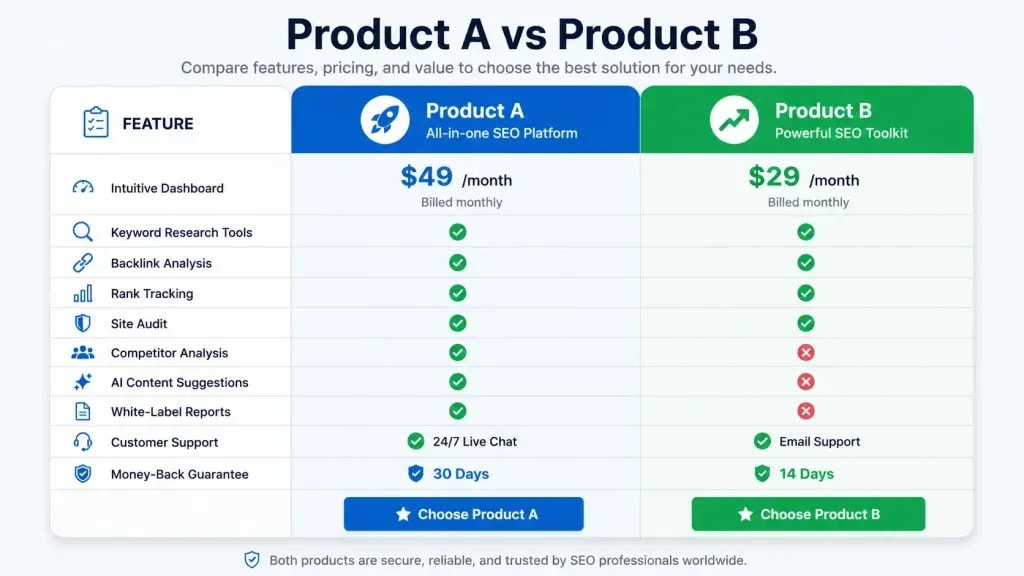
Comparison articles and best-of roundups earn higher click-through and conversion rates than standard reviews. These formats match commercial search intent because the user is already comparing options. Someone searching "Hostinger vs Bluehost" is closer to buying than someone searching "what is web hosting". That difference in intent is the difference between a page that earns commissions and a page that earns nothing.
For comparison content:
- Put a comparison table at the top with pricing and feature ratings
- Add a quick verdict below the table
- Write individual reviews for each product with a specific recommendation
- Include a "Which one should you choose?" section organized by user type
For best-of content:
- Lead with your number one pick and explain why
- List the rest in rank order with clear differentiators
- Add a comparison table that summarizes differences
- Organize buying criteria by user profile so readers self-select
Key Insight: Google frequently features comparison tables in AI Overviews and featured snippets. A well-structured comparison table can earn citations in both systems at the same time.
7. Earn Backlinks That Drive Rankings and Traffic
Backlinks are still one of Google's top three ranking factors. For affiliate sites on new domains like anobee.com launched in May 2026, building a backlink profile is essential to compete against sites that have accumulated links for years. Without backlinks, even good content struggles to rank on competitive terms. Backlinks are the difference between ranking on page two and ranking on page one.
Link building approaches that work for affiliates:
- Guest post on related but non-competing authority sites with contextual links back to your content. Target adjacent niches like digital marketing blogs or business blogs rather than direct affiliate competitors who will not link to you.
- Broken link building: find broken links on SEO resource pages and suggest your content as a replacement. Use the Check My Links Chrome extension or Ahrefs broken link checker. This works because the site owner already wants to fix the broken link and your request helps them do that.
- Resource page outreach: ask relevant sites to include your content on their curated resource pages. Many educational sites maintain lists of recommended tools and guides and welcome additions that actually help their readers.
- Original data: create surveys or benchmarks that other publishers naturally cite. A simple survey of 100 people in your niche can produce quotable stats that earn links without you having to ask anyone for them.
- Digital PR: pitch your affiliate story or case study to journalists via HARO, Featured, or Qwoted. Writers covering affiliate marketing need real examples from people who are actually doing it and can show real numbers.
Key Insight: One backlink from a DA 40-plus domain in your niche can move your article from page 3 to page 1 for low-competition keywords. Focus on one strong link per article rather than ten weak ones.
8. Optimize Affiliate Links for SEO and UX
How you implement affiliate links affects both search rankings and conversion rates. Get it wrong and you lose on both fronts. Get it right and the links contribute to your page's authority while earning clicks. This is one of those details that looks small but makes a measurable difference over time.
Use rel="sponsored" for all affiliate links. Google has recommended this since 2023. Unlike nofollow, which tells Google to ignore the link entirely, sponsored signals the commercial relationship while letting Google treat it as a hint for ranking. Your affiliate links can pass some link equity while staying compliant.
Best practices:
- Place primary affiliate links within the first third of the content where it feels natural
- Use contextual anchor text that describes the product, not "click here" or "buy now"
- Limit to one affiliate link per product mention. More than that looks spammy to readers and search engines.
- Disclose affiliate relationships clearly at the top in plain language. The FTC requires it. Beyond compliance, transparency builds trust.
- Only use link cloaking with clear disclosure. Transparency builds trust with readers and Google.
Key Insight: Google's spam policies penalize pages that prioritize links over content. Keep a ratio of at least 5:1 informational text to commercial links. For every affiliate link, write at least five paragraphs of useful content.
Learn more about link attributes from Rank Math's official score 100 guide.
9. Use Programmatic SEO for Scale
Programmatic SEO lets you create multiple optimized pages from a single template, targeting similar keywords across different locations, products, or categories. This is how large affiliate sites scale to thousands of pages without losing quality per page. The sites that dominate affiliate niches use this approach to cover every possible variant of a query.
For affiliate sites, programmatic SEO works for:
- Location-based pages like "Best web hosting in Nepal" or "Best CRM for UK small businesses"
- Product category pages with different filter combinations across price ranges or user types
- Comparison pages for every product pair in your niche
- Review pages using the same structure with product-specific data and testing notes
The catch is maintaining quality at scale. Each page needs unique value beyond swapped city names. Add pricing in local currency, local support availability, local payment methods, and local user reviews. Google's helpful content system detects templated content with minimal unique value and ranks it lower. Use programmatic SEO to expand your topical coverage, not to fill the index with thin pages.
For anobee.com, a programmatic approach could produce location-specific versions of affiliate guides for the six target countries. Each version keeps the same core structure but changes pricing, available products, currency, shipping info, and user testimonials per region. The US version promotes Amazon and Hostinger. The Nepal version highlights local payment options and region-specific affiliate programs. Small differences like these make each page unique enough to rank independently.
Key Insight: Programmatic SEO scales content production without scaling the authority problem. Each new page adds to your topical coverage and internal linking density, strengthening the entire site instead of diluting it.
10. Track, Analyze, and Iterate with Google Search Console
Most affiliate site owners publish and pray. The ones who win track performance and iterate based on data. Google Search Console is free and gives you more actionable data than most paid tools. It tells you exactly which pages are working and which ones are not.
Set up tracking for your affiliate content:
- Check which queries your affiliate pages rank for, not just your target keyword
- Monitor average position and click-through rate weekly
- Find pages that rank in the top 10 but earn zero clicks. These need title and description changes.
- Find pages that get clicks but zero conversions. These need conversion optimization, not more SEO.
- Compare performance across target countries using GSC's country filter
Key Insight: When my anobee.com affiliate article ranked but did not convert, Search Console showed me exactly which queries drove the traffic. The problem was not the rankings. The traffic came from informational queries like "what is affiliate marketing" instead of commercial ones like "best affiliate program Nepal". I restructured the content to target commercial keywords and conversions improved the next month. That data was sitting in GSC the whole time. I just had to look.
Refresh your affiliate content every six months. Update stats to the current year, add new products, replace broken affiliate links, and add new FAQ questions from People Also Ask data. Google's freshness algorithm rewards current content. Expired offers and outdated pricing cost you reader trust. A six-month refresh cycle also lets you catch and fix pages that are losing traffic before they drop out of the top 10 entirely.
Key Insight: The affiliate site that ranks high but converts low does not need more SEO. It needs better targeting of buyer-intent keywords and content that moves readers from learning to buying. Use GSC data to find the gap and close it.
Learn more in our guide on How to Maximize Traffic from Article in 2026.
SEO for Affiliate Marketing 2026: Bottom Line
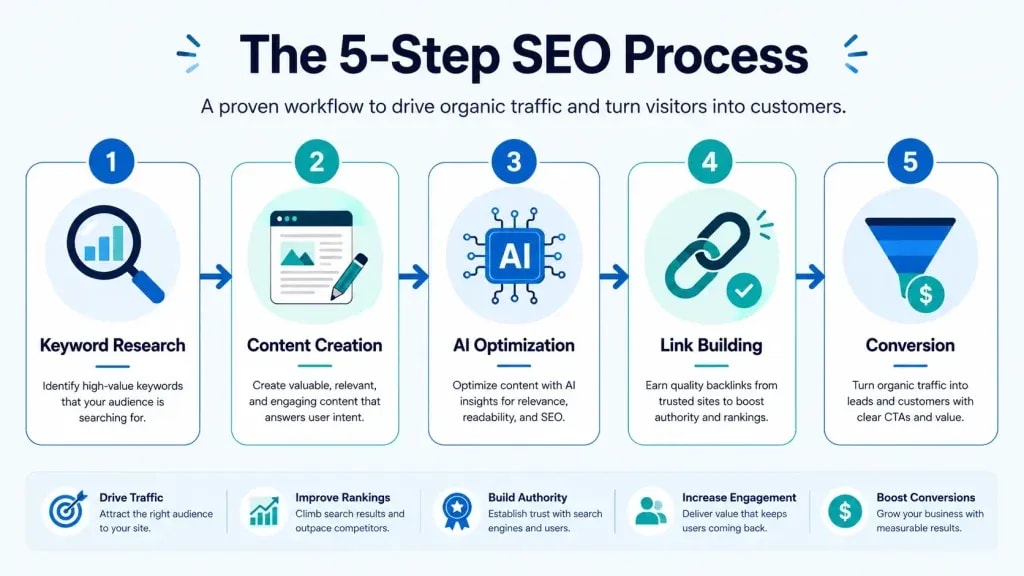
SEO for affiliate marketing 2026 still comes down to quality content, proper technical SEO, and real authority building. But how you execute those has shifted. AI Overviews need extraction-ready structuring. Google's June 2026 guidelines need firsthand experience. Multi-country targeting needs localized keyword strategies. The sites that adapt will outrank the ones still using tactics from 2020.
The ten strategies here work as a system, not a checklist you pick from. Use all of them and your affiliate content will rank higher, get cited by AI, and convert more visitors into commissions. Start with strategy one and build from there.
Frequently Asked Questions
What is the difference between affiliate SEO and regular SEO?
Affiliate SEO targets commercial intent keywords where users compare products before buying. Regular SEO covers any search intent. Affiliate SEO also requires specific link optimization and content formats that drive conversions, not just traffic.
How long does it take for affiliate SEO to work?
For low-competition keywords, rankings appear in 2-8 weeks. For medium-competition terms, expect 3-9 months. New affiliate sites on new domains may wait 3 months for Google's initial indexing and trust assessment
Can AI-generated affiliate content rank on Google?
Yes, if it meets Google's quality standards, includes firsthand experience, and provides unique value. Google permits AI-assisted content in their June 2026 AI Optimization Guide, as long as it is people-first and not created for search engines alone.
Do affiliate links hurt SEO?
Not when implemented correctly. Use the sponsored rel attribute on affiliate links instead of nofollow. Google's 2025 update made sponsored a hint for link equity, meaning your affiliate links can pass ranking value while remaining compliant
Should I use nofollow or sponsored for affiliate links?
Use rel="sponsored" for all affiliate and paid links. This is Google's official recommendation since 2023. It signals the commercial relationship and allows Google to treat the link as a hint for ranking purposes.
Why does my affiliate content get clicks but no conversions?
This happened to me on anobee.com. My affiliate article ranked well and drove traffic, but visitors clicked and left without buying. The fix is matching search intent to content. Informational visitors need nurturing before buying. Add comparison tables, trust signals, and clear next steps.
Sources and References

Written by
Bibek Thapa
AI-Powered Digital Growth Strategist
Bibek Thapa works across AI workflows, SEO, AI search optimization, content strategy, website growth, and productivity systems. Anobee documents practical lessons, tools, experiments, and systems for improving digital presence.
- AI workflows
- Digital growth
- SEO
- GEO
- AEO
- Content strategy
- Website growth