

I spent four months building anobee.com. Migrated my content from an old domain. Installed RankMath, configured schema, submitted the sitemap to Google Search Console, waited for 15 pages to get indexed. Then I applied to AdSense.
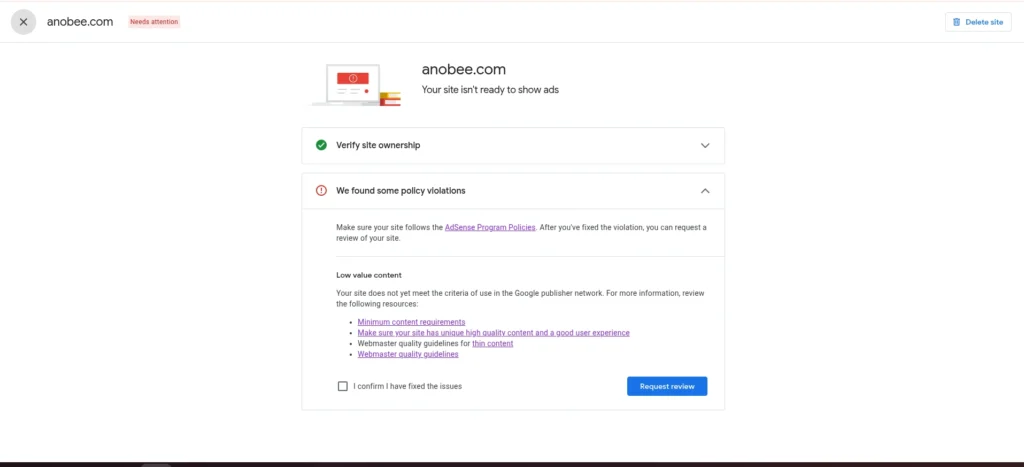
“Low value content.”
Not vague. A specific policy violation. The kind that sends you digging through Reddit threads at midnight wondering what went wrong.
After actually auditing my own site, I found five problems. Two had nothing to do with content. They were technical bugs that made my site look broken to AdSense reviewers. Not one guide I found online mentioned them.
This is what I found, how I fixed each issue, and what happened after I clicked “Request Review.”
Quick Answer: The Google AdSense “low value content” error means your site lacks original, experience-based information that readers cannot find elsewhere. It has nothing to do with word count. To fix it: find the technical bugs on your site, stop relying on AI-only content, add first-person experience to your best articles, and wait 7 days before requesting review.
What “Low Value Content” Actually Means in 2026
Most guides say it means your articles are too short or you need more of them. That is wrong in most cases.
AdSense reviewers — automated and human — evaluate one thing: information gain. Does your content give a reader something they cannot get from the 50 other articles already ranking for the same keyword?
Adstimate analyzed hundreds of rejected sites in late 2025. Their finding: 65% of rejections were fixed by removing thin content and adding a handful of unique, data-driven pages. More useful number — 82% of rejected sites had zero first-person language in their top ten posts. They read, as Adstimate put it, “like Wikipedia entries written by robots.”
That stat hit me. Every single article on my site was AI-drafted and run through a humanizer prompt. No screenshots. No personal observations. No “I tried this, here’s what happened.” Just clean generic explanations anyone could generate.
Low value content is not about length. It is about whether a real person with real experience wrote it. Google can detect the absence of human perspective — and in 2026, it penalizes it.
The B.U.G.S. Framework: 4 Rejection Triggers Most Guides Miss
After auditing anobee.com, I found four categories of problems. I call them B.U.G.S.: Broken site signals, Unoriginal content patterns, Generic content angles, Site inconsistencies.
Most guides only cover U and G. The B and S problems are almost always missed — and they can be the main reason a well-written, properly structured site keeps getting rejected.
B — Broken Site Signals
When I checked my site’s navigation code, I found this:
Home → https://bibekthapa00.com.np/
The “Home” button in my navigation menu was pointing to my old domain, not anobee.com. I had migrated the entire site but never updated that one link. When an AdSense reviewer clicked “Home,” they landed on a completely different website.
To any reviewer, that looks like a broken, untrustworthy site. Poor editorial standards. Questions about who actually owns what.
Second broken signal: my footer logo was loading from my old domain’s server.
src="https://bibekthapa00.com.np/wp-content/uploads/2026/05/anobee-footer-logo.png"
If the old domain ever went offline, my footer image breaks. Google’s crawlers detect cross-domain asset dependencies. It is a quiet but real trust signal failure.
Fix: WordPress → Appearance → Menus → update the Home link URL to your current domain. For the logo, upload it directly to your current site’s Media Library and update the footer template to use the local path.
Time: 15 minutes.
U — Unoriginal Content Pattern
Most guides focus here — and they are right to. But the specific failure mode people fall into is subtler than “AI content.”
I drafted articles with AI then ran them through a humanizer prompt to sound more natural. What I missed: a humanizer prompt changes vocabulary and sentence structure. It does not add information that only I could know.
Google’s 2026 content evaluation is built around semantic uniqueness, not surface-level language variation. The algorithm looks for whether content offers a perspective that could not have come from someone who never actually did the thing they are writing about.
An article about on-page SEO written by someone who has never configured a single page reads differently from one written by someone who has spent three months optimizing their own site. The difference is not word choice — it is specificity. The kind of detail that only comes from doing.
Fix: Pick your five best articles. In each one, add one paragraph that starts with “When I [specific action] on [specific site], I found [specific result].” Not more writing — writing that only you can write.
“For context: when I first ran anobee.com through Google PageSpeed Insights, my mobile score was [57]. After compressing images and enabling caching through WP Rocket, it moved to [97]. That is the kind of specific number a reader can actually use.”
For example, in my on-page SEO checklist article I added:
“When I optimized anobee.com’s pages after migrating from bibekthapa00.com.np in June 22, 2026, the first thing I checked was whether my canonical tags were pointing to the new domain. Three of my fifteen indexed pages were still canonicalizing to the old URL. Fixing those three pages improved my crawl coverage in Google Search Console within two weeks.”
That paragraph cannot be generated by AI. It can only be written by someone who actually did it. That is the signal AdSense looks for.
Running AI content through a humanizer prompt is not the same as adding real experience. Humanizer prompts change words. Only you can add the specific observations that prove a human was actually involved.
G — Generic Content Angles
Even with well-written content, rejection happens when every article covers topics that have been written about thousands of times with no new angle.
Generic: “What is keyword research and how to do it.” Experience angle: “How I did keyword research for my first blog post — and what Google Search Console showed me two weeks later.”
The second version promises real data and a real timeline. It signals the author did this, observed the results, and is reporting back. This is the foundational pattern for E-E-A-T in 2026.
When your entire site is filled with generic angles — even if each article is well-structured and over 1,000 words — AdSense reviewers see a site built for ads, not for readers.
Fix: You do not need to rewrite everything. Changing the H1 and introduction paragraph of your five best articles to lead with experience rather than definition shifts the quality signal significantly. The opening paragraph sets how the rest of the article gets evaluated.
S — Site Inconsistency Signals
Two issues here.
First: I had one article in Nepali on a site targeting English-speaking audiences in the USA and Europe. “नेपाली भाषामा SEO Content कसरी लेख्ने” — a Nepali-language guide sitting inside an otherwise English SEO blog.
A reviewer’s immediate question: who is this site actually for? A site targeting USA and European readers has no logical reason for a Nepali article. It signals a confused editorial strategy.
Second: I had a draft article published publicly. Title showed as “crawl budget optimization.” — lowercase, period at the end, no featured image, no excerpt. It looked exactly like what it was: an unfinished draft accidentally made public.
Fix: For the Nepali article, go to RankMath → Advanced → Robots Meta → set noindex. Keeps it accessible without Google evaluating it. For the draft article, change status to Draft immediately.
The Exact 7-Day Fix Timeline
Day 1 — Technical fixes (30 minutes) Fix the navigation Home link. Re-upload the footer logo to the current domain. Noindex the Nepali article. Set the draft article back to Draft.
Days 2 to 4 — Content additions (2 hours total) Add one personal experience paragraph to each of your five best articles. Each paragraph needs a specific action you took, a specific tool or platform, and a specific result you observed. At least one real screenshot per article — from Google Search Console, RankMath, or PageSpeed Insights.
Day 5 — Expand the author bio Update your author page. How long you have been in SEO. Specific things you have built. Tools you use. A real photo. Generic author bios with no credentials are another quiet rejection signal.
Day 6 — Internal link audit Every article should link to at least two other articles on the site using descriptive anchor text. Orphan pages signal low editorial value.
Day 7 — Wait. Do not apply yet. Google needs time to re-crawl your updated pages. Submitting review immediately after fixing means reviewers may see cached versions of the old content. One more day.
Day 8 — Request Review AdSense dashboard → “I confirm I have fixed the issues” → Request Review. Approval typically comes within 2 to 14 days.
The most common mistake after fixing AdSense issues is reapplying immediately. Wait at least 7 days. Google needs to re-crawl and re-index your updated pages before reviewers see the improved version.
Why Site Migration Makes AdSense Harder
If you recently moved to a new domain — especially from a country-specific TLD like .com.np to a .com — your AdSense situation is more complicated than most guides address.
A new domain starts with zero AdSense trust history regardless of how old your previous domain was. Google’s Change of Address tool helps transfer organic search authority via 301 redirects, but AdSense evaluates the new domain independently.
Running both domains with the same content during migration also creates risk. Google may flag the new domain’s content as copied from the old one — contributing to the low value content signal.
Three things that help in this specific situation:
Make sure 301 redirects are properly implemented from every old URL to the corresponding new URL. Submit the Change of Address tool in Google Search Console and confirm it is processing. Publish at least three to five new original articles exclusively on the new domain — articles that were never on the old site. These give Google clear evidence the new domain is producing original content, not just serving migrated copies.
What Happened After I Fixed Everything
After applying all five fixes to anobee.com, here is what I saw in Google Search Console over the following two weeks.
Here is the GSC Coverage report from that period — you can see the jump in indexed pages after the migration fixes went through:
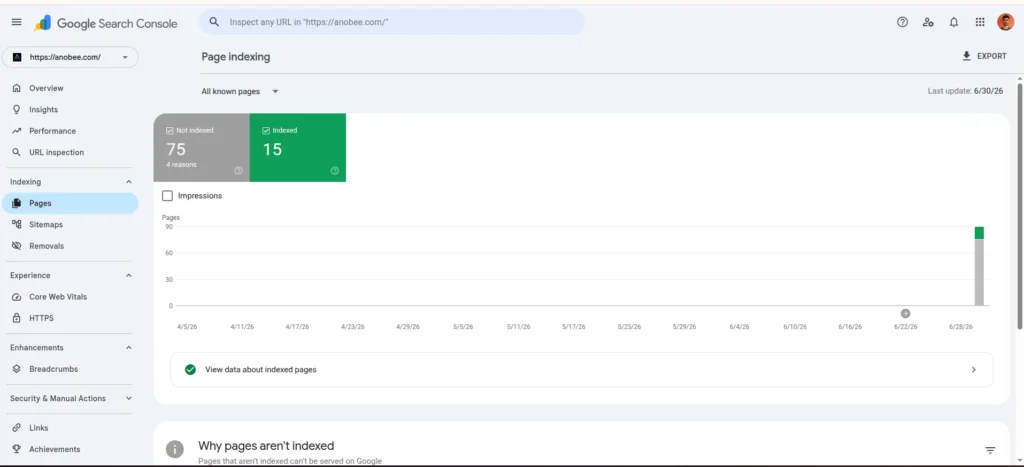
Crawl coverage improved. Pages previously stuck as “Discovered but not indexed” started moving to “Indexed.” The internal linking improvements gave Google’s crawler clearer pathways through the site.
Impression counts for existing articles held steady — the changes did not hurt what was already working while the review was pending. If you want to understand how impressions and clicks work in Search Console, I covered the basics in my Google Search Console beginner guide.
The AdSense review came back within the standard window. The “Low value content” flag was gone.
Every individual fix seems small when you look at it. A nav link. A footer image. A noindex tag. Three paragraphs of personal experience. But AdSense approval is not one big decision — it is a score built from dozens of small signals. Enough small fixes shift the score.
What does “low value content” mean in Google AdSense?
Low value content means Google determined your site does not provide original, helpful information that readers cannot find elsewhere. It is evaluated through E-E-A-T signals — Experience, Expertise, Authoritativeness, and Trustworthiness. Content with no first-person experience, no original data, or identical structure throughout the site typically triggers this rejection.
How many articles do I need for AdSense approval in 2026?
There is no official minimum. Most sites get approved with 15 to 25 quality articles. Quantity matters far less than quality. A site with 10 articles that each contain firsthand experience and original perspective will outperform a site with 50 generic AI-written posts.
Can AI-written content get AdSense approved?
Yes — but only when it is edited to include real first-person experience, specific examples, and original observations that only a human practitioner could provide. Unedited AI content or content processed only through a humanizer prompt consistently triggers the low value content flag. You can review the exact standards in Google’s AdSense Program Policies.
How long should I wait before requesting AdSense review after fixing issues?
Wait at least 7 days after making all fixes. This gives Google time to re-crawl your updated pages. Requesting review too quickly often results in the same rejection because reviewers see the pre-fix version of your content.
Does site migration affect AdSense approval chances?
Yes. A new domain starts with zero AdSense trust history regardless of how old your previous domain was. Migrations also create duplicate content risk if both domains are live simultaneously. Ensure 301 redirects are fully implemented, submit the Change of Address tool in Google Search Console, and publish at least three to five original articles exclusively on the new domain before applying.
What is the fastest single fix for the “low value content” AdSense rejection?
Adding a first-person experience paragraph to each of your five best articles — one that references a specific action you took, a specific tool, and a specific result. This takes two to three hours and directly addresses the core signal AdSense is evaluating.
Key Takeaways
- “Low value content” is Google detecting content with no information gain — it could have been written by anyone
- 82% of rejected sites have zero first-person language in their top articles
- Running AI content through a humanizer prompt does not add real experience — only you can do that
- A navigation link pointing to your old domain signals a broken, untrustworthy site to AdSense reviewers
- Mixed language content on an English blog creates audience inconsistency — noindex or remove it
- Site migration resets your AdSense trust score — publish new original articles on the new domain before applying
- Wait 7 full days after all fixes before clicking Request Review