SEO & AI Search
AI-Powered Digital Growth: A Practical GEO Framework for Bloggers
By Bibek Thapa · Updated · 13 min read
Quick Answer
The Anobee GEO framework is a five-part workflow for improving an existing article: answer the reader's question, connect relevant topics, strengthen evidence, check technical access and share useful work responsibly. Measure AI citations separately from visits and conversions. The framework is an editorial method, not a proven formula for getting cited.

Table of ContentsOn this page
- What AI-powered digital growth means for a blog
- Before applying the GEO framework, choose a page and a goal
- Apply the five-part Anobee GEO framework
- Worked example: refresh a blogging-platform guide
- Measure the GEO framework without confusing visibility with growth
- Run a small four-week pilot
- Frequently Asked Questions
- Sources and References
Key Takeaways
- Start with one existing article and one reader task instead of rewriting your entire archive.
- Google's AI search features use SEO fundamentals; special AI files and citation-oriented schema are not required.
- Evidence should show what happened, when and under which conditions. A single citation cannot establish cause.
- Track linked citations, search visibility, website visits and conversions as separate outcomes.
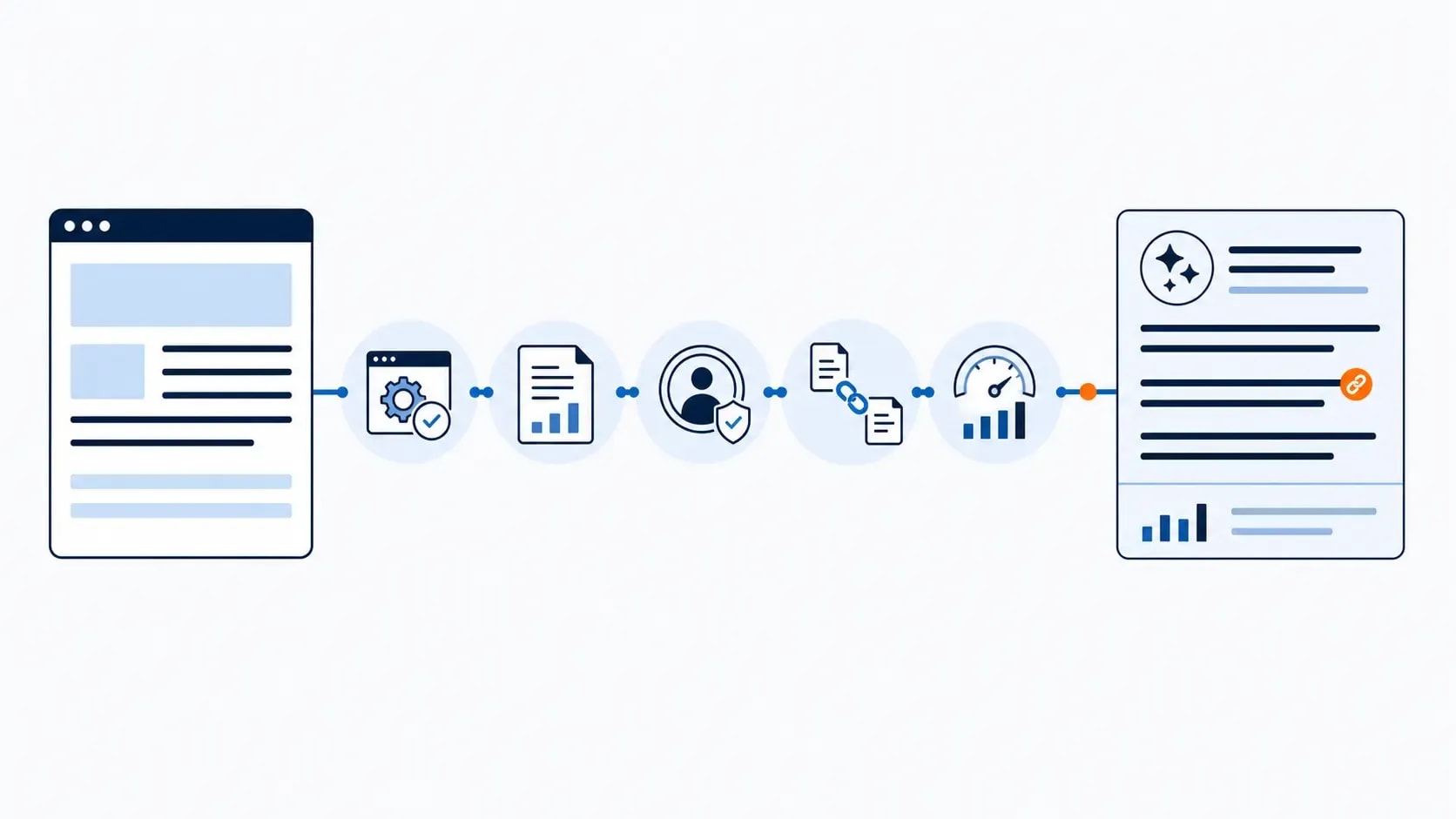
The Anobee GEO framework is a five-part workflow for improving an existing blog article for readers, organic search and AI-supported discovery. Clarify the answer, connect relevant topics, strengthen the evidence, check technical access and share useful work responsibly. Measure the results separately from the work you put in.
Start with one page that has a clear job. Rewriting an entire archive at once makes it harder to maintain quality or understand which changes helped.
This guide walks through that one-page workflow. The framework is Anobee's editorial method, not a tested ranking formula or a guarantee of AI citations.
What AI-powered digital growth means for a blog
AI-powered digital growth means using AI-assisted work, useful articles and a well-maintained website to attract the right readers and help them take a worthwhile next step. Search visibility is part of that system. So are editing, analytics, email subscriptions and the page a visitor reaches.
An AI tool might help organize research or identify an unclear passage. You still need to open the sources, check the claims and decide whether the article solves the reader's problem.
Three terms describe overlapping parts of this work:
| Term | Main job | What to inspect |
|---|---|---|
| SEO: search engine optimization | Help relevant pages be discovered and compete in organic search | Index eligibility, queries, clicks and landing pages |
| AEO: answer engine optimization | Make a question's answer clear and usable | Accuracy, scope and whether the answer stands on its own |
| GEO: generative engine optimization | Improve information that may be used or cited in generated answers | Linked sources, correct attribution and useful audience exposure |
Google treats optimization for its generative AI search experiences as SEO. Its current guidance rejects the need for special AI files, tiny content chunks or a separate writing style just for AI systems [1].
That statement concerns Google Search. ChatGPT Search, Perplexity and Gemini Apps should not be assumed to have identical retrieval systems or publisher controls. Record results from each product separately.
If you want the broader definitions and strategy, read Anobee's generative engine optimization guide. This article focuses on applying the workflow to a page you already own.
Before applying the GEO framework, choose a page and a goal
Choose an article that answers a real question and gives the reader somewhere useful to go next. Search impressions can help you choose. They do not, by themselves, justify rewriting a page that is already accurate and useful.
Write a short brief before editing:
- Reader: who needs this page, and what do they already know?
- Task: what should they be able to do after reading?
- Primary query: which question best expresses that task?
- Scope: which location, product version or constraint changes the answer?
- Next action: read a related guide, use a worksheet, subscribe or evaluate a relevant offer.
For example, an analytics setup guide should help a reader confirm that measurement works. An introduction about the importance of data cannot do that job.
Save the current title, introduction, important sections and available performance data. Record the date and reporting filters. A Search Console export filtered to a different article is not evidence about the page you are refreshing.
Check eligibility before working on wording. For Google AI Overviews and AI Mode, a supporting page must be indexed and eligible to appear with a snippet. Meeting those requirements does not guarantee inclusion [2].
Confirm the page loads, the intended content is visible, crawling is allowed and no accidental noindex applies. Inspect the canonical URL and use Search Console URL Inspection when you need Google's selected canonical or indexing verdict. Neither a sitemap entry nor a brand search establishes those facts.
Apply the five-part Anobee GEO framework
Give each part only the attention the page needs. Strong evidence may already be there, buried under an unclear introduction. If readers and crawlers cannot reach the page, fix access before polishing the opening.
1. Answer the reader's question before adding background
Read the opening paragraph without the rest of the page. Does it answer the main question, state an important limitation and make sense to someone who has never heard of your site?
Replace scene-setting with the information the reader came for. There is no mandatory opening word count. A simple definition may need two sentences; a high-risk decision may need a qualification before a recommendation.
An illustrative rewrite:
Before: “In the changing world of blogging, choosing a platform is an important decision for every creator.” After: “Choose a blogging platform by the control, maintenance and monetization options you need. Check payment availability in your country before paying for a plan.”
The revised opening gives the reader a decision rule and a constraint that could change the choice. The comparison and evidence still belong underneath it.
Keep headings descriptive. A heading such as “Check payment availability” is useful even though it is not a question. Avoid forcing every heading into a question or repeating the same keyword across the outline.
On a commercial page, a direct answer can explain who an option suits and who should skip it. Leave the supporting tradeoffs easy to inspect; do not withhold essential information to force a click.
2. Connect the article to the right topics and entities
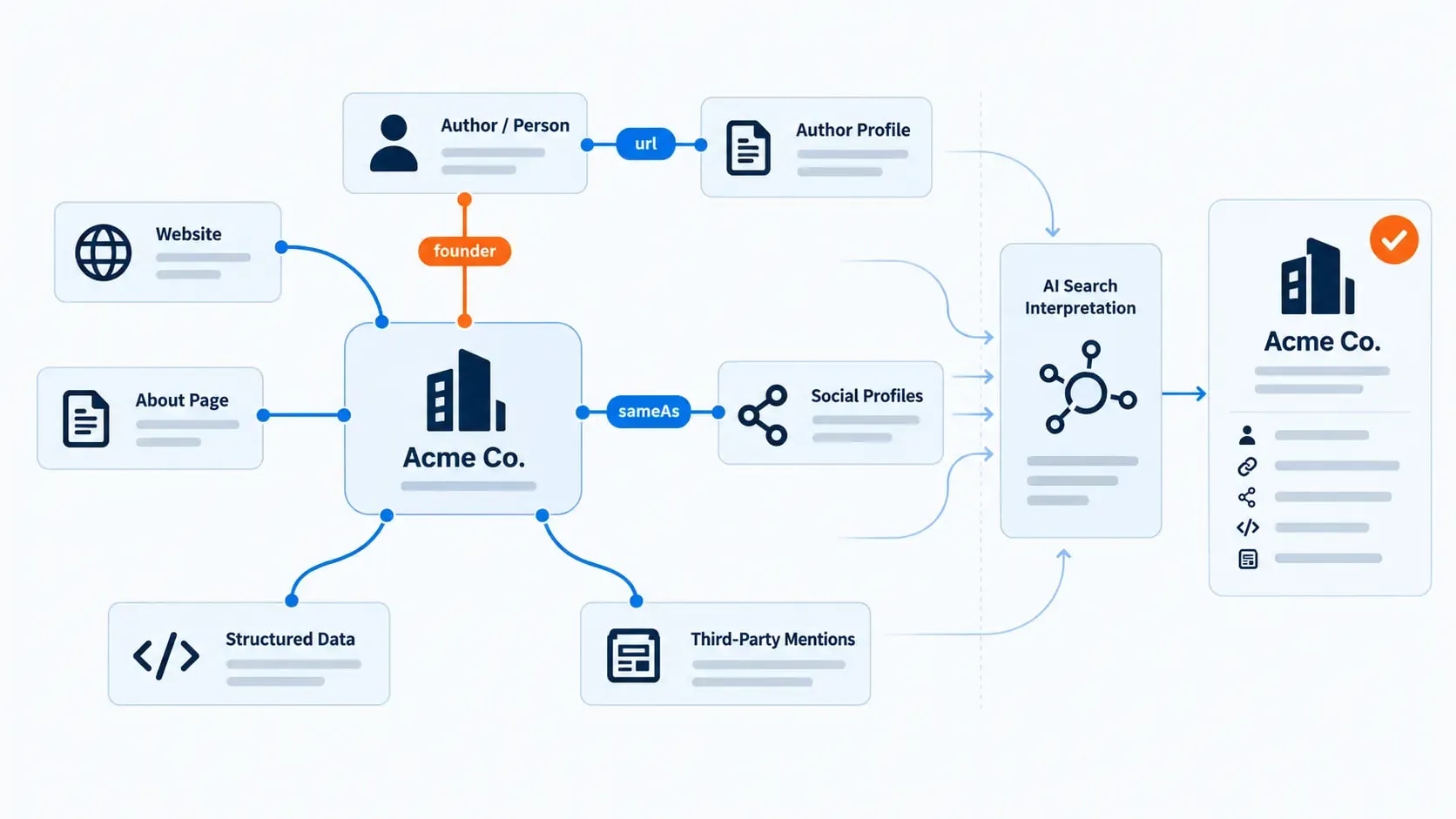
An entity is an identifiable person, organization, product or concept. Name it precisely, explain its role and use the same identity across the page, byline and supporting pages.
For a tool guide, distinguish the product from its provider. For a publication, make the author and publisher clear. Do not invent credentials, partnerships or a team to make the site appear more established.
Build supporting pages around different tasks. An analytics topic cluster might need a setup guide, a tag-manager guide and troubleshooting instructions. Repeating the setup article under slightly different keywords gives readers little extra help.
Google recommends descriptive, relevant link text and contextual internal links. It also says there is no ideal number of links for a page [3].
Link where the next question changes. A reader checking brand identity may need the entity optimization guide; a reader documenting outcomes needs the citation-checking workflow. Do not link every occurrence of a term.
The purpose is a navigable set of useful resources. There is no fixed cluster size that makes a site authoritative.
3. Strengthen claims with evidence the reader can inspect
For each important claim, ask what supports it. An official feature description, a published measurement and a personal observation are different kinds of evidence. Keep that distinction visible.
Google's people-first content guidance asks whether articles provide original information, clear sourcing and evidence of relevant knowledge or experience. It does not prescribe a minimum word count [4].
Original material can be small. A dated configuration example, a reproducible calculation or a documented error can explain something readers otherwise have to work out alone. Show enough detail for them to inspect it.
Use this evidence worksheet while editing:
| Claim type | Evidence to keep | Limit to state |
|---|---|---|
| Product feature or price | Current official documentation and verification date | Plan, country, currency or version when relevant |
| First-hand test | Task, environment, date, procedure and saved output | What was and was not tested |
| Search or analytics movement | Exact URL, date window and reporting filters | Other changes and attribution uncertainty |
| AI citation | Exact prompt, platform, mode, date, linked URL and saved answer | One answer is not a repeatable rate or proof of cause |
| Worked example | Explicit hypothetical label and checkable reasoning | Not a client result or observed performance |
If you cannot substantiate a number, remove it. A clear explanation with an honest limitation is more useful than a precise-looking claim nobody can verify.
Use this part of the GEO framework when revisiting older articles, too. Preserve genuine observations with their original dates and separate them from broader conclusions. A citation appearing after a schema change does not show that schema caused it.
4. Check technical access and machine-readable details
Technical checks should establish that the right page and information are available. They cannot make an unsupported claim trustworthy.
Review the final HTTP status, canonical, robots directives, important internal links and visible main content. Check mobile readability and whether a firewall or login blocks the intended audience or crawler.
For structured data, inspect the actual output rather than assuming the CMS generated it correctly. Google supports Article, NewsArticle and BlogPosting, with relevant properties such as headline, author, images and publication or modification dates [5].
Preserve the original publication date. A substantial refresh can justify a real modification date, but a date change alone is not an update. Make the visible information and generated markup agree.
Do not treat FAQ markup as a citation tactic. Google removed documentation for its FAQ rich-result feature on June 15, 2026 because that feature was no longer shown in Search [6]. Keep genuinely useful questions for readers, without promising a special search display.
Crawler controls also need product-specific interpretation. Google states that Google-Extended controls certain Gemini training and grounding uses; it does not affect inclusion or ranking in Google Search [7]. Do not disable a training control or allow a crawler solely because a generic checklist tells you to.
When using another platform, check its current publisher documentation and your CDN rules. A crawler request in a server log shows access activity, not that the page was indexed, used for training or cited.
5. Share useful work and earn real corroboration
Make the article worth referring to before asking others to refer to it. A reusable worksheet, documented method or specific correction gives someone a reason to share the page.
Contribute to communities where you can answer the actual question. Follow the rules, disclose your connection to the source and link only when the destination adds something the discussion needs. Sometimes the useful response has no link.
Google's AI optimization guide specifically warns against seeking inauthentic mentions across the web [1]. Repeating your brand name through manufactured discussions is not a credible substitute for independent evidence.
Avoid calling this “citation seeding” if that encourages posting for the sake of a mention. The goal is legitimate distribution and corroboration. You cannot control whether an AI service later retrieves a discussion or selects your article.
Worked example: refresh a blogging-platform guide
Suppose you publish a guide helping bloggers choose a platform in their country. This is a hypothetical editing exercise, not an Anobee performance case study.
First, define the page's job: help a reader compare ownership, cost, maintenance and payment constraints. Preserve the existing URL if it still serves that job.
Then apply the framework to the parts that need attention:
| Page issue | Useful change | What would verify the change? |
|---|---|---|
| Opening gives generic blogging advice | Lead with a platform-selection rule and the main constraint | The first paragraph answers the page's core question |
| Comparison says one platform is “best” for everyone | Compare platforms by reader needs and limitations | Each recommendation has a clear use case |
| Price or payment claim has no support | Check the official provider page and cite the applicable terms | Source supports the exact plan and country claim |
| Guide repeats a WordPress setup tutorial | Link to a separate setup guide instead | The selection page stays focused on choosing |
| Result is described as “proven growth” | Replace it with a dated, scoped observation or remove it | Saved evidence matches the claim |
| No useful next step | Offer a decision worksheet or a relevant setup guide | Reader can act without buying an unrelated tool |
AI can assist with this audit. For example, ask it to flag unsupported comparisons, identify repeated sections or turn your verified criteria into a draft table. Do not let it fill missing payment terms, product features or test results from memory.
The finished article should be useful even if no assistant cites it. That is the standard for this GEO framework: better decisions for readers, with discovery and business outcomes measured afterwards.
Measure the GEO framework without confusing visibility with growth
Record outcomes separately. A brand mention, a linked citation, a website visit and a conversion are not interchangeable.
| Outcome | What counts | What it does not establish |
|---|---|---|
| Mention | The answer names your publication or brand | That your page was used as a source |
| Citation | A visible source link points to your page | A website visit or endorsement |
| Referral | A person reaches your site from a trackable source | That every AI-influenced visit is attributed |
| Conversion | A reader completes your defined useful action | That a citation caused the action |

Build a fixed prompt list from the questions your audience asks. Keep branded identity checks separate from non-branded discovery questions. Asking an assistant about your brand tests a different task from asking it for relevant resources without naming you.
For each observation, save the exact prompt, platform and mode, country, language, date, linked source and supported claim. Keep zero-citation results. Open the links rather than counting cards by their domain labels.
For one platform and one fixed prompt set, you can use this reporting convention:
Observed citation rate = prompts with at least one link to your domain ÷ total prompts tested × 100.
Report the numerator and denominator beside the percentage. Ten prompts are a small editorial test, not a representative sample of every question people ask. Repeated results are more informative than a single positive answer, but changing prompts or account conditions weakens comparisons.
Anobee's guide to checking AI citations explains the logging procedure and how to distinguish source links from other related links.
As of September 17, 2026, Google's Search Console documentation describes a Generative AI performance report for impressions from AI Overviews and AI Mode. It supports page, country, date and device views. Google notes that a report may be absent when there are insufficient impressions [8].
Use those impressions as visibility evidence, not as a substitute for clicks or sales. Continue reviewing ordinary Search performance and website analytics. Check source definitions before comparing reports, because the AI report's data also belongs to the Web search data [8].
If an article earns more citations but fewer visits, inspect what happens next. Readers may be getting their answer without clicking. Or the people who do visit may be more likely to take a useful next action. Landing-page and conversion data help you distinguish those possibilities.
Run a small four-week pilot
This is a work schedule you can adapt, not a forecast for citation results.
| Period | Main task | Deliverable |
|---|---|---|
| Week 1 | Choose the page, check eligibility and save a baseline | One-page brief, reporting filters and fixed prompt list |
| Week 2 | Improve the answer, evidence and relevant links | A reviewed article with traceable claims |
| Week 3 | Validate the published page and share selectively | Correct rendered content, metadata and a distribution record |
| Week 4 | Repeat observations and review audience outcomes | Comparable evidence and a short next-action list |
Keep an execution log with the date, URL and substantive changes. If you also change the title, navigation and offer, record those changes. Otherwise a later traffic movement is easy to attribute to the wrong intervention.
Choose the next action from the evidence. Fix an indexing issue before publishing more articles. Correct a misleading claim before chasing more mentions. If the page serves readers well but has little discovery, investigate relevant supporting links and legitimate distribution rather than expanding it automatically.
Start with one article you can maintain. Keep the GEO framework only as complex as the decisions require.
Frequently Asked Questions
How long does a GEO framework take to produce results?
There is no reliable universal timeline for AI citations. Complete a small pilot, confirm that changes are crawlable, then repeat the same observations over comparable periods. A four-week work plan schedules your tasks; it does not promise citations or traffic within four weeks.
Do you need paid GEO tools to begin?
No. A spreadsheet, Search Console, website analytics and manual source checks are enough for a small pilot. Consider paid monitoring when the number of prompts or platforms makes consistent manual checks impractical. A tool's visibility score does not prove rankings, citations or revenue.
Should you rewrite every old article for AI search?
No. Refresh pages with a clear reader need, factual gaps or useful existing search history. Keep accurate sections and stable URLs. Do not change a publication date or add an AI-focused introduction to a page that already serves its audience well.
Sources and References
- Google Search Central — Optimizing your website for generative AI features on Google Search ↩
- Google Search Central — AI features and your website ↩
- Google Search Central — Link best practices for Google ↩
- Google Search Central — Creating helpful, reliable, people-first content ↩
- Google Search Central — Article structured data ↩
- Google Search Central — Documentation updates: June 15, 2026 ↩
- Google Crawling Infrastructure — Google-Extended ↩
- Google Search Console Help — Generative AI performance report (Search) ↩
Was this guide helpful?
Your answer helps Anobee improve future updates.

Written by
Bibek Thapa
AI-Powered Digital Growth Strategist
Bibek Thapa works across AI workflows, SEO, AI search optimization, content strategy, website growth, and productivity systems. Anobee documents practical lessons, tools, experiments, and systems for improving digital presence.
- AI workflows
- Digital growth
- SEO
- GEO
- AEO
- Content strategy
- Website growth