
SEO & AI Search
Keyword Research in Nepal: How to Find Keywords That Drive Traffic and Leads
A practical Nepal-focused keyword research guide covering search intent, local demand, language variants, SERP validation, clustering and keyword-to-page mapping.
By Bibek Thapa · Published · 22 min read

Quick Answer
Start keyword research in Nepal with real customer language. Expand ideas in Google Keyword Planner with Nepal selected, then validate them using Search Console, Google Trends, autocomplete and live SERPs. Test English, Romanized Nepali and Devanagari, and group close variants by search intent so each URL has one clear purpose.
Table of ContentsOn this page
- What Is Keyword Research in Nepal?
- Why Keyword Research for Nepal Needs More Than Search Volume
- The Nepal Keyword Research Workflow
- How to Map Keywords to the Right Page
- Keyword Research for Nepal Businesses vs. Nepali Blogs
- Which Keyword Research Tools Work for Nepal?
- What to Do When a Nepal Keyword Shows Zero Volume
- How to Find Local SEO Keywords in Nepal
- A Practical Keyword Mapping Example
- Build a Keyword Sheet You Can Actually Use
- Common Keyword Research Mistakes in Nepal
- How to Measure Whether the Keyword Strategy Is Working
- A Better Way to Think About Keyword Research in 2026
- Keyword Research in Nepal Checklist
- Final Takeaway
- Sources and References
Key Takeaways
- Use search volume as one signal, not the final decision; intent, SERP fit and business value matter more.
- Set Nepal as the target location in Keyword Planner and use Search Console as first-party evidence when the site already has impressions.
- Test English, Romanized Nepali and Devanagari where each form is plausible instead of assuming one language pattern fits every audience.
- Cluster keyword variations by search job and create separate URLs only when intent, audience or required page type genuinely changes.
- Keep this page broad for Nepal businesses, websites, services, ecommerce and SEO, while protecting the existing Nepali Blog keyword research article.
A keyword tool can give you ideas. It cannot decide what your Nepal-focused website should publish.
For that, you need to connect four things: the words people use, the intent behind them, the page Google already rewards, and the value of that visit to your business. This matters because specific Nepal queries can look tiny or disappear from keyword tools altogether. Google notes that very low-volume terms may not be discoverable or forecastable in Keyword Planner [1].
So when a useful query shows “0” or almost no volume, the sensible response is not to publish blindly or throw it away. It is to check more evidence.
This guide shows how to do that for Nepal businesses, websites, agencies, creators, and SEO teams.
What Is Keyword Research in Nepal?
Keyword research in Nepal is the process of discovering, validating, grouping, and prioritizing the searches people use when looking for information, products, services, or local businesses relevant to the Nepali market.
The useful output is not a spreadsheet with hundreds of phrases. It is a clear page plan.
For every useful keyword cluster, you want to know:
- What is the searcher trying to accomplish?
- Is the intent informational, commercial, transactional, local, or navigational?
- Does the query need a blog post, service page, category page, comparison, tool, or local landing page?
- Is the demand specific to Nepal, a city such as Kathmandu or Pokhara, or a broader international audience?
- Which language form does the audience actually use: English, Romanized Nepali, Devanagari, or a mix?
- Does an existing page already satisfy the same intent?
- What evidence would make your page more useful than what currently ranks?
A strong keyword plan connects search behavior to website architecture. That is the difference between collecting keywords and building an SEO system.
Why Keyword Research for Nepal Needs More Than Search Volume
Search volume is useful, but it is not a verdict.
Google Keyword Planner can narrow keyword ideas by country, region, city, language, and network [2]. Google also states that keywords with very low search volumes may not be discoverable or forecastable [1]. That is especially important when you are researching specific local or long-tail queries.
In practice, that means a keyword can be commercially useful even when a tool shows little data. Consider the difference between these two hypothetical searches:
accounting softwareaccounting software for small business in Nepal
The first may have more visible demand, but it is broad and could attract searchers from anywhere. The second is narrower, but the user has already added a market and business context. If you sell accounting software in Nepal, that specificity may be more valuable than raw volume.
The same logic applies to local services:
dentistemergency dentist in Lalitpur
Or ecommerce:
office chairergonomic office chair price in Nepal
Those examples are not claims about actual monthly volume. They illustrate the decision you are making: intent and business fit can matter more than the biggest number in the sheet.
Use volume as a signal, not a filter that decides everything
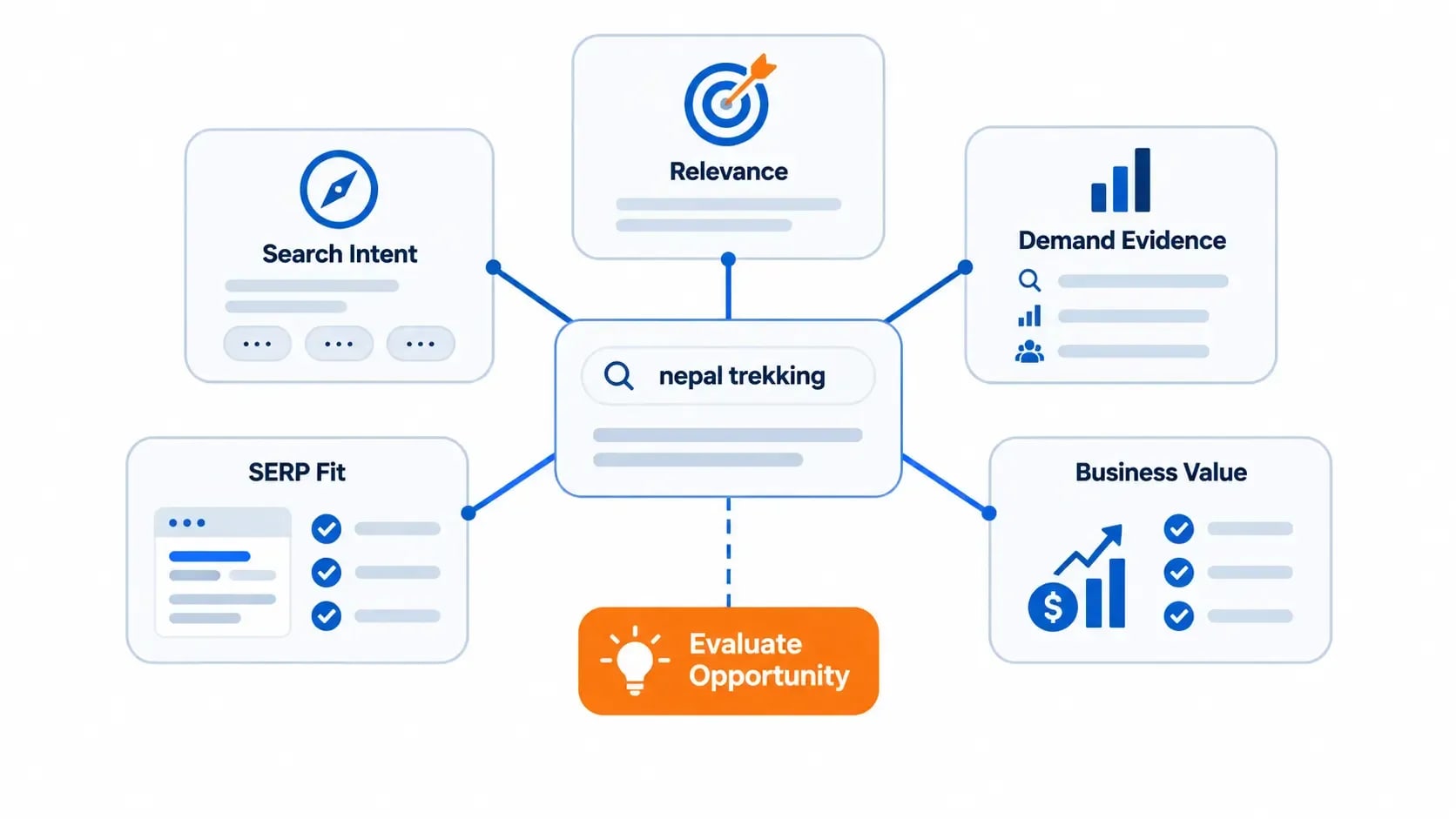
A useful decision combines at least five signals:
| Signal | What it tells you | Why it matters |
|---|---|---|
| Relevance | Does the query match what you offer or can genuinely answer? | Irrelevant traffic rarely helps the business. |
| Search intent | What type of result does the searcher expect? | The wrong page type can fail even with good content. |
| Demand evidence | Do Keyword Planner, Search Console, Trends, autocomplete, or the SERP show activity? | One tool can miss low-volume or emerging variants. |
| Competition / SERP fit | What already ranks, and can you create a meaningfully better result? | Difficulty scores alone do not show page-one reality. |
| Business value | Could the visit lead to a lead, sale, signup, or useful next step? | Traffic is a means, not the final KPI. |
The Nepal Keyword Research Workflow
You can use the following process for a local business, service company, ecommerce store, publisher, SaaS product, agency, or personal brand.

Step 1: Start with the business, not the tool
Before opening Ahrefs, Semrush, Keyword Planner, or any other platform, list what the website actually needs to be found for.
Create seed categories from:
- products and services;
- customer problems;
- common sales questions;
- locations served;
- industries served;
- use cases;
- comparisons customers make;
- pricing or cost questions;
- support questions;
- topics you have real experience explaining.
For an SEO agency in Nepal, the seed list might include:
- SEO services
- technical SEO
- local SEO
- ecommerce SEO
- SEO audit
- keyword research
- SEO pricing
- Google Search Console
A trekking company would start somewhere else entirely. That is the point: the seed list should come from the business and its customers before a tool expands it.
Step 2: Add Nepal and local modifiers where they match real intent
Location modifiers are useful when geography changes the answer.
Common patterns include:
[service] Nepal[service] in Nepal[service] Kathmandu[service] Lalitpur[product] price in Nepalbest [category] in Nepal[service] near me
Adding “Nepal” only helps when geography changes the answer. Ask whether the broader searcher would genuinely expect Nepal-specific information.
For example, how to compress images does not inherently need a Nepal angle. SEO cost in Nepal does.
This distinction helps prevent awkward pages created only to force a geographic keyword into the URL.
Step 3: Expand seeds in Google Keyword Planner with Nepal selected
Google Keyword Planner is useful for discovery because you can start with keywords or a website and narrow results by location [1] [2]. For Nepal research, set the location to Nepal before evaluating ideas.
A practical workflow:
- Open Keyword Planner in Google Ads.
- Choose Discover new keywords.
- Enter a small group of closely related seed terms.
- Set the location to Nepal.
- Set the language that matches the audience you are testing.
- Export relevant ideas.
- Remove terms that do not match the business or target audience.
Google currently requires you to complete Google Ads account setup and enter billing information to access basic Keyword Planner features [1] [2]. You should not treat its Competition column as an organic SEO difficulty score: Google defines that metric around the number of advertisers showing on a keyword relative to other keywords under the selected targeting [8].
Also remember the low-volume limitation: if a specific query is absent, continue validating it with other sources instead of assuming nobody searches it.
Step 4: Use Search Console as first-party keyword evidence
If the site already receives Google Search impressions, Google Search Console should be one of the first places you look. The Performance report exposes query and page performance alongside metrics such as clicks, impressions, CTR, and average position [3].
The Performance report can group data by:
- queries;
- pages;
- countries;
- devices;
- dates;
- search appearance.
For a Nepal-focused site, useful investigations include:
- filter country to Nepal and review top queries;
- find queries with impressions but weak CTR;
- find pages ranking for terms they do not answer clearly;
- identify query clusters appearing across multiple URLs;
- compare recent periods after a content update;
- inspect queries that already contain Nepal, Kathmandu, Lalitpur, Pokhara, or other relevant location terms.
Search Console is particularly valuable because the data comes from your own search visibility rather than a market estimate. You can group or filter the Performance report by dimensions such as query, page, country, device, and date [3] [4] [5].
There is one limitation to keep in mind: Google omits anonymized queries from parts of the Performance report, so the visible table is not a complete census of every search that led to an impression [5]. Search Console is powerful first-party evidence, but it still has reporting limits.
Step 5: Test English, Romanized Nepali, and Devanagari
Do not begin with a rule such as “Nepali users search in English” or “local users prefer Romanized Nepali.” The better approach is to test the language patterns that make sense for the audience.
Take one concept and brainstorm variants across scripts and phrasing.

For a generic example around SEO pricing, you might investigate patterns such as:
seo price in nepalseo cost nepal- Romanized Nepali phrasing around SEO price or cost
- Devanagari phrasing where the audience and topic make it plausible
Then validate those variants using:
- Search Console query data;
- Google autocomplete;
- the actual results page;
- Google Trends where enough data exists;
- customer conversations and support messages;
- Keyword Planner or a third-party tool when it returns usable data.
You are not trying to squeeze three language forms into one paragraph. You are trying to learn how the same need is actually phrased.
Step 6: Use Google Trends for direction and seasonality
Google Trends helps answer a different question from Keyword Planner: is interest rising, falling, seasonal, or concentrated in particular regions?
Trends data is relative, not an exact monthly-search count. Google explains that Trends normalizes data by time and geography and scales relative interest from 0 to 100 [9]. Regional popularity is also relative to total Google searches in that place and time [6].
Use it to:
- compare wording variations;
- check whether a topic has a seasonal peak;
- compare a search term with a broader topic when available;
- narrow the view to Nepal;
- look for related topics and queries.
Be careful when comparing a search term with a topic. Google treats them differently: a search term is the literal phrase entered, while a topic represents a broader concept that can group related searches across languages and spelling variants [7].
For seasonal businesses, this can change the publication calendar. If a topic repeatedly climbs before a predictable period, the page should usually be published or refreshed before the peak, not after demand has already arrived.
Step 7: Read the SERP before assigning a page type
Search intent is visible in the results Google already chooses to show.
Search the target keyword and inspect the top results. Look at the dominant page type:
- guides and articles;
- service pages;
- product pages;
- ecommerce category pages;
- comparison pages;
- local map results;
- videos;
- forums or community discussions;
- tools or calculators.
Then ask what the page-one results have in common.
If a keyword returns mostly service pages, publishing another informational article may be the wrong format. If it returns detailed guides, a thin service page may not satisfy the search job.
For broader strategy, use Anobee's search intent analysis guide to classify the query before writing.
Step 8: Evaluate competitors at the page level
Competitor keyword research is most useful when you compare specific pages, not entire domains in the abstract.
For each promising query, record:
- ranking page type;
- title and H1 angle;
- subtopics covered;
- evidence or original data used;
- local examples;
- date / freshness;
- useful media or tools;
- unanswered questions;
- weak claims that need better sourcing;
- internal links and related coverage.
Your goal is not to make the same article 500 words longer. Look for a reason your page deserves to exist.
For a Nepal keyword research guide, possible differentiators include:
- a transparent methodology for low-volume queries;
- screenshots showing Nepal location settings;
- a small first-party comparison of tool estimates versus Search Console impressions;
- examples of keyword-to-page mapping for Nepal businesses;
- clear rules for separating local service intent from informational content;
- explicit handling of English, Romanized Nepali, and Devanagari variants.
If you do not have original data yet, say so. A clear method is better than invented precision.
Step 9: Score keywords by opportunity, not just difficulty
Keyword Difficulty can be useful as a comparative metric inside a tool, but it should not become the strategy.
A simple opportunity score can use four inputs:
- Relevance — how closely the keyword matches the business or topic.
- Intent value — how useful the visitor could be.
- Evidence of demand — whether multiple sources indicate demand.
- SERP attainability — whether the current results leave room for a credible page from your site.
You can score each from 0 to 3 and review the total.
| Score | Relevance | Intent value | Demand evidence | SERP attainability |
|---|---|---|---|---|
| 0 | Poor fit | No useful next step | No evidence found | Results clearly mismatch your capabilities |
| 1 | Loose fit | Mostly awareness | One weak signal | Strong results with little gap |
| 2 | Good fit | Useful traffic | Multiple signals | Competitive but realistic with a better page |
| 3 | Core fit | High business value | Strong first-party / multi-source evidence | Clear gap you can credibly fill |
The scoring model is intentionally simple. Its job is to stop one proprietary metric from making the decision for you.
Step 10: Cluster keywords by intent before creating URLs
This step prevents one of the most expensive content mistakes: creating a separate page for every keyword variation.
Suppose your list contains:
keyword research Nepalkeyword research in Nepalhow to do keyword research in NepalSEO keyword research Nepal
If the live SERP shows these phrases share the same search job, they can usually belong to one comprehensive page.
A different query such as keyword research for Nepali blog can justify its own article when the audience and job are narrower. Anobee already has a dedicated guide for that use case: Keyword Research for Nepali Blog.
That separation is intentional:
- This page: broad keyword research for Nepal businesses, websites, marketers, creators, and SEO work.
- The blogger guide: a narrower workflow for planning and growing a Nepali blog.
The two pages should link to each other where the reader's next step changes, rather than repeating the same article with different wording.
How to Map Keywords to the Right Page
Once clusters are clear, assign each cluster to one URL and page type.

Here is a practical model:
| Keyword pattern | Likely intent | Best starting page type |
|---|---|---|
| what is [topic] | Informational | Guide / explainer |
| how to [task] | Informational | Tutorial / workflow |
| best [product/service] Nepal | Commercial investigation | Comparison / shortlist |
| [service] Nepal | Commercial / transactional | Service page |
| [product] price in Nepal | Commercial / transactional | Product/category/pricing page depending on SERP |
| [business type] near me | Local | Location / Google Business Profile / local page |
| [brand] login | Navigational | Usually not an SEO content target unless it is your brand |
Do not use the table as a substitute for checking the SERP. It is a starting hypothesis.
One intent can rank for many keyword variations
A page does not need one exact phrase repeated over and over. A useful page often ranks for many related queries because it covers the underlying topic and search job well.
That is why keyword mapping should happen at the cluster and intent level, not as “one keyword = one page.”
If you are unsure whether two phrases deserve separate pages, compare:
- the top ranking URLs for each query;
- the dominant content type;
- the SERP features;
- the audience implied by the wording;
- the action the user wants to take.
High overlap usually suggests consolidation. Clear differences in page type or audience can justify a split.
Keyword Research for Nepal Businesses vs. Nepali Blogs
The workflow is related, but the prioritization changes.
| Nepal business website | Nepali blog / publisher |
|---|---|
| Prioritize service, product, local, comparison, and problem-aware queries | Prioritize informational clusters, recurring questions, and content depth |
| Measure leads, calls, bookings, sales, or qualified enquiries | Measure organic growth, engaged readership, email signups, ad/affiliate outcomes |
| Map transactional intent to service/product pages | Map informational intent to articles and pillar/supporting content |
| Use city/service-area modifiers where they change the result | Use Nepal modifiers when the information is genuinely local |
| Build around revenue-driving categories plus supporting education | Build topical authority around a clear editorial niche |
If your only goal is blogging, the Nepali blog keyword research guide goes deeper on blog-specific planning without turning this broader page into a duplicate.
Which Keyword Research Tools Work for Nepal?
Each tool answers a different question, so I would not choose one “winner.”
Google Search Console
Use Search Console when the site already has impressions. It shows the queries and pages Google associates with your site, plus clicks, impressions, CTR, average position, country, device, and date dimensions [3] [4]. That makes it one of the strongest first-party sources for finding opportunities you already have a foothold in.
The catch is that some queries are anonymized, and filtering can also affect totals because of data truncation and omitted anonymized queries [5].
Google Keyword Planner
Use Keyword Planner to expand seed terms and compare broad demand with Nepal selected as the location [2]. It is useful for discovery and relative demand, but its Competition column describes advertiser competition rather than organic ranking difficulty [8]. Very low-volume terms may also be missing or unforecastable [1].
Google Trends
Use Trends when timing matters. It is good for comparing wording, spotting seasonal movement, and checking relative interest by region. Google normalizes Trends data by time and geography and scales it from 0 to 100, so the numbers are relative interest rather than exact monthly search counts [9].
Google Search and autocomplete
Use the live SERP to check intent and page type. Autocomplete can surface wording worth investigating, while the results themselves show whether Google is rewarding guides, service pages, products, local results, videos, or something else.
Results can vary by place, device, language, time, and recent search history, so one SERP check is evidence rather than a permanent rule [3].
Ahrefs, Semrush, and similar SEO platforms
Paid SEO tools are useful when you need faster competitor discovery, larger keyword sets, backlink context, or proprietary difficulty and traffic estimates. Keep the provider and date beside any metric you export. A number without its source becomes hard to trust later.
What to Do When a Nepal Keyword Shows Zero Volume
A zero-volume result needs a second look, not an automatic yes or no.
Use this validation sequence:
- Check whether the phrase appears in Search Console.
- Test close wording variants.
- Check Google autocomplete.
- Search the phrase and inspect whether Google returns a coherent, relevant SERP.
- Compare the concept in Google Trends if enough data exists.
- Look for the same need in customer emails, calls, chats, communities, or support tickets.
- Check whether the phrase belongs inside a broader cluster instead of needing its own page.

The final point matters. A low-volume phrase can be valuable as a subsection or secondary query without deserving a dedicated URL.
Zero volume is not permission to create thin pages
If five low-volume phrases all describe the same problem, combine them into one strong resource.
For example, these could belong together if the SERP intent overlaps:
keyword research Nepalkeyword research in NepalSEO keyword research Nepal
Creating three near-identical guides would fragment signals and make internal linking harder. One clear canonical page is usually the better architecture.
How to Find Local SEO Keywords in Nepal
Local keyword research adds place and proximity to the search job.
Start with:
- service + city;
- service + neighborhood;
- service + Nepal;
- service +
near me; - problem + city;
- category + price + location;
- brand/service comparisons relevant to the location.
Then confirm whether Google responds with:
- a local map pack;
- business profiles;
- directories;
- local service pages;
- informational articles.
If the SERP is heavily local, a generic blog article may not be enough. The business may need a better Google Business Profile, strong location/service pages, consistent business information, reviews, and local authority signals.
Keyword research tells you what people ask. Local SEO determines whether the business is eligible and persuasive when those local results appear.
A Practical Keyword Mapping Example
Imagine a Kathmandu-based accounting software company.
Raw ideas might include:
- accounting software Nepal
- accounting software price in Nepal
- best accounting software for small business Nepal
- VAT billing software Nepal
- inventory and accounting software Nepal
- how to choose accounting software
- cloud accounting software Nepal
Seven ideas do not automatically mean seven URLs.
After checking the SERPs, you might map them like this:
| Cluster | Page type | Example URL |
|---|---|---|
| Core accounting software Nepal terms | Product/service landing page | /accounting-software-nepal/ |
| Price / plans intent | Pricing page | /pricing/ |
| Best software / comparison intent | Commercial comparison | /best-accounting-software-nepal/ |
| VAT billing use case | Feature/use-case page | /vat-billing-software-nepal/ |
| How to choose software | Informational guide | /how-to-choose-accounting-software/ |

The exact mapping depends on what the SERP shows and what the product actually offers. The value of the exercise is that every page now has a distinct job.
Build a Keyword Sheet You Can Actually Use
A useful spreadsheet needs more than keyword and volume.
Recommended columns:
- primary keyword;
- secondary / related queries;
- cluster;
- search intent;
- target country/region;
- language/script;
- page type;
- target URL;
- current URL if one exists;
- local search volume and source date;
- global volume if relevant;
- keyword difficulty and provider;
- traffic potential if provided;
- business value;
- trend direction;
- SERP notes;
- cannibalization risk;
- evidence required;
- internal links from;
- internal links to;
- status;
- review date.
Keeping source and date beside third-party metrics is important. A naked number such as “KD 18” becomes meaningless later if nobody knows which tool produced it or when it was checked.
Common Keyword Research Mistakes in Nepal
Treating every tool number as exact
Search-volume and difficulty data are estimates or ranges, depending on the source. Use them to compare opportunities, then validate with first-party and SERP evidence.
Writing a blog post for every keyword
Some searches need service, product, location, comparison, category, or tool pages. Match the format to the search job.
Creating one page per slight keyword variation
keyword research Nepal and keyword research in Nepal do not automatically need separate URLs. Check intent and ranking-page overlap first.
Assuming the language before checking data
Test English, Romanized Nepali, and Devanagari when each is plausible. Let actual query and customer data decide.
Chasing broad traffic with no business connection
A lower-volume query that maps cleanly to your product or service can be more useful than a broad term that attracts the wrong audience.
Ignoring existing rankings
Before creating a new page, check Search Console. An existing URL may already rank for the query and only need a focused refresh, stronger internal links, or better intent alignment.
Forgetting cannibalization after publishing
After the new page is indexed, compare queries and pages in Search Console. If two URLs repeatedly compete for the same search job, review whether they need clearer differentiation, consolidation, or internal-link changes.
How to Measure Whether the Keyword Strategy Is Working
One position-one keyword is not the only sign the research worked. Track the cluster over time.
Useful Google Search KPIs include:
- indexed and eligible status;
- impressions from Nepal;
- clicks;
- CTR;
- average position;
- number of relevant non-brand queries;
- pages gaining impressions for intended clusters;
- cannibalization between similar URLs.
Business KPIs include:
- qualified organic sessions;
- enquiry form submissions;
- calls or bookings;
- ecommerce revenue;
- newsletter or lead-magnet signups;
- assisted conversions from organic search.
For a new page, review early indexing and query association first. Then check performance at roughly 30, 60, and 90 days before making major changes unless there is a clear technical or factual problem.
If a page is already getting impressions but weak engagement from search, use Anobee's on-page SEO checklist to review title, intent alignment, headings, internal links, evidence, and page experience before rewriting everything.
A Better Way to Think About Keyword Research in 2026
People no longer phrase every information need as a short Google query. They ask longer questions in AI assistants, compare answers across platforms, and move between search, social, communities, maps, and websites.
Keyword research still matters, but the useful unit is increasingly the intent and question cluster, not just the two-word head term.
A two-word keyword is often just the visible tip of a larger set of questions:
- What is it?
- How does it work?
- Which option is best for my situation?
- What does it cost in Nepal?
- Can I trust this provider?
- What should I do next?
Build pages that answer the real cluster of questions without bloating the article with unrelated topics.
For SEO, GEO, and AEO, the same fundamentals still matter: clear intent, useful evidence, understandable structure, credible sourcing, and a page that earns the right to be referenced. Anobee's SEO, GEO & AEO hub connects those pieces across Google and AI search.
Keyword Research in Nepal Checklist
Before you approve a keyword cluster, confirm:
- [ ] The keyword is relevant to a real audience or business goal.
- [ ] The target location is correct.
- [ ] You checked at least one first-party or Google-owned data source where possible.
- [ ] You did not reject the keyword solely because one tool showed zero volume.
- [ ] You checked the current SERP and identified the dominant intent.
- [ ] The page type matches what the searcher wants.
- [ ] English, Romanized Nepali, and Devanagari variants were considered where relevant.
- [ ] Related variants are grouped by intent instead of split into thin pages.
- [ ] An existing URL is not already satisfying the same search job.
- [ ] Search-volume and difficulty metrics include their source and date.
- [ ] The page has a clear internal-link role in the topic cluster.
- [ ] You know what business or engagement KPI the page should influence.
- [ ] You have a review window after publication.
Final Takeaway
Good keyword research in Nepal is not about finding the biggest number in a tool. It is about finding the right search job, proving enough demand to justify the work, and assigning that job to the right page.
Use Keyword Planner to expand the market. Use Search Console to learn from your own visibility. Use Trends to understand direction. Use the SERP to confirm intent. Test language variants instead of making assumptions. Then cluster related queries so every URL has a clear purpose.
If you are working specifically on a content site, continue with Anobee's Keyword Research for Nepali Blog guide. For broader search planning, keep this page as the Nepal-wide keyword research framework and build supporting articles beneath it only when the search job genuinely changes.
Sources and References
<a id="ref-1"></a>1. Google Ads Help — Use Keyword Planner <a id="ref-2"></a>2. Google Ads Help — Refine your new keywords in Keyword Planner <a id="ref-3"></a>3. Google Search Console Help — Performance report overview and setup <a id="ref-4"></a>4. Google Search Console Help — Performance report dimensions and data groupings <a id="ref-5"></a>5. Google Search Console Help — Advanced filtering and comparison <a id="ref-6"></a>6. Google Trends Help — Explore results by region <a id="ref-7"></a>7. Google Trends Help — Compare search terms and topics <a id="ref-8"></a>8. Google Ads Help — About Keyword Planner forecasts <a id="ref-9"></a>9. Google Trends Help — FAQ about Google Trends data
Frequently Asked Questions
What does keyword research in Nepal mean?
Keyword research in Nepal is the process of finding and organizing the searches relevant to Nepali audiences, then mapping those searches to the right website pages. It combines search intent, Nepal-specific location targeting, real query data, SERP analysis, language variants and business value rather than relying on search volume alone.
How do I do keyword research in Nepal?
Start with products, services, customer questions and locations. Expand those seeds in Google Keyword Planner with Nepal selected, check Search Console for real queries, use Google Trends for direction and seasonality, inspect the live SERP for intent, then cluster related keywords and assign one URL to each distinct search job.
Which keyword research tools work in Nepal?
Google Search Console, Google Keyword Planner, Google Trends and Google Search are strong starting points. Ahrefs, Semrush and similar SEO platforms can speed up competitor and keyword discovery, but their volume and difficulty metrics should be treated as provider-specific estimates and recorded with a source date.
Why do some Nepal keywords show zero search volume?
Low-volume queries can fall below a tool's reporting or forecasting threshold. Google states that very low-volume keywords may not be discoverable or forecastable in Keyword Planner. Validate the idea with Search Console, autocomplete, Trends, the live SERP, customer language and related queries before deciding whether to ignore it.
Should I target English, Nepali, or Romanized Nepali keywords?
Choose based on evidence, not a blanket rule. Test the formats that fit your audience and topic, then use Search Console, autocomplete, SERP results, Trends and customer language to see what people actually use. Different industries and audiences can produce different patterns.
How many keywords should one page target?
Think in terms of one primary search intent and a cluster of closely related variations. A page can naturally cover many secondary queries when they represent the same job. Create a separate page only when the audience, intent or required page type is meaningfully different.
Is keyword research Nepal the same as keyword research for Nepali blog?
They overlap, but they do not have to serve the same audience. Keyword research Nepal can cover businesses, websites, services, ecommerce, creators, local SEO and general Nepal market research. Keyword research for Nepali blog is narrower and can focus specifically on editorial planning for bloggers. Keeping those jobs distinct reduces duplication and cannibalization risk.
How often should I refresh keyword research?
Review Search Console regularly as new query data accumulates, and revisit the wider keyword map when rankings plateau, search intent shifts, important tools change, new products or services launch, or the market produces new language and demand patterns. A six-month strategic review is a reasonable baseline for an evergreen plan.
Sources and References
- Google Ads Help - Use Keyword Planner ↩
- Google Ads Help - Refine Your New Keywords in Keyword Planner ↩
- Google Search Console Help - Performance Report Overview and Setup ↩
- Google Search Console Help - Performance Report Dimensions and Data Groupings ↩
- Google Search Console Help - Advanced Filtering and Comparison ↩
- Google Trends Help - Explore Results by Region ↩
- Google Trends Help - Compare Search Terms and Topics ↩
- Google Ads Help - About Keyword Planner Forecasts ↩
- Google Trends Help - FAQ About Google Trends Data ↩

Written by
Bibek Thapa
AI-Powered Digital Growth Strategist
Bibek Thapa works across AI workflows, SEO, AI search optimization, content strategy, website growth, and productivity systems. Anobee documents practical lessons, tools, experiments, and systems for improving digital presence.
- AI workflows
- Digital growth
- SEO
- GEO
- AEO
- Content strategy
- Website growth