

Quick Answer: Choosing a profitable blog niche means finding the overlap between your expertise, genuine audience demand, and a monetization model with a viable income ceiling. Evaluate each candidate niche across five criteria: search demand, affiliate or ad income potential, competition gap, your expertise level, and long-term evergreen durability.
What Is a Blog Niche and Why the Right One Changes Everything
A blog niche is the specific subject area your blog covers consistently, defined narrowly enough that you can build real expertise and attract a particular audience. “Personal finance” is a topic. “Debt payoff strategies for single-income households” is a niche. That narrowing is what makes you rankable and monetizable. Search engines and AI systems reward specificity.
The niche decision shapes almost everything downstream: what you write, who finds it, how you earn money from it. Get it wrong and you do not just slow your growth. You can spend 18 months building in entirely the wrong direction.
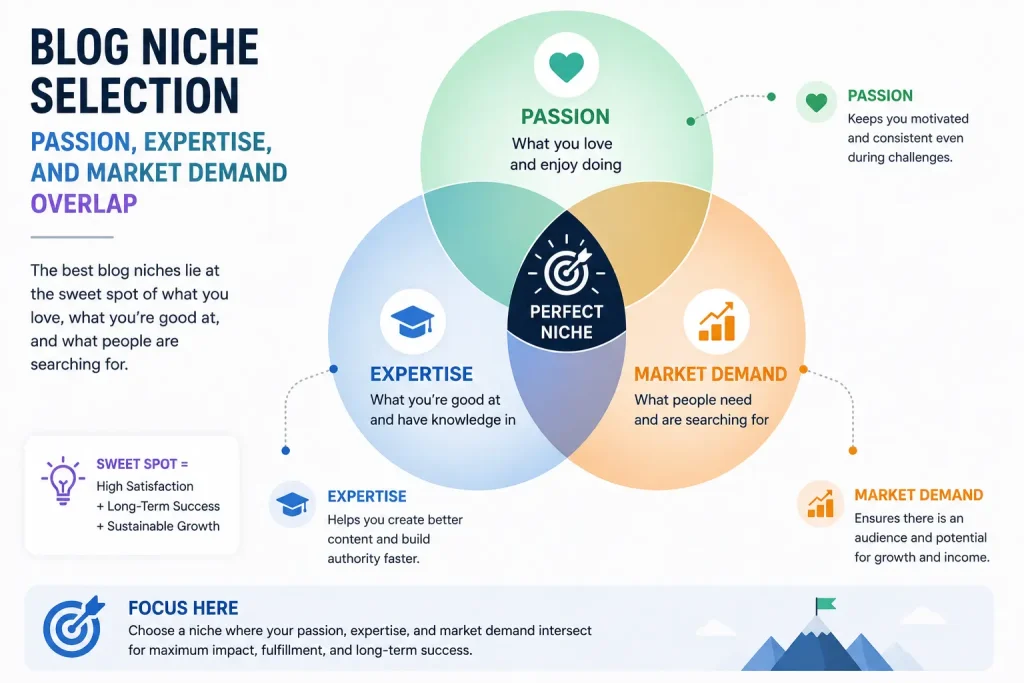
The difference between a niche and a topic
A topic is broad. A niche narrows it by audience, angle, or application. “Travel” is a topic. “Budget travel for digital nomads in Southeast Asia” is a niche. “Health” is a topic. “Intermittent fasting for women over 50” is a niche. That narrowing gives you a real shot at ranking, building authority, and eventually earning consistent income.
Why “write about your passion” is incomplete advice
Passion matters. It just is not enough on its own. You can love a topic that has almost no commercial search volume, no affiliate programs, and zero advertiser demand. The bloggers who actually generate income from their content tend to have two things working simultaneously: relevant expertise or first-hand experience, and a market actively searching for what they write. Passion gets you through the slow months. The market builds the audience.
The Real Criteria for a Profitable Blog Niche
A profitable niche is not simply popular or interesting. It needs a monetization model with a realistic income ceiling at your traffic level. Those are different things.
Search demand: is anyone looking for this?
Search demand tells you whether people actively seek information on your topic. A niche without it can still attract readers through social media or email, but organic search is the most scalable traffic channel available to bloggers. Use Google Keyword Planner, Ahrefs, or SEMrush to check monthly search volume across your core topic keywords. Use Google Keyword Planner, Ahrefs, or SEMrush to check monthly search volume, or follow this keyword research guide for bloggers to run a full sweep in under an hour.
Key Insight: Total volume matters less than the commercial intent within that volume. A niche pulling 30,000 monthly searches where 40% are commercial often outearns one pulling 100,000 searches that are almost entirely informational.
Income ceiling: what can this niche realistically earn?
Two niches can have identical traffic and wildly different revenue. That gap comes from CPC rates, affiliate commission structures, and how much the audience actually spends. Most competitor articles never explain this clearly.
Blogging has three main income levers: display advertising RPM (revenue per 1,000 pageviews), affiliate commission rates tied to average order values, and digital product or service potential.
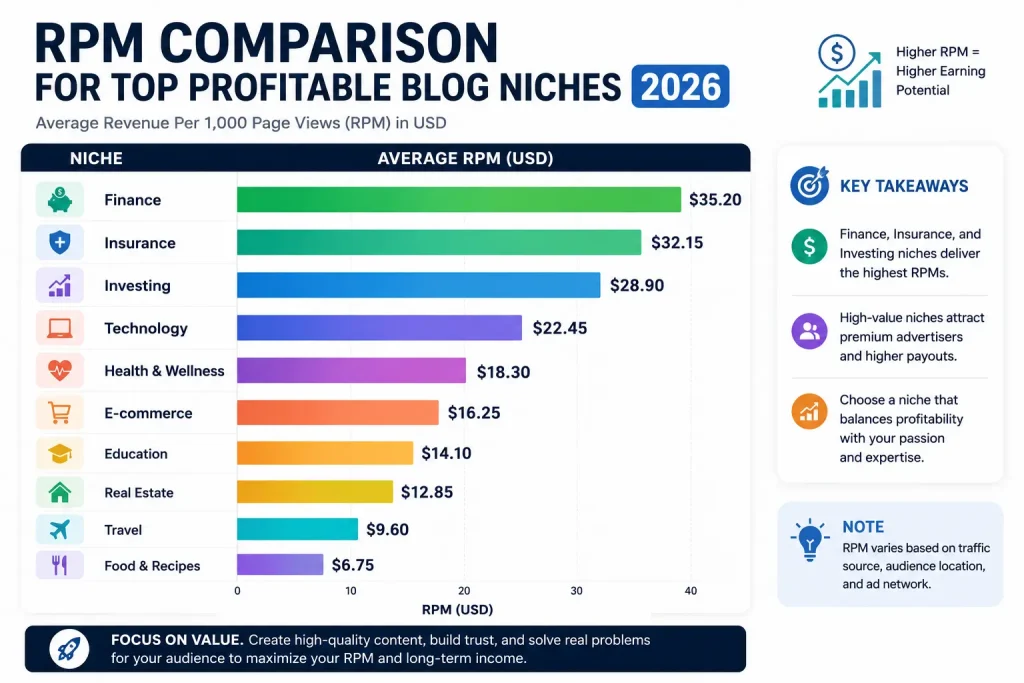
A personal finance blog earning $35 RPM from Mediavine or AdThrive earns roughly 5 to 7 times more per pageview than a cooking blog at $5 RPM with the same traffic. Over three years, that gap is the difference between a hobby and a business.
Competition gap: can you actually rank?
Asking whether a niche is crowded is the wrong question. The right one: is there a content gap? That means an angle, audience segment, or query cluster that established sites are ignoring. Many high-competition niches contain underserved micro-angles with low keyword difficulty and real search volume. Finding those gaps is what separates a strategic niche selection from a guess.
Expertise fit: can you build genuine authority?
Google’s quality raters evaluate E-E-A-T. AI systems prefer citing sources with demonstrated domain knowledge. A blog with thin, generic content in a lucrative niche will struggle to rank and will not get cited. Expertise fit is your honest assessment of whether you can produce accurate, insightful content on this topic for years. A formal credential is not required. Real knowledge or first-hand experience that produces content competitors cannot easily copy is.
Evergreen durability: will this niche matter in five years?
Some niches run on trends: a specific social platform, a technology cycle, a fading cultural moment. Others are built on permanent human concerns like money, health, relationships, and career. Evergreen content compounds. Old articles keep earning. Trend-driven niches demand constant refreshes and carry real obsolescence risk. Your core niche should sit on durable foundations, with trend coverage as a supplement.
Introducing the NICHE MATRIX: A Scoring Framework for Niche Selection
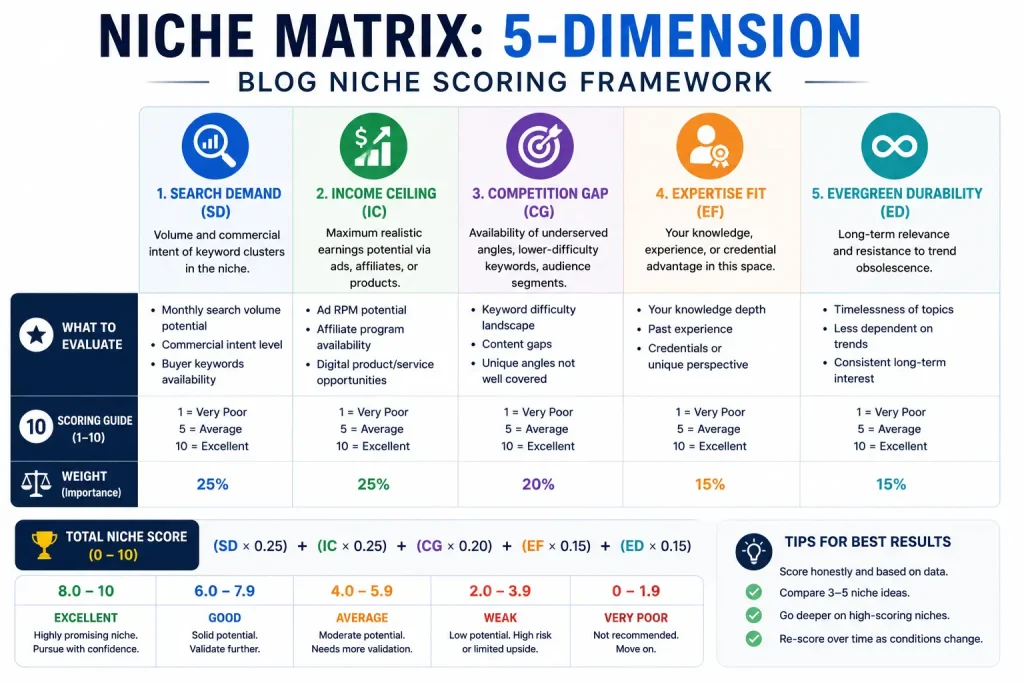
The NICHE MATRIX scores any blog niche candidate across five dimensions before you spend time or money on it. Each dimension is rated 1 to 10, producing a total out of 50.
The 5 Dimensions:
- Search Demand (SD) — Volume and commercial intent of keyword clusters in the niche
- Income Ceiling (IC) — Maximum realistic earnings potential via ads, affiliates, or products
- Competition Gap (CG) — Availability of underserved angles, lower-difficulty keywords, audience segments
- Expertise Fit (EF) — Your knowledge, experience, or credential advantage in this space
- Evergreen Durability (ED) — Long-term relevance and resistance to trend obsolescence
NICHE MATRIX Score = SD + IC + CG + EF + ED (maximum 50)
Scoring Tiers
| Score | Interpretation |
|---|---|
| 42-50 | Strong niche — launch with confidence |
| 33-41 | Viable niche — launch with a clear positioning plan |
| 22-32 | Risky niche — needs repositioning or micro-niche focus |
| Below 22 | Reconsider — low probability of a profitable outcome |
How to score each dimension
Search Demand (SD):
- 8-10: Large keyword clusters, high search volume, strong commercial intent
- 5-7: Moderate volume, mixed commercial intent
- 1-4: Low volume, mostly informational, limited discovery potential
Income Ceiling (IC):
- 8-10: High-RPM ads ($20+), strong affiliate programs (10%+ commission or high AOV), digital product potential
- 5-7: Moderate RPM ($8-20), some affiliate options, limited product potential
- 1-4: Low RPM (under $8), minimal affiliate options, no obvious product fit
Competition Gap (CG):
- 8-10: Clear underserved audience segments or keyword gaps despite overall niche competition
- 5-7: Moderate gaps exist, requires specific positioning
- 1-4: Fully saturated, dominated by major publishers, minimal gap available
Expertise Fit (EF):
- 8-10: Professional credentials, years of direct experience, insider knowledge
- 5-7: Solid familiarity, practical experience, willingness to build through research
- 1-4: Surface-level interest only, no differentiating knowledge
Evergreen Durability (ED):
- 8-10: Niche tied to permanent human needs (money, health, relationships, career)
- 5-7: Mostly stable with some trend exposure
- 1-4: Heavily trend-dependent, technology-specific, or culturally time-bound
NICHE MATRIX Worked Example
Candidate Niche: “Budget travel for solo female travelers”
| Dimension | Score | Reasoning |
|---|---|---|
| Search Demand | 7 | Strong volume, moderate commercial intent |
| Income Ceiling | 6 | Affiliate (travel gear, booking platforms), limited ad RPM |
| Competition Gap | 7 | Underserved angle: solo safety + budget combined |
| Expertise Fit | 9 | Author has 5 years of personal travel experience |
| Evergreen Durability | 8 | Travel demand is permanent; solo travel trend is growing |
| Total | 37 | Viable niche — launch with positioning plan |
Positioning plan: The solo safety plus budget angle targets lower-competition keywords than generic budget travel and serves an audience with specific, recurring needs. That combination is more defensible than a broad travel blog and far more monetizable than a pure inspiration site.
Step-by-Step: How to Choose Your Blog Niche
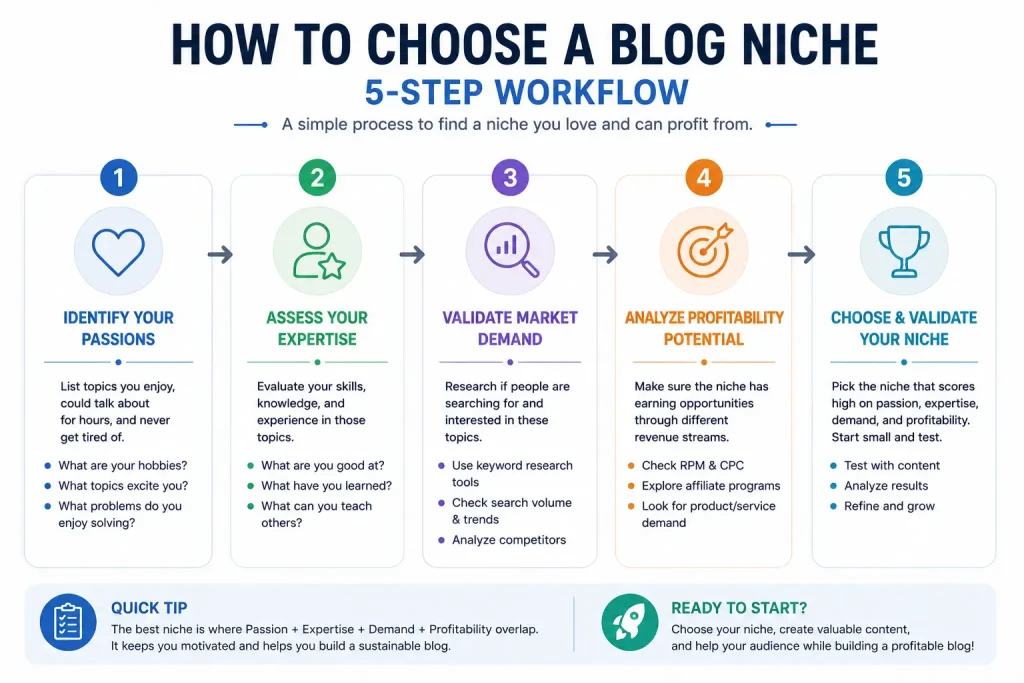
Step 1 — Audit your interests, experience, and unfair advantages
Write down 10 to 15 topics you know more about than most people. Think professional skills, hobbies practiced for years, problems solved from the inside, industries worked in, subjects you read about for no reason other than genuine interest.
Label each with your honest experience level: novice (interested but limited knowledge), practitioner (working knowledge, personal experience), or expert (professional background, deep expertise, real insider access). Your strongest niche candidates come from the practitioner and expert columns. Novice-level interest is where you start learning, not where you start competing.
Unfair advantages worth looking for:
- A professional background most people in the niche lack
- Direct experience with the problem the audience faces
- Access to a community or network within the niche
- Original data, case studies, or documented results
- A perspective underrepresented in existing content
Step 2 — Map the monetization landscape before you commit
Spend 30 minutes on this for each candidate niche. Search “[niche] affiliate programs” and look at commission rates and average order values. Check Mediavine’s public RPM data for the niche category. Ask a practical question: does this audience buy things? Do products or services exist that align with what you would write?
Monetization types by niche suitability:
| Monetization Model | Best Niche Fit | Income Ceiling |
|---|---|---|
| Display advertising | Personal finance, health, legal, insurance | High ($20-60 RPM) |
| Affiliate marketing | Tech, software, outdoor gear, finance products | High (5-40% commission) |
| Digital products | Business, marketing, creative skills, education | High (100% margin) |
| Coaching / services | Career, fitness, business, wellness | Medium-High |
| Sponsored content | Lifestyle, parenting, food, travel | Variable |
A niche that supports multiple monetization models holds up better than one with a single income path.
Step 3 — Run a keyword research sweep
Use Ahrefs, SEMrush, or Ubersuggest (free) to run through your top niche candidates. For each one:
- Search the primary niche term and note total search volume
- Pull the top 20 related keywords and check difficulty scores
- Find 10 to 15 long-tail keywords: KD below 30, at least 500 monthly searches
- Estimate the commercial intent ratio — what share of keywords signal buying intent?
A niche with a solid pool of low-difficulty, high-intent long-tail keywords is far more realistic for a new blog than one where every keyword sits above difficulty 60.
Internal Link: [anobee.com: Keyword Research Guide for Bloggers]
Step 4 — Analyze the competition with honest eyes
Look at the top 5 to 10 ranking pages for your primary niche keyword. For each, check:
- Domain Authority (Ahrefs DR or Moz DA)
- Content quality: is it actually helpful, or just long?
- Content gaps: what does the content fail to answer?
- Audience gaps: is there a specific reader this content ignores?
- Freshness: when was it last updated?
High-DA competitors are not automatically disqualifying. A fair share of high-authority sites publish mediocre content because their brand carries the ranking. A focused new blog with better content in a specific angle can displace them — this is more common than most beginners assume.
For a full breakdown of how to do this systematically, see the competitor content analysis guide on anobee.com
Step 5 — Score your candidates using the NICHE MATRIX
Take your top 3 to 5 niche candidates and score each across the five dimensions. The candidate with the highest total score combined with the strongest Expertise Fit and Income Ceiling is your best starting point.
If two candidates score within 5 points of each other, default to the one with the higher Expertise Fit. Content built on real knowledge is the most durable advantage a blogger can hold.
The 12 Most Profitable Blog Niches in 2026
High-RPM Niches (display advertising focus)
These niches attract premium advertising budgets because their audiences actively spend on high-value purchases. Display ad revenue tracks closely with advertiser CPC.
| Niche | Avg RPM Range | Dominant Monetization | Competition Level |
|---|---|---|---|
| Personal Finance | $20-$50 | Ads + Affiliate | High |
| Insurance | $25-$60 | Ads + Lead gen | Very High |
| Legal / Law | $20-$45 | Ads + Lead gen | High |
| B2B Software / SaaS | $15-$40 | Ads + Affiliate | Medium-High |
| Health / Medical | $12-$30 | Ads + Products | High |
| Real Estate | $15-$35 | Ads + Affiliate | High |
RPM estimates based on Mediavine and AdThrive publisher reports. Actual RPM varies by traffic source, geography, and season.
High-Commission Niches (affiliate marketing focus)
| Niche | Typical Commission Rate | Example Programs | Competition Level |
|---|---|---|---|
| Web Hosting / Tech | 30-70% or flat $50-$200 | Hostinger, WPX, Kinsta | High |
| Finance Products | $50-$300 per conversion | Credit card, loan referrals | Very High |
| Online Courses / EdTech | 20-50% | Coursera, Teachable | Medium |
| Software Tools | 20-40% recurring | SEO tools, marketing tools | Medium-High |
| Outdoor / Sporting Gear | 5-12% of sale | Amazon, REI, Backcountry | Medium |
| Home Improvement | 5-10% of sale | Amazon, Home Depot | Medium |
High-Growth Niches (2026 opportunity window)
- AI Productivity Tools: Strong search growth, new affiliate programs launching frequently, low-competition micro-angles still available
- Personal Finance for Gen Z: Underserved by current personal finance blogs still written for older demographics
- Remote Work and Career Development: Sustained demand post-pandemic, strong affiliate potential across tools, courses, and hardware
- Senior Tech and Digital Literacy: Aging population entering digital spaces; very low competition; high engagement rates
- Sustainable Living on a Budget: Combines evergreen finance and lifestyle with growing search interest
Key Insight: The most profitable niche for any individual blogger is not the one with the highest RPM. It is the one where their expertise is strongest and an underserved audience segment exists. A personal finance blog written by someone with no financial background will consistently underperform a senior tech blog written by someone who spent years in IT support. The tables above show ceilings; your Expertise Fit score determines which ceiling you can actually reach.
Broad Niche vs. Micro-Niche: Which Should You Choose?
| Factor | Broad Niche | Micro-Niche |
|---|---|---|
| Competition | Very high | Low to medium |
| Time to first ranking | 12-36 months | 3-12 months |
| Content volume needed | 200+ articles for authority | 30-80 articles can establish authority |
| Monetization ceiling | High (more audience segments) | Medium (smaller total addressable market) |
| Topical authority speed | Slow | Fast |
| AI citation likelihood | Lower (many competitors) | Higher (fewer authoritative sources) |
| Audience loyalty | Lower (broad appeal, lower specificity) | Higher (speaks directly to audience needs) |
When a broad niche works
A broad niche is viable when you already have an audience, some domain authority, real content investment capacity, and a defined cluster strategy. Launching a general personal finance blog from scratch in 2026 means competing with sites carrying thousands of articles and a decade of link equity. That is a very long runway.
Why micro-niches win for new blogs
A micro-niche blog can establish topical authority with 40 to 60 high-quality articles. Google and AI systems reward depth over breadth. A blog that comprehensively covers “personal finance for freelance designers” will rank for that audience’s specific queries faster than a general personal finance site covering the same queries without focus or commitment.
The niche-within-a-niche strategy
For a new blog in 2026, pick a profitable broad niche, identify a specific audience segment that existing content underserves, and build the first 40 to 60 articles around that micro-angle. Once topical authority is established there, expand into adjacent areas.
Example:
- Broad niche: Personal Finance
- Micro-niche entry: “Debt payoff strategies for teachers” (specific audience, specific problem)
- Expansion phase: broader personal finance for educators, then career finances, then general personal finance
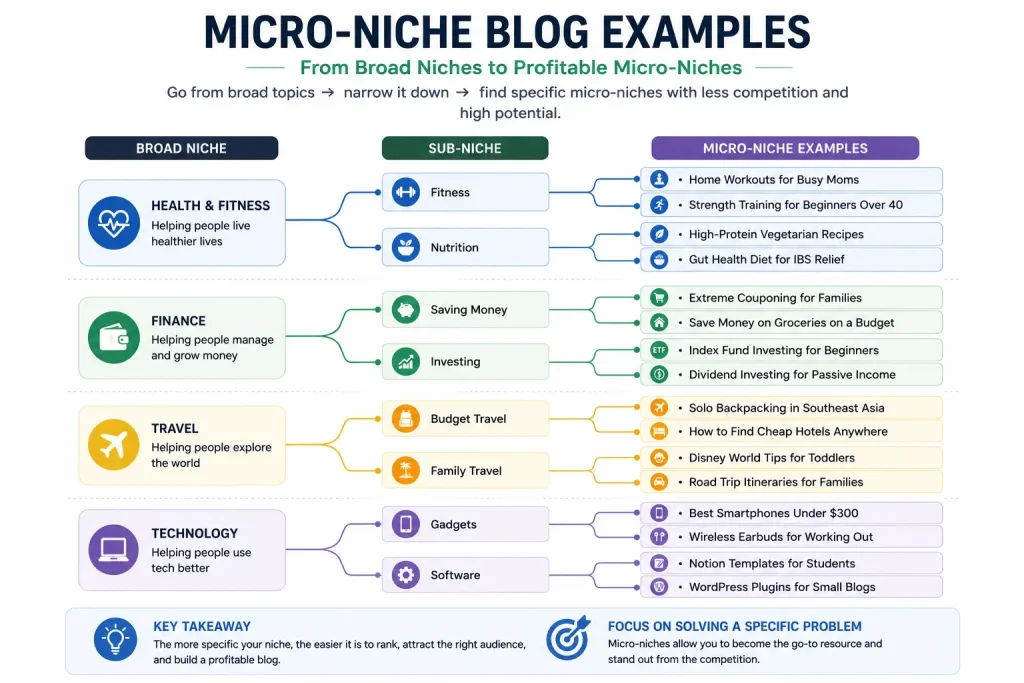
Authority built in the micro-niche transfers as you expand. Starting broad from day one does not give you that compounding advantage.
Niche Validation: What to Check Before You Publish Anything
Keyword Validation Checklist
- [ ] Primary niche keyword has 10,000+ monthly searches (collectively across core terms)
- [ ] At least 15 long-tail keywords identified with KD below 30 and 500+ monthly searches
- [ ] Commercial intent keywords exist within the niche (not purely informational)
- [ ] Average CPC for core keywords exceeds $0.75
- [ ] Google Trends shows stable or upward trend over 5 years (not declining)
Monetization Validation Checklist
- [ ] At least 3 affiliate programs exist with commission rates above 5% or flat rates above $30
- [ ] Niche RPM estimate (from public data) exceeds $8 on mainstream ad networks
- [ ] Audience in this niche demonstrably spends money (forums, subreddits, Facebook groups show product purchases)
- [ ] Digital product opportunity identified (course, template, tool, guide)
- [ ] At least one alternative monetization path beyond display ads
Audience Validation Checklist
- [ ] Target audience is findable and active (subreddits, Facebook groups, forums, YouTube communities)
- [ ] Audience expresses recurring pain points you can address with content
- [ ] Existing content in the niche has engagement (comments, shares, backlinks to niche sites)
- [ ] You can describe your ideal reader in one specific sentence
Common Niche Selection Mistakes
1. Choosing based on personal interest alone Interest is a starting condition, not a qualification. Bloggers who choose a niche purely on enjoyment, without checking search demand or monetization potential, often spend a year producing content that earns almost nothing. Run the monetization check before you commit.
2. Picking a niche with no monetization path Some niches have enthusiastic audiences and no commercial ecosystem. If advertisers do not spend money targeting your readers and no relevant affiliate programs exist, RPM will be low and affiliate income will be negligible. Local history, hobby genealogy, and certain creative arts niches tend to fall here. Verify at least two viable income streams before you choose.
3. Underestimating content volume requirements Topical authority in any niche requires substantially more content than most beginners expect. One pillar post does not establish authority. A content cluster of 40 to 80 interlinking articles does. Before settling on a niche, try to list 60 specific article ideas. If you cannot get there, the niche is probably too narrow.
4. Ignoring topical authority when evaluating competition Many bloggers see high-DA competitors and either quit or charge in without a positioning strategy. The correct read: does the top-ranking content have genuine depth, or does it rank on brand authority alone? Sites with strong DA and thin content can be displaced by a focused blog with real depth — especially now that AI citation favors specificity over brand size.
5. Choosing trend-driven niches without an evergreen core Blogs built entirely on a technology product, platform, or cultural moment carry real risk. Blogs that rode Pinterest strategy, Google+ marketing, or specific crypto projects found this out the hard way. Choose a niche where the core subject survives trends; cover trends as a supplement.
The Long Game: Topical Authority and Niche Depth
Why topical authority matters more than domain authority now
Google’s ranking systems have moved considerably toward topical authority. The older model, where backlink strength could compensate for thin content, has less influence than it used to. For niche blog strategy, this is genuinely good news for new sites.
A new blog that covers a specific niche thoroughly, with pillar articles, cluster content, FAQ pages, and comparison pieces all internally linked, can outrank larger sites that cover the same niche casually. Specialization is increasingly legible to both search engines and AI systems.
How to build a content cluster around your niche
The content cluster model connects a pillar article to multiple cluster articles through internal links. Cluster articles reinforce the pillar; the pillar links back to each cluster. This creates a semantic map that search engines and AI systems can read and attribute.
For a new blog, a workable structure looks like this:
- 1 pillar article per major niche topic (2,000 to 5,000 words)
- 8 to 15 cluster articles per pillar (800 to 2,000 words each)
- FAQ pages and comparison pages as supporting content
- Internal links from every cluster article back to the pillar
AI visibility as a niche selection factor
AI search tools surface content in response to queries where users never reach a traditional results page. Being cited by Google AI Overviews, ChatGPT, Gemini, or Perplexity is now a real traffic channel with its own optimization logic. Those systems tend to cite:
- Clear, direct definitions and answers
- Original frameworks and methodologies
- Structured data: tables, lists, step-by-step processes
- Sources with demonstrated topical authority
- Pages with strong entity associations: author bios, schema markup, consistent brand identity
When evaluating niche options, ask whether the niche lends itself to the kind of definitive, structured content AI systems can extract and attribute. Technical, instructional, and reference-oriented niches earn more AI citations than purely narrative or lifestyle content.
What is a blog niche?
A blog niche is a specific subject area that a blog consistently covers, defined narrowly enough to establish expertise and attract a clearly identified audience. A niche is not just a broad topic like “health”, it is a specific angle such as “nutrition for marathon runners over 40” that signals authority to both readers and search engines.
How do I know if my blog niche is profitable?
Evaluate your niche against three financial signals: (1) average CPC for niche keywords above $1.00 suggests advertiser spending, (2) affiliate programs offering commissions of 5% or higher exist within the niche, and (3) the niche has a demonstrated audience willing to spend money, either through product purchases or professional services.
Can I change my blog niche after I start?
Yes, but it carries a cost. Changing niches means reconsidering your domain, existing content, backlink profile, and audience expectations. A partial pivot, narrowing or expanding within an adjacent space, is far less disruptive than a complete switch. Many successful bloggers start broad and narrow down once they identify which content performs best.
Should I choose a niche I’m passionate about or one that’s profitable?
Both criteria matter, but expertise is more important than passion. You can develop interest in almost any topic over time. What you cannot manufacture is genuine knowledge, practical experience, and the ability to write about a subject with depth and authority. Choose a niche where you have an existing advantage, skills, credentials, professional experience, and where a viable market exists.
How narrow should my blog niche be?
Narrow enough to build topical authority, but broad enough to sustain 50-100 articles without exhausting the subject. A useful test: can you list 50 distinct article ideas right now without stretching? If yes, the niche has sufficient depth. If you struggle at 20, you may need to broaden. If you easily reach 200, you may have a content cluster rather than a single niche blog.
What are the highest-RPM blog niches?
The highest-RPM niches (ranked by display advertising revenue per 1,000 pageviews) are personal finance ($20-$50+ RPM), insurance ($25-$60 RPM), legal ($20-$45 RPM), B2B software ($15-$40 RPM), and health/medical ($12-$30 RPM). RPM varies significantly by traffic source, audience geography, and season.
How long does it take for a niche blog to make money?
Most niche blogs take 12-24 months to reach consistent monthly income. Factors that accelerate this timeline include choosing a micro-niche with low competition, publishing high-frequency content (3-5 posts per week early on), targeting long-tail keywords from launch, and actively building backlinks. Blogs that try to compete immediately in high-authority niches typically take 24-36 months.