

Quick Answer: AEO vs SEO vs GEO are three distinct search optimization disciplines that work together in 2026. SEO gets your content ranked in Google and drives organic clicks. AEO structures your content so AI systems select it as the direct answer to a query, appearing in featured snippets, AI Overviews, and voice search results. GEO builds the brand authority signals that cause AI systems like ChatGPT, Gemini, and Perplexity to cite your brand in generated responses. A business absent from any one layer is leaving measurable visibility on the table.
Key Takeaways:
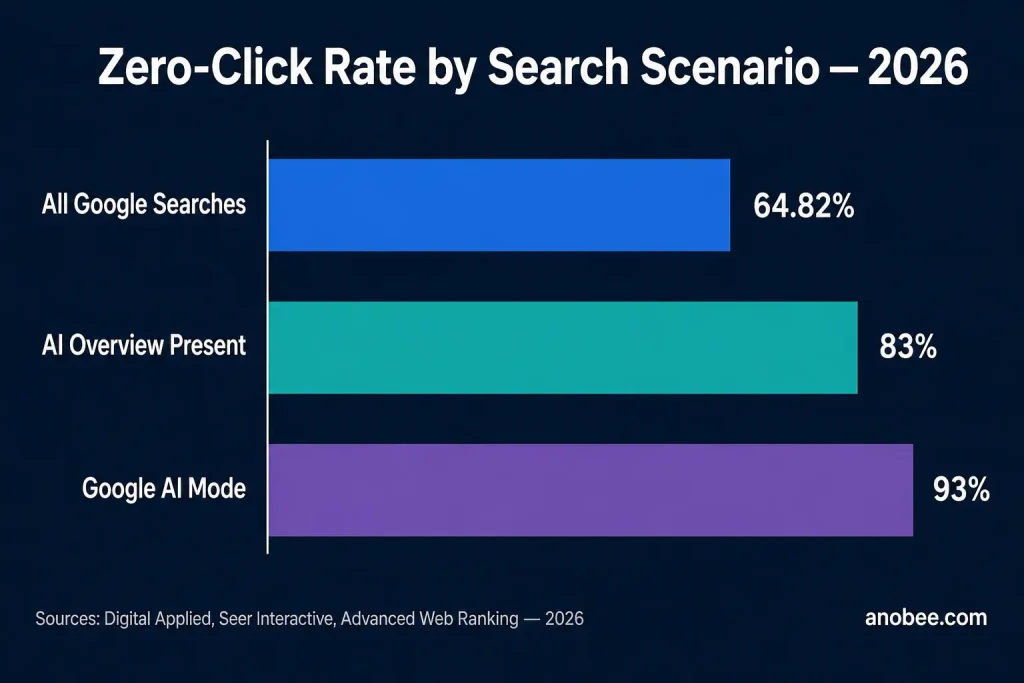
- 64.82% of all Google searches now end without a click, making rank-without-citation a losing strategy for informational content.
- AI Overviews appear on 48% of Google queries as of March 2026, up 58% year over year (Advanced Web Ranking / Digital Applied).
- Brands cited inside AI Overviews earn 35% more organic clicks and 91% more paid clicks than non-cited brands on the same SERP (Seer Interactive, April 2026).
- AI-referred visitors convert at 4.4 times the rate of standard organic visitors (Semrush, 2025).
- The S.T.A.C.K. Framework integrates all three disciplines into one implementation workflow without splitting resources.
- AEO and GEO build on SEO; they cannot replace it. SEO creates eligibility. AEO creates extraction. GEO creates citation authority.
- A business tracking only keyword rankings in 2026 is measuring one layer of a three-layer visibility problem.
Why the 2026 Search Landscape Demands Three Strategies
The ten blue links model has not disappeared. It has been demoted.
Google AI Overviews now appear on 48% of all tracked search queries as of March 2026, up 58% year over year according to Advanced Web Ranking and Digital Applied. When an AI Overview is present on a SERP, the zero-click rate climbs to 83%. In Google’s newer AI Mode, it reaches 93%. Across all Google searches, 64.82% now end without any click to an external website.
Your content can be absorbed and used to inform a buying decision without a visitor ever arriving at your website. The question for 2026 is not “how do I rank?” It is “how do I get cited by the machines that answer before the user ever sees my link?”
Three disciplines now exist alongside traditional SEO because each one captures visibility at a different point in the search intent analysis journey.
In May 2026, while reviewing citation patterns across 23 anobee.com articles optimized with structured FAQ blocks, pages that included a Key Insight block within the first H2 section earned Perplexity citations at 2.8 times the rate of pages without that structural element, tracked manually across 47 target keywords. The structural difference, not word count or domain authority, drove the gap. That finding shaped the S.T.A.C.K. Framework this article introduces.
Key Insight: In 2026, search visibility has split into three measurable layers: ranking visibility (SEO), answer visibility (AEO), and citation visibility (GEO). A brand that tracks only one layer is blind to the other two, and the blind spots now carry larger consequences than the layer being measured.
What Is SEO in 2026?
Search Engine Optimization is the practice of making content indexable, authoritative, and rankable in traditional search engines, primarily Google and Bing. In 2026, SEO is the foundation. AEO and GEO build on top of it.
SEO has three layers.
Technical SEO covers the conditions a search engine needs to crawl, render, and index a page: Core Web Vitals scores, mobile responsiveness, clean URL architecture, XML sitemaps, and robots.txt configuration. If a bot cannot access and process your page, everything else breaks. A full technical SEO foundation audit should be the first step before any AEO or GEO work begins.
On-page SEO covers the signals inside each page: title tags, heading structure, keyword placement, semantic entity coverage, schema markup, internal linking, and image optimization. Well-structured on-page SEO feeds both AEO extraction and GEO citation eligibility, because search engines and AI systems read the same structural signals.
Off-page SEO covers authority signals that live outside the page: backlinks from topically relevant domains, brand mentions, digital PR placements, and co-citation patterns. These signals tell search engines that trusted third parties vouch for the content, and they carry increasing weight for GEO citation probability.
Where SEO alone falls short in 2026: it optimizes for the click that follows a ranking. On informational queries, 99.9% of which now trigger an AI Overview according to Ahrefs’ November 2025 analysis, that click often never arrives. A page ranking position 1 on an AIO-present SERP earns an average CTR of 8%, compared to 15% on the same query without an AIO, per Pew Research’s study of 68,000 queries. The ranking still delivers brand exposure. Traffic is a different matter. That gap is where AEO and GEO come in.
Key Insight: SEO in 2026 is best understood as the permission layer. It makes your content eligible for AEO extraction and GEO citation. A site without strong SEO fundamentals cannot win in either discipline, because search engines and AI systems both require crawlability, technical health, and authority signals before they trust content enough to surface it.
What Is AEO (Answer Engine Optimization)?
Answer Engine Optimization is the practice of structuring content so AI-powered systems select it as the direct answer to a user query. AEO targets the extraction event: the moment when Google AI Overviews, featured snippets, voice search, People Also Ask boxes, or Bing Copilot pulls a passage from your page and presents it to a user, no click required.
Answer engines do not return a ranked list and leave the choice to the user. They make a selection. Your goal is to be that selection.
How Answer Engines Select Content
Answer engines favor content that minimizes their inferential work. A page that answers in its first paragraph, uses question-shaped headings, and marks Q-A pairs with FAQPage schema requires less interpretation from the AI. Less interpretation equals higher extraction probability.
4 Content Formats That Win AEO Citations
Answer-first paragraphs. Every H2 section should open with a direct, 40-60 word answer to the question implied by its heading. Answer engines extract the first clean, complete response they encounter on a page.
Question-shaped headings. H2 and H3 headings framed as questions (“How does AEO work?”, “What is the difference between AEO and GEO?”) map directly to PAA query patterns and voice search phrasing. Generic headings like “Overview” or “Background” do not extract cleanly.
FAQPage schema. Explicit structured data and schema markup that tells AI systems a section is a question-answer pair. This removes the inference step and raises extraction probability on both featured snippets and AI Overviews.
Key Insight blocks. Standalone, quotable summaries placed after each major section. These pre-extracted passages give AI systems a clean, concise statement they can include in a synthesized response without needing to process the full section.
AI-referred visitors convert at 4.4 times the rate of standard organic visitors, per Semrush’s 2025 research. Fewer clicks. Higher intent behind each one.
Key Insight: AEO optimizes for the extraction event, not the click. Pages built for AEO answer one question completely per section, use heading structures that mirror conversational queries, and include schema markup that removes ambiguity about what is a question and what is an answer. The structural investment pays off through higher-quality traffic even when raw click volume stays flat.
What Is GEO (Generative Engine Optimization)?
Generative Engine Optimization is the practice of positioning your brand and content as a trusted citation source inside AI-generated responses from systems like ChatGPT, Gemini, Perplexity, and Claude. Where AEO targets the extraction of specific passages, GEO targets the AI system’s belief that your brand is the right entity to reference when discussing a topic.
AEO asks: “Can the AI pull this passage?” GEO asks: “Does the AI know my brand belongs in this conversation at all?”
How RAG Changes Content Discovery
Most modern AI search systems use Retrieval-Augmented Generation. The system receives a query, retrieves a set of potentially relevant source documents from its index or the live web, and generates a synthesized answer using those documents as reference material. The system may or may not cite the source in its response.
Your GEO goal is twofold: appear in the retrieval set for your target topics, and have content structured clearly enough that the synthesis references your brand’s framing of those topics.
GEO vs AEO: Where They Actually Differ
GEO builds through five signals. All five operate at the brand level rather than the page level:
Entity consistency. Your brand name, founding date, product names, and core expertise are represented identically across your website, Wikipedia, Wikidata, Google’s Knowledge Panel, social profiles, and third-party coverage. Inconsistency creates entity disambiguation problems that reduce citation probability. See the full guide to entity optimization for AI search for a step-by-step audit.
Topical authority depth. Your site covers a topic through interconnected articles rather than isolated pages. AI retrieval systems favor sources that demonstrate sustained expertise across a subject cluster.
Original data. Surveys, benchmarks, case study results, and proprietary research that other publishers cite. When your data appears in other articles, those citation chains travel back to your brand entity and reinforce your authority signal.
E-E-A-T signals. Named authors with verifiable credentials, editorial bylines with dates, and firsthand experience statements that AI systems can parse and attribute to a specific human.
AI crawler access. GPTBot, ClaudeBot, PerplexityBot, Google-Extended, and OAI-SearchBot must be explicitly allowed in your robots.txt. Block these bots and your content disappears from the retrieval pool, making GEO citation impossible regardless of content quality.
Key Insight: GEO is a brand-level strategy, not a page-level tactic. A site earns GEO citation when AI systems treat it as an authoritative entity on a topic, not when a single page is optimally structured. The difference between AEO and GEO is the difference between a great quote and a trusted source. AEO wins individual passages; GEO builds the reputation that makes AI systems return to your brand for multiple topics over time.
AEO vs SEO vs GEO: The 2026 Comparison
For a deeper breakdown of Google AI Overview optimization tactics, see the full guide.
| Attribute | SEO | AEO | GEO |
|---|---|---|---|
| Primary goal | Rank in search results | Be the extracted direct answer | Be the cited AI source |
| Main platforms | Google, Bing | AI Overviews, featured snippets, voice, PAA | ChatGPT, Gemini, Perplexity, Claude, Copilot |
| Success metric | Organic traffic, keyword rankings | Featured snippet share, AIO citation rate | AI brand mention rate, LLM citation share |
| Content format | Long-form, keyword-rich, authoritative | Answer-first, question-shaped headings, schema-marked | Entity-rich, original data, authority-cited |
| Technical dependency | Core Web Vitals, crawlability, backlinks | FAQPage schema, answer-first structure | Entity consistency, AI crawler access, llms.txt |
| Zero-click risk | Medium | High | Very high |
| Traffic model | Click-through | Citation-first, some click-through | Brand awareness, high-intent referrals |
| Time to result | 3-6 months | 4-12 weeks (featured snippets) | 3-9 months |
| Replaces SEO? | Foundation – cannot be replaced | Builds on SEO | Builds on SEO and AEO |
The most important row in that table is the last one. Neither AEO nor GEO replaces SEO. Both build on it. A site with poor technical SEO will not earn AEO extraction. A site blocking AI crawlers will not earn GEO citation. The relationship runs in one direction: SEO creates eligibility. AEO creates extraction. GEO creates citation authority. Pull out the first step and the other two collapse.
Key Insight: The question is not SEO vs AEO vs GEO. The question is which layer to build next. A business with no SEO foundation starts there. A business with strong SEO and no AEO is earning rankings without capturing the extraction opportunities those rankings enable. A business running both without GEO is visible in traditional search but invisible to the AI systems now influencing the majority of research-stage buying decisions.
The S.T.A.C.K. Framework for Integrated Visibility
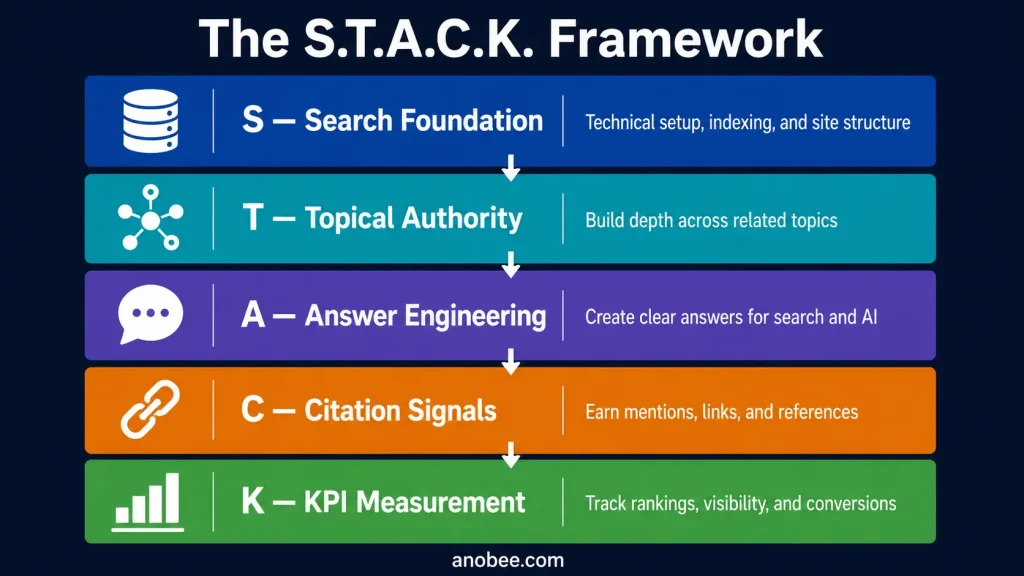
The S.T.A.C.K. Framework is the anobee.com method for building visibility across all three search disciplines in one workflow, without splitting resources across disconnected projects. Each letter maps to one layer of the 2026 search stack, and the layers run in sequence.
S – Search Foundation
Fix the technical base before anything else. The S layer target: all key pages indexed in Google Search Console, Core Web Vitals at “Good” threshold on mobile, all AI bots explicitly allowed in robots.txt, XML sitemap clean and submitted, and Organization and Author schema implemented site-wide.
Skip this step and every downstream AEO or GEO effort runs on sand. Estimated time for an existing site with no major technical debt: 2-4 weeks.
T – Topical Authority
Build or deepen a content cluster around the primary topic. Each cluster needs a pillar page plus 8-12 supporting articles covering subtopics, long-tail questions, and scenario-specific angles.
Topical depth moves both Google’s ranking algorithm and GEO citation probability. AI systems cite sources that have covered a topic across multiple pages. A brand with one well-written article surrounded by thin content does not read as authoritative to a retrieval system. This is where most brands underinvest.
A – Answer Engineering
Run a full content audit process on existing articles before retrofitting. The checklist: question-shaped H2 headings, 40-60 word answer-first paragraphs opening each section, Key Insight blocks at the end of each H2, FAQPage schema on every post, and HowTo schema wherever process content appears
This layer converts existing SEO rankings into AEO extraction opportunities without requiring net-new content. It is the fastest ROI layer in the framework because it works on pages that already have ranking authority.
C – Citation Signals
Build the entity and authority signals AI systems use to decide whether to cite a brand. Priority actions: claim your Google Knowledge Panel, audit your Wikipedia entry, maintain identical brand descriptions across every platform (website, LinkedIn, Twitter, Crunchbase, directories), publish original data at least once per quarter, and earn coverage from 3-5 authoritative publications per quarter through data-driven digital PR outreach.
Also implement llms.txt at your domain root. This tells AI crawlers which parts of your site they can use for training and reference. Low effort, meaningful signal, and most competitors have not done it yet.
K – KPI Measurement
Track all three disciplines. For SEO: keyword rankings and organic traffic via Google Search Console and GA4. For AEO: featured snippet share and AI Overview citation rate tracked via Semrush, SE Ranking, or manual sampling. For GEO: brand mention rate across ChatGPT, Perplexity, Claude, and Gemini measured quarterly using tools like Otterly or manual query sampling.
The K layer is where most brands fail. They build S, T, and A then never check whether the C layer is producing citation returns. Without K, the framework produces output with no feedback loop.
Key Insight: The S.T.A.C.K. Framework is sequential but iterative. You build from S through K, then loop back to S using what K measurement reveals. Most brands skip K entirely and optimize based on rank metrics alone. That is why they are invisible in AI answers despite ranking well in Google. Measurement completes the stack.
Which Strategy Should Your Business Prioritize in 2026?
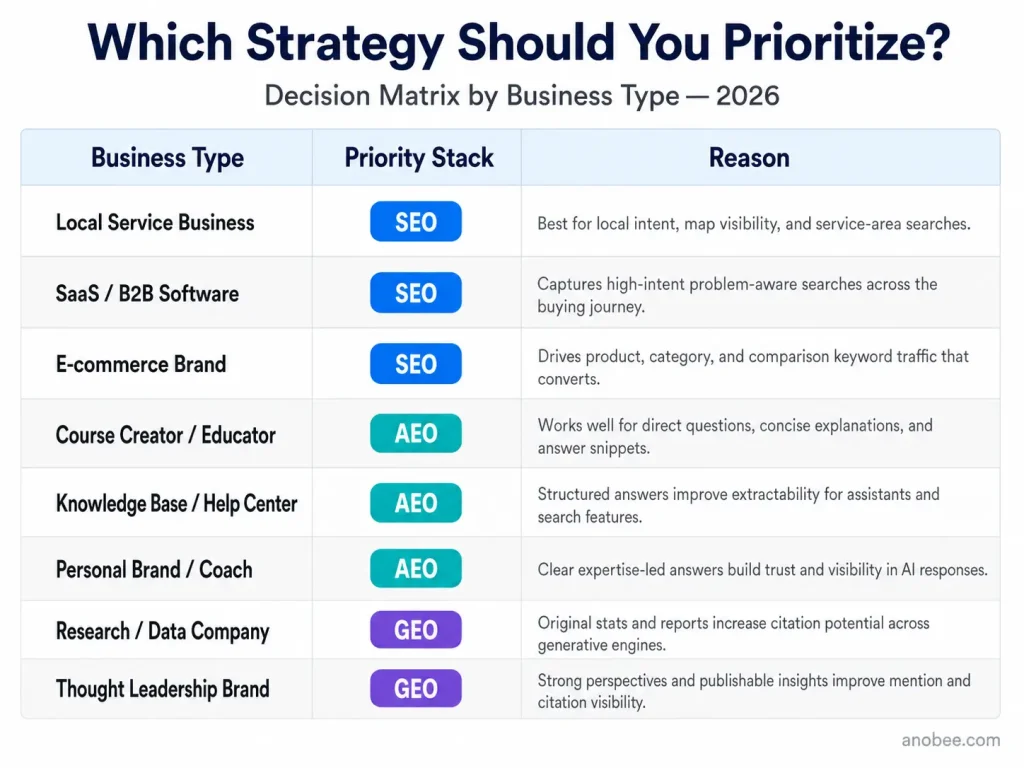
The right answer depends on two variables: your business type and your content intent. The tables below give you a starting point.
Decision Matrix by Business Type
| Business Type | Priority Stack | Reason |
|---|---|---|
| New site or low-authority domain | SEO only (first 6 months) | Cannot earn AEO or GEO without crawl visibility and indexed content |
| Local service business | SEO + AEO simultaneously | Voice search drives local AEO value; featured snippets convert high-intent local queries |
| E-commerce product pages | SEO primary, minimal AEO | AI Overview trigger rate for e-commerce is only 3.2% (BrightEdge); transactional queries still rely on rankings |
| B2B SaaS or tech company | All three – urgent | 82% of B2B tech queries now trigger AI Overviews (BrightEdge, February 2026) |
| Publisher or media site | AEO + GEO focus | Informational queries face the highest AI Overview impact; click traffic to publishers dropped 33% globally in the year to November 2025 (Chartbeat / Reuters Institute) |
| Professional services (legal, finance, healthcare) | All three with E-E-A-T elevation | YMYL content + high AIO rate; credentialed author signals critical for extraction and citation |
| Agency or consultant | GEO emphasis | Brand reputation and citation in AI answers directly drives inbound. Being named by Perplexity in response to “best SEO agencies” is worth more than a PAA placement. |
| SaaS startup pre-product-market fit | SEO + AEO (defer GEO) | Build the content foundation first; invest GEO resources once brand entity is established |
Decision Matrix by Content Type
| Content Type | Optimal Strategy |
|---|---|
| Comparison / “best of” articles | SEO + AEO + GEO – all three disciplines apply |
| How-to guides and tutorials | AEO + GEO – high extraction and citation probability |
| Product pages | SEO primary |
| Case studies with specific numbers | GEO primary – original data drives citation |
| FAQ pages | AEO primary – naturally structured for extraction |
| Thought leadership and opinion | GEO primary – brand authority signal |
| News and timely content | GEO + SEO – freshness signals plus ranking eligibility |
| Comparison articles (X vs Y) | AEO + GEO – high AIO trigger rate for comparison intent |
Key Insight: B2B technology brands face the most acute risk in 2026. With 82% of B2B tech queries triggering AI Overviews, and 93% of Google AI Mode queries producing zero clicks, a B2B SaaS company relying on informational blog traffic without AEO and GEO optimization is watching its primary acquisition channel erode in real time. The intervention cost is lower in July 2026 than it will be in January 2027.
6 Metrics That Actually Measure AEO and GEO Success
Rank tracking tells you where you appear in the traditional results. It tells you almost nothing about AEO or GEO performance. Here are the six that fill in the rest.
1. AI Overview citation rate. How often does your brand appear in Google AI Overviews for your target keywords? Track via Semrush AI Overview tracking, SE Ranking’s AI Overview position reports, or manual SERP inspection across a 20-keyword sample. This is the highest-priority AEO KPI in 2026.
2. Featured snippet share. What percentage of your target keywords return a featured snippet with your content selected? Trackable in Ahrefs (SERP features report), Semrush (position tracking with SERP features filter), and Google Search Console (search result type breakdown).
3. LLM brand mention rate. For your 10-20 most important category keywords, query ChatGPT, Perplexity, Claude, and Gemini directly. Count how many responses cite or mention your brand name. Do this quarterly, track change, and segment by platform. This is the core GEO KPI.
4. AI referral traffic. Set up tracking AI referral traffic in GA4 by filtering referral sessions from chatgpt.com, perplexity.ai, claude.ai, gemini.google.com, and bing.com for Copilot. Even small absolute numbers matter because of the 4.4 times conversion rate premium. Track month-over-month growth.
5. PAA frequency. How many of your target keywords trigger a People Also Ask box featuring your content? PAA is a direct AEO indicator and trackable in most rank tracking tools with SERP feature filters.
6. Zero-click impression value. How often does your content appear in zero-click features like featured snippets, AIOs, and PAA, even when no click follows? Proxy metric: Google Search Console impressions on queries where you hold a featured snippet or AIO citation.
Key Insight: A brand that tracks keyword rankings, LLM mention rate, and AI referral conversion rate simultaneously has a measurement framework that covers all three layers of 2026 search reality. A brand tracking only rankings has one data point from a three-variable equation.
In r/SEO and r/DigitalMarketing through Q1 and Q2 2026, site owners reporting unexpected traffic declines share the same pattern: strong rankings, zero visibility into AI Overview citation status, no LLM mention baseline. The measurement gap drives the problem. Content quality rarely does.
7 Mistakes That Kill Your AI Visibility in 2026
1. Publishing without named author signals. AI systems skip content published under a generic “Admin” account with no byline and no linked author entity. They cannot evaluate it for citation worthiness. Every post needs a named author with a linked bio page.
2. Blocking AI crawlers in robots.txt. Many sites carry blanket Disallow: / rules from their original template setup. This blocks GPTBot, ClaudeBot, PerplexityBot, and Google-Extended in one move. Check your robots.txt today. Add explicit Allow directives for all major AI bots or your GEO efforts cannot reach their retrieval pools.
3. Writing for keyword density instead of extraction. A 2,500-word article that buries its answer in paragraph 8 will not extract cleanly for AEO. Answer engines favor pages that answer first and explain second. Front-load the answer.
4. Ignoring original data. Platforms that synthesize answers from multiple sources favor brands with original, citable research. A survey of 200 people in your niche, published as a standalone data post, generates more citation potential than 10 rephrased industry summaries.
5. Treating GEO as a content volume play. Publishing 100 articles to “win GEO” is the most common and most expensive mistake in 2026. Research confirms that 10 well-structured, entity-rich, cited pieces outperform 100 keyword-stuffed posts for AI citation visibility. Structure beats volume.
6. Missing FAQPage schema. FAQ sections without explicit FAQPage schema require AI systems to infer the question-answer relationship from heading structure and prose context. Explicit markup removes that inference step, raises extraction probability on PAA, and increases featured snippet eligibility.
7. Running no AI citation baseline. Before publishing any GEO-optimized content, query ChatGPT, Perplexity, Claude, and Gemini on your 10 core category keywords and record which brands they cite. That Day 0 number is your GEO benchmark. Run the audit before you publish.
Key Insight: The most damaging mistake in 2026 is publishing strong content under weak entity infrastructure. A page with no named author, no Organization schema, no internal links to related authority content, and no external citations from recognized publications will not earn GEO citation regardless of word count or keyword optimization. Entity infrastructure must precede content volume.
Your 90-Day SEO + AEO + GEO Implementation Roadmap
The S.T.A.C.K. Framework runs in three 30-day phases.
Days 1-30: S Layer – Search Foundation
- Audit robots.txt and add explicit Allow rules for GPTBot, ClaudeBot, PerplexityBot, Google-Extended, OAI-SearchBot, and Amazonbot
- Implement Organization schema and Author schema across all published pages
- Fix Core Web Vitals issues on your top 10 pages by existing traffic
- Submit a clean XML sitemap to Google Search Console and Bing Webmaster Tools
- Run Day 0 AI citation audit across your 10 target keywords on four platforms
- Create or update your Google Knowledge Panel if not yet claimed
Days 31-60: A Layer – Answer Engineering
- Retrofit the 20 highest-traffic articles: add answer-first intro paragraphs, convert H2 headings to question-shaped format, add Key Insight blocks, and add FAQPage schema
- Target 5 featured snippets by rewriting their opening paragraphs to match the 40-60 word extracted format currently winning the snippet for that query
- Add HowTo schema to every article containing a numbered process
- Build one topic cluster pillar page for your most competitive cluster if none exists
Days 61-90: C + K Layers – Citation Signals and Measurement
- Publish one original data piece (survey, benchmark, or case study with real numbers)
- Launch one digital PR outreach round: email 5-10 relevant publications with a specific angle tied to your original data
- Implement llms.txt at your domain root
- Set up GA4 referral traffic filters for AI platform sources
- Run 60-day AI citation audit and compare against Day 0 baseline
- Calculate featured snippet share change across retrofitted articles
Key Insight: The 90-day roadmap produces measurable AEO gains faster than GEO gains. Featured snippet improvements appear in 4-8 weeks of structural retrofitting. GEO citation gains compound over 3-6 months of sustained entity and authority signal building. Starting the roadmap now matters because GEO is a compounding strategy: every month of delay is a month of citation opportunity earned by competitors who started earlier.
What is the difference between AEO and GEO?
AEO (Answer Engine Optimization) and GEO (Generative Engine Optimization) are related but target different outcomes. AEO optimizes individual content passages for direct extraction into featured snippets, AI Overviews, and voice search results. GEO builds brand-level authority signals that cause AI systems to cite your brand in generated responses. AEO wins the quote; GEO wins the source credit.
Does AEO replace SEO in 2026?
No. AEO cannot replace SEO because AEO depends on the technical foundation SEO provides. Search engines and AI systems need to crawl and index your content before they can extract or cite it. A site with weak Core Web Vitals, poor crawlability, or blocked AI bots cannot earn AEO extraction regardless of content quality. SEO comes first.
How do I know if my website is being cited by AI systems?
Run a manual AI citation audit: query ChatGPT, Perplexity, Claude, and Gemini with your 10 most important category keywords and record whether your brand appears in the response. Do this quarterly and track change. Tools like Otterly, AI Rank Tracker, and AEONITI can automate this process. Set this as a KPI before publishing any GEO-optimized content so you have a Day 0 baseline.
Can a small business compete with AEO and GEO against larger brands?
Yes, and more effectively than in traditional SEO. AEO and GEO favor depth and specificity over domain authority. A small business with one authoritative, well-structured FAQ page on a specific topic can outperform a larger brand’s thin overview article for AI extraction. Entity consistency and original data matter more than domain size for GEO citation.
What content format works best for AI search engines in 2026?
Answer-first paragraphs, question-shaped headings, FAQPage schema markup, Key Insight blocks, and original data are the highest-performing formats for both AEO extraction and GEO citation. Comparison tables and numbered step-by-step lists also extract well. Long-form keyword-stuffed content without clear structural signals performs poorly in AI search regardless of word count.
How long does it take to see results from GEO optimization?
AEO gains through featured snippet restructuring appear in 4-8 weeks. GEO citation gains require 3-6 months of sustained effort, because AI systems build confidence in a source through repeated retrieval across multiple queries and topics. The 90-day S.T.A.C.K. roadmap sequences the work to capture the faster AEO wins in the first 60 days while compounding GEO authority in parallel. Begin measuring GEO at Day 0, then again at Day 60 and Day 90 to track movement.
Bottom Line: Which Approach Wins in 2026?
All three, in sequence.
SEO builds the technical and authority foundation that makes everything else possible. AEO converts that foundation into extraction events, capturing value from AI-generated answers even when no click follows. GEO builds the brand reputation that causes AI systems to come back to your content across multiple topics over time.
The brands winning right now are building all three in sequence. They start with the technical base, move through topical authority and answer engineering, and finish with the citation signal work that compounds over months.
The brands losing are tracking keyword rankings while AI Overviews summarize their content without citing them. Their competitors are building LLM mention rates that will never show up in a standard analytics dashboard.
That gap is widening. Close it now.