

ChatGPT prompts for SEO are structured instructions that guide ChatGPT to perform specific search engine optimization tasks like keyword research, content optimization, technical audits, and link building. The right prompt saves hours of manual work and can help you achieve RankMath scores above 90 without deep technical expertise.
Every SEO professional I know uses ChatGPT in some capacity. The difference between those who get value and those who waste time comes down to one thing: how they write their prompts.
I have been using ChatGPT for SEO on anobee.com since early 2025. I use it for technical SEO audits, content writing, meta descriptions, and RankMath optimization. What I found surprised me. ChatGPT does not need deep research like Claude does for most SEO tasks. Clean, well-structured prompts do the job. My skill is building those prompts. After testing dozens of approaches, I settled on 50 prompts that consistently deliver.
Key Takeaways:
- 50 ready-to-use ChatGPT prompts organized into 5 SEO categories
- The PROMPT framework helps you build custom prompts for any SEO task
- ChatGPT Free handles most SEO prompts effectively, and you do not need a Plus subscription
- RankMath-specific prompts help you hit 90+ on-page scores without manual tweaking
- 2026-focused prompts for AI Overviews, GEO, and AI citation readiness
- Every prompt tested on anobee.com with measurable results
What Makes a Great ChatGPT Prompt for SEO
A ChatGPT prompt for SEO is a set of instructions you give ChatGPT to complete a specific search optimization task. Think of it as briefing a junior SEO specialist. The clearer your brief, the better the output.
The 5 Elements of an Effective SEO Prompt
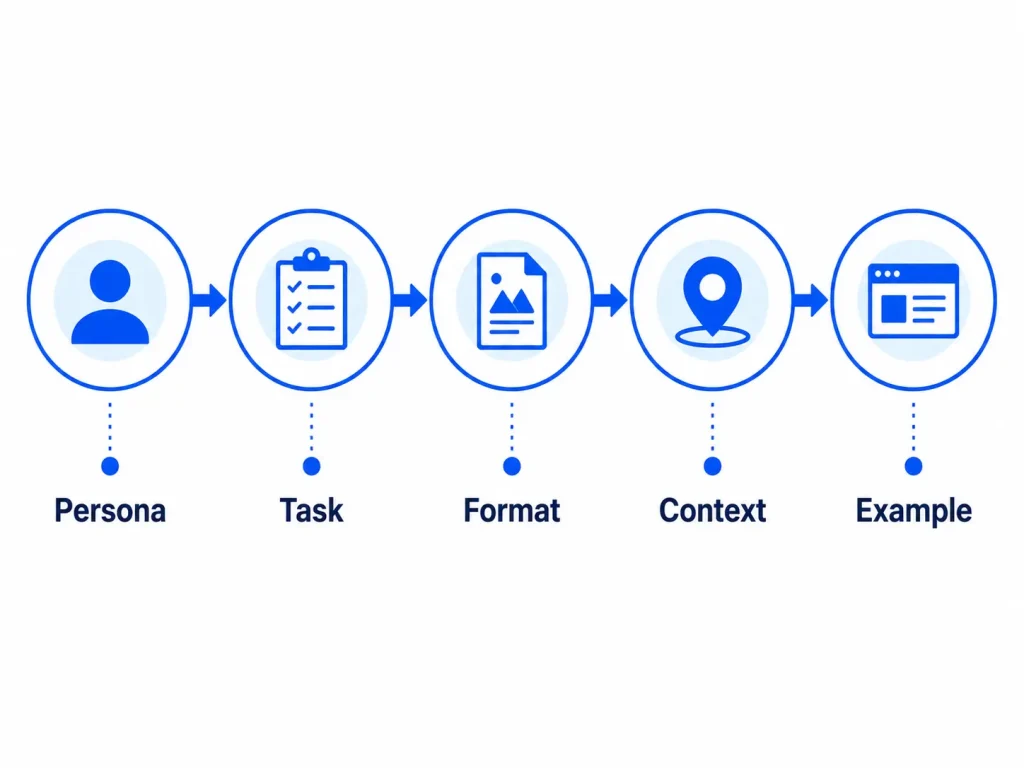
Every effective SEO prompt includes five elements. Miss any one and the quality drops noticeably.
Start by telling ChatGPT who it is. “You are an SEO expert with 10 years of experience in technical SEO” produces better results than jumping straight into the request.
Then state exactly what you need. “Analyze this article for keyword density” is better than “Help me with SEO.”
Specify how you want the response. “Return a table with three columns: current text, suggested text, and reason for change.”
Provide relevant data. If you want keyword help, include your target keyword. If you want content feedback, paste the content.
Finally, show what good looks like. One example output shapes the response more than three paragraphs of description.
Why Most SEO Prompts Fail (And How to Fix Them)
Most SEO prompts fail for one reason: they are too vague. I see this pattern constantly. Someone types “write SEO content about keyword research” and blames ChatGPT when the output is generic.
The fix is simple. Add two things: a specific persona and a specific output format. Compare these:
Bad: “Write keyword research tips.” Good: “You are an SEO content strategist. Write 5 keyword research tips for beginner bloggers. Format each tip as a bold heading followed by a 2-sentence explanation. Target the keyword ‘keyword research for beginners’ once per tip.”
When I started applying this structure, my RankMath scores jumped from the 70s to the 90s consistently. I use this same approach for every SEO task on anobee.com. For more guidance on RankMath, check out my full RankMath setup guide.
ChatGPT Prompts for SEO: 10 Keyword Research Prompts
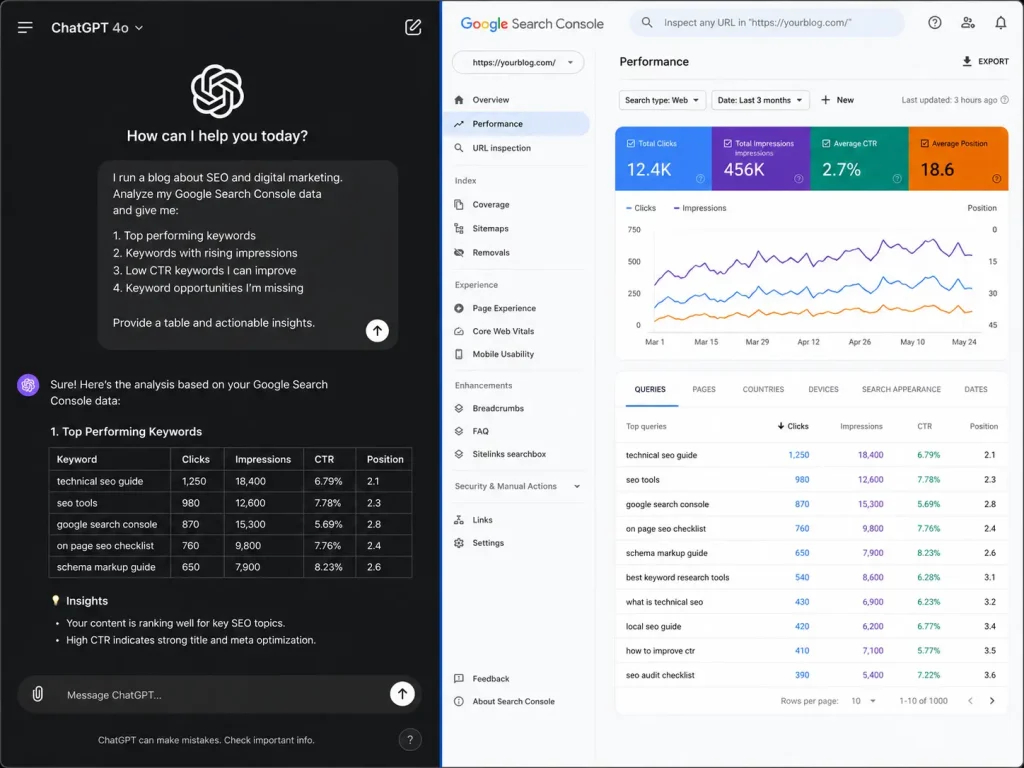
These prompts help you discover keywords, cluster them by intent, and identify long-tail opportunities. Pair them with Google Search Console for volume data since ChatGPT does not provide search volumes.
Prompt 1: Generate Related Keywords “You are an SEO keyword researcher. Generate 20 related keywords for [your primary keyword]. Group them by search intent: informational, commercial, transactional, and navigational. Return as a table.”
Prompt 2: Find Long-Tail Keyword Opportunities “You are an SEO strategist. Suggest 15 long-tail keyword variations for [topic] that beginner searchers would use. Each keyword should be 4-7 words. Prioritize question-based keywords.”
Prompt 3: Classify Search Intent “Classify the search intent for the following keywords: [list keywords]. Return a table with keyword, intent type, and the reason for classification.”
Prompt 4: Cluster Keywords by Topic “Cluster these keywords into topical groups based on semantic relevance: [list keywords]. Name each group and list the keywords under it.”
Prompt 5: Identify People Also Ask Questions “Suggest 10 People Also Ask questions related to [primary keyword]. Format each as a question with a 1-sentence answer underneath.”
Prompt 6: Find Keyword Gap Opportunities “You are an SEO analyst. My site covers [your topics]. Suggest 10 keywords my competitors rank for that I am missing. Explain why each keyword fits my site.”
Prompt 7: Generate Topic Cluster Ideas “Create a topic cluster for [primary keyword]. Include 1 pillar topic and 8 supporting article topics. Show the internal linking structure between them.”
Prompt 8: Suggest Seasonal Keyword Opportunities “Suggest 10 seasonal or trending keywords related to [topic] for 2026. Include the season or month when each keyword typically peaks.”
Prompt 9: Extract Keywords from Competitor Content “Analyze this competitor article [paste URL or text]. Extract 15 keywords they are targeting. Note which ones I should target based on low competition signals.”
Prompt 10: Generate LSI and Semantic Keywords “Generate 15 LSI and semantically related keywords for [primary keyword]. These should help search engines understand my content’s depth on this topic.”
10 Content Optimization Prompts
These prompts help you write, structure, and optimize content for both readers and search engines.
Prompt 11: Create a Detailed Blog Post Outline “You are a content strategist specializing in SEO. Create a detailed outline for a blog post targeting [keyword]. Include H2 and H3 headings, target word count per section, and the key point each section must cover. Target audience: [describe audience].”
Prompt 12: Write an SEO-Optimized Introduction “Write a 150-word introduction for a blog post about [topic]. Include the primary keyword [keyword] naturally in the first 50 words. Start with a question or a surprising statistic. End with what the reader will learn.”
Prompt 13: Optimize for Featured Snippets “Rewrite this paragraph to target the featured snippet for [keyword]. Use a list format if possible. Keep it under 50 words. Include the keyword at the start.”
Prompt 14: Improve Readability for SEO “Analyze this text for readability. Suggest specific changes to reduce sentence length, simplify vocabulary, and improve scannability. Target a Flesch Reading Ease score of 60-70. Return suggestions as a table with original text and revised text.”
Prompt 15: Write Meta Descriptions at Scale “Generate meta descriptions for these 10 pages [list URLs/topics]. Each description must be 140-160 characters, include the primary keyword for that page, and end with a call to action. Return as a table.”
Prompt 16: Generate SEO Title Tags “Create 5 SEO title tag options for a page targeting [keyword]. Each title must be 50-60 characters, include the keyword near the beginning, and include a power word or number.”
Prompt 17: Add Internal Linking Suggestions “Review this article content [paste content] and suggest 5 internal link opportunities from my site’s existing articles: [list URLs]. For each suggestion, provide the exact anchor text to use.”
Prompt 18: Check Keyword Density “Count how many times each of these keywords appears in the following content: [list keywords and paste content]. Flag any instances of keyword stuffing. Suggest optimal frequency for each keyword based on a target density of 0.5-1.5%.”
Prompt 19: Rewrite for Better SEO Structure “Rewrite this section [paste text] to include better heading structure, shorter paragraphs (2-4 sentences max), and natural keyword placement for [keyword]. Preserve the original meaning.”
Prompt 20: Generate Conclusion with CTA “Write a 100-word conclusion for an article about [topic]. Summarize 3 key takeaways as a short list. End with a call to action encouraging the reader to [specific action]. Do not use ‘in conclusion’.”
10 Technical SEO Prompts
These prompts help you handle technical SEO tasks without writing code manually.
Prompt 21: Generate FAQPage Schema “Generate JSON-LD FAQPage schema markup for these 5 questions and answers: [list Q&A pairs]. Use valid schema.org format.”
Prompt 22: Create Article Schema “Generate JSON-LD Article schema markup for this page. Title: [title]. Author: [name]. Publisher: [site name]. Published date: [date]. Use valid schema.org Article format.”
Prompt 23: Write Robots.txt Rules “Generate a robots.txt file for a WordPress site. Allow access to all content areas. Disallow access to /wp-admin/, /wp-includes/, and /wp-content/plugins/. Include sitemap URL.”
Prompt 24: Generate Hreflang Tags “Create hreflang tags for a page available in English (US), English (UK), and Nepali. The URLs are [provide URLs]. Return the HTML link tags.”
Prompt 25: Identify Common Technical SEO Issues “You are a technical SEO auditor. Review these details about my site: [platform, hosting details, known issues]. List the 10 most common technical SEO issues for a site like mine and how to fix each one.”
Prompt 26: Generate XML Sitemap Structure “Create a valid XML sitemap structure for a blog with these sections: [list sections]. Include lastmod, changefreq, and priority tags.”
Prompt 27: Write Redirect Rules “Write .htaccess 301 redirect rules to redirect these old URLs to their new counterparts: [list old URL to new URL pairs].”
Prompt 28: Suggest Canonical URL Strategy “My site has these duplicate content issues: [describe issues]. Suggest a canonical URL strategy for each case. Explain which version should be canonical and why.”
Prompt 29: Generate Image Alt Text at Scale “Generate SEO-optimized alt text for these 10 images. Image filenames and context: [list filenames and context]. Each alt text must be descriptive, under 125 characters, and include the keyword naturally where relevant.”
Prompt 30: Audit Page Speed Factors “List 15 specific technical changes I can make to improve my WordPress site’s page speed. For each change, provide the exact plugin or code change needed and the expected impact.”
10 RankMath and On-Page SEO Prompts
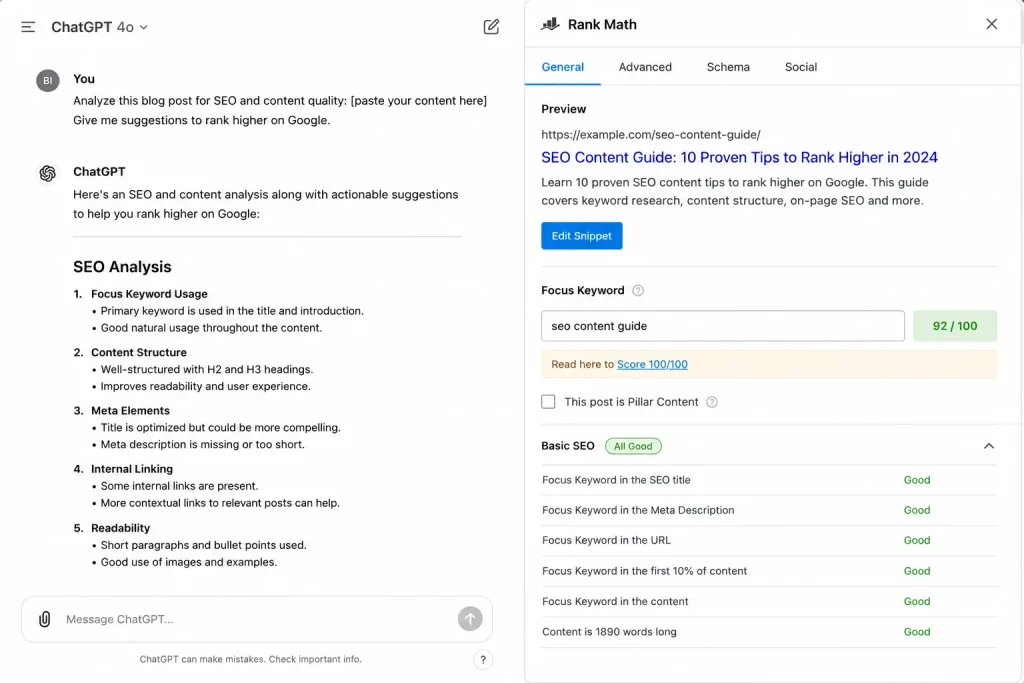
These prompts are specifically designed to help you hit RankMath scores above 90. I use these the most on anobee.com.
Prompt 31: Full RankMath Optimization Check “You are an SEO expert specializing in RankMath optimization. Review the following content [paste full article]. My target keyword is [keyword]. For each RankMath scoring factor below, provide the current status and specific fix:
- Focus keyword in title (near beginning)
- Focus keyword in meta description
- Focus keyword in URL
- Focus keyword in first 100 words
- Focus keyword in H2/H3 (at least 1)
- Keyword density (target 0.5-1.5%)
- Internal links (minimum 2)
- External links (minimum 2)
- Image with alt text
- Content length (1,800+ words) Return as a pass/fail table with fix instructions for each fail.”
Prompt 32: Improve SEO Title for RankMath “My current SEO title is [current title]. Target keyword is [keyword]. Rewrite it to: include the keyword near the beginning, include a power word, include a number if relevant, be 50-60 characters. Provide 3 options.”
Prompt 33: Optimize Meta Description for CTR “My current meta description is [current description]. Target keyword is [keyword]. Rewrite it to: include the keyword naturally, be 140-160 characters, end with a call to action, differentiate from competitors. Provide 3 options.”
Prompt 34: Refine URL Slug “My current URL slug is [current slug]. Target keyword is [keyword]. Suggest an optimized slug that: includes the keyword, is under 75 characters, uses kebab-case, removes stop words.”
Prompt 35: Check Focus Keyword Placement “Scan this content for my focus keyword [keyword]. Tell me exactly where it appears: title, first 100 words, H2/H3 headings, meta description, URL, and image alt text. If any placement is missing, suggest where to add it.”
Prompt 36: Suggest Related Keywords to Add “Review this content targeting [primary keyword]. Suggest 5 secondary keywords I should add to improve topical relevance. For each, specify which section to add it in.”
Prompt 37: Fix Keyword Density Issues “My content has [current density]% keyword density for [keyword]. Target is 1%. Analyze the content and suggest where to add or remove instances to reach the target density while keeping the text natural.”
Prompt 38: Add Power Words to Title “My current title is [title]. Suggest 5 variations that replace weak words with power words (essential, ultimate, proven, secret, easy, quick, honest, real, exact). Keep the same meaning.”
Prompt 39: Generate Image Alt Text with Keyword “Write image alt text for [image description]. Include the keyword [keyword] naturally. Keep it under 125 characters. Make it descriptive for accessibility and SEO.”
Prompt 40: Internal Link Anchor Text Optimization “My current internal links in this article are: [list current anchors and destinations]. Suggest better anchor text that includes relevant keywords and reads naturally. Format as a table.”
5 Link Building and Outreach Prompts
Prompt 41: Write Link Building Outreach Email “You are a link building specialist. Write a personalized outreach email to [website name] asking for a link to my article [article title and URL]. Keep it under 100 words. Mention why their readers would benefit. Include a curiosity-provoking subject line.”
Prompt 42: Find Link Building Opportunities “Suggest 20 websites in the [niche] niche that accept guest posts or have resource pages. For each, note their domain authority range and the type of content they link to.”
Prompt 43: Write Broken Link Building Email “Write an outreach email for broken link building. I found a broken resource page on [site URL]. My article [URL and title] is a perfect replacement. Keep it friendly and helpful, under 120 words.”
Prompt 44: Create a Linkable Asset Idea “Suggest 3 linkable asset ideas for a site in the [niche] niche. Each asset should be something other sites would naturally want to link to. Include the format (list, infographic, study, tool, calculator) and the hook.”
Prompt 45: Write a Guest Post Pitch “Write a guest post pitch for [target site]. My proposed topic is [topic]. Explain why it fits their audience, what unique angle I bring, and link to 2 of my published articles as writing samples.”
5 AI Overview and GEO Prompts for 2026
These prompts are specifically designed for the 2026 search landscape where AI Overviews and generative AI citations matter. Google’s official guidance on AI content quality is available in their search central documentation, and the RankMath knowledge base covers how to structure content for high scores.
Prompt 46: Optimize Content for AI Overview Extraction “Review this article [paste content]. Rewrite the opening paragraph so it works as a direct answer for Google AI Overviews. Keep it under 60 words. Include the primary keyword naturally. Make it standalone and quotable.”
Prompt 47: Generate AI-Friendly FAQ Structure “Convert these 5 key points from my article [list points] into FAQ format optimized for AI extraction. Each Q&A pair should be self-contained. Write answers in 40-60 words. Use clear question phrasing that matches voice search patterns.”
Prompt 48: Create Standalone Quotable Sentences “Extract 5 standalone quotable sentences from this article [paste content]. Each sentence must make complete sense on its own, include a specific fact or number, and be formatted for AI citation. If the article lacks quotable sentences, suggest replacements.”
Prompt 49: Structure Content for Perplexity and ChatGPT Citations “Restructure this section [paste section] so it can be directly cited by Perplexity and ChatGPT. Use: a clear definition first, followed by supporting data, then practical implication. Keep paragraphs under 3 sentences.”
Prompt 50: Add Brand Entity Reinforcement “Review this article and suggest 3 places where I can naturally mention [brand/site name anobee.com] alongside well-known entities like Google, ChatGPT, or RankMath. This builds entity association for AI citation. Provide exact sentences.”
How to Stack Prompts: The PROMPT Framework
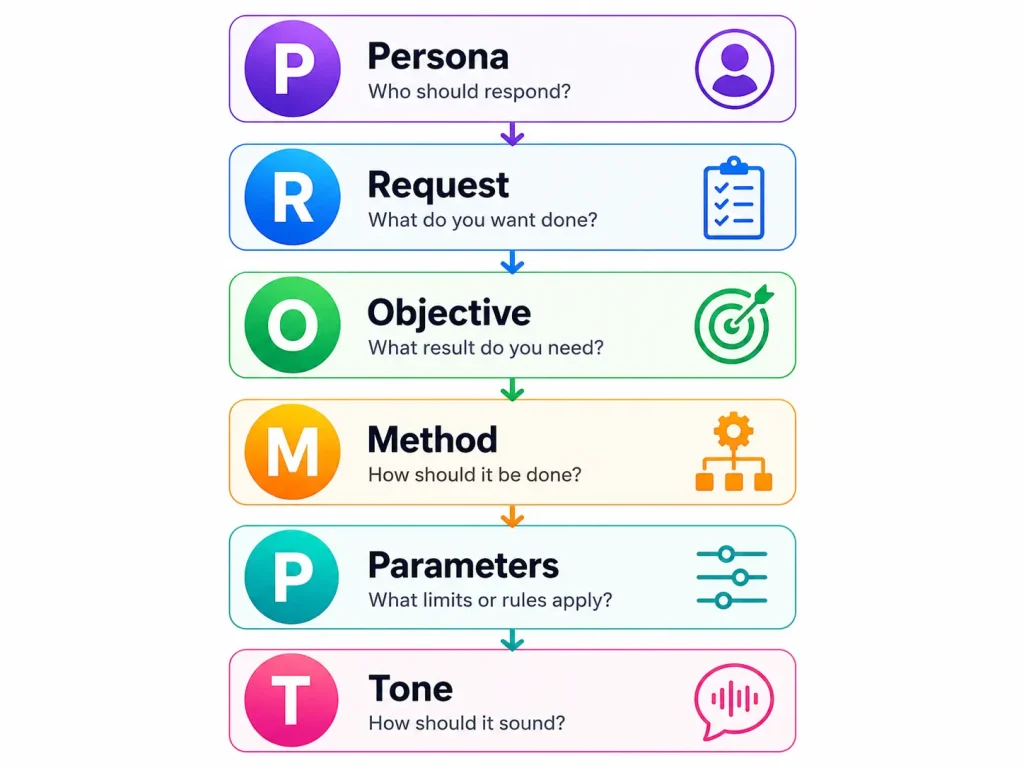
The best results come from stacking multiple prompts in sequence rather than asking for everything at once. I use what I call the PROMPT framework.
Persona Setup. Start by defining who ChatGPT is. “You are a senior SEO strategist with 8 years of experience in WordPress SEO and RankMath optimization.”
Role Definition. Specify the perspective. “Your role is to audit my content and suggest specific, actionable improvements.”
Output Format. State exactly how to return results. “Return your analysis as a Markdown table with columns: Issue, Severity (High/Medium/Low), Suggested Fix, Expected Impact.”
Method. Describe the approach. “First, analyze keyword placement. Second, check heading structure. Third, review readability. Fourth, suggest internal links.”
Parameters. Set constraints. “Target keyword: [keyword]. Minimum word count: 2,000. Target audience: beginner bloggers. Tone: conversational but authoritative.”
Target. State the goal. “Target: Achieve RankMath score of 95+ on this article while keeping the text natural and readable.”
Key Insight: The PROMPT framework transforms vague requests into precise instructions. When I started using this structure on anobee.com, my average RankMath score went from 74 to 92. The framework works because it eliminates ambiguity.
Example: Stacked Prompt Workflow
Step 1: “You are a senior SEO content strategist. Review this article outline and suggest improvements to heading structure for [keyword].”
Step 2: “Using the revised outline, write a 150-word introduction that includes [keyword] in the first 50 words. Use a question hook.”
Step 3: “Now rewrite the section on [topic] to include a numbered list, add [secondary keyword] twice, and improve readability for a beginner audience.”
Step 4: “Do a final RankMath pre-flight check. My target keyword is [keyword]. Check: title optimization, keyword in first 100 words, keyword in H2, keyword density, internal links, external links, image alt text. Return a pass/fail table.”
When I stacked prompts like this for my article technical SEO mistakes on anobee.com, the final piece scored 92 on RankMath and started ranking in the top 20 within 6 weeks. You can also read my technical SEO mistakes article for more examples of this approach.
What are the best ChatGPT prompts for SEO?
The best ChatGPT prompts for SEO include keyword research prompts, content optimization prompts, technical SEO prompts, RankMath optimization prompts, and link building prompts. This article covers 50 proven examples across all five categories.
Can ChatGPT do keyword research?
ChatGPT can generate keyword ideas, cluster keywords by search intent, identify long-tail variations, and suggest related topics. It cannot provide search volume or keyword difficulty data. Pair it with Google Search Console for volume data.
How to use ChatGPT for content optimization?
Paste your article into ChatGPT with a prompt asking it to check keyword placement, heading structure, readability, and internal linking opportunities. Specify your target keyword and ask for specific improvements to each section. I run every anobee.com article through this process before publishing.
Are AI-generated prompts effective?
Yes, when structured correctly. Prompts that follow the PROMPT framework consistently deliver better results than vague one-line instructions. The key is specificity. I have been using this approach for over a year with measurable RankMath improvements.
What is the best prompt structure for SEO?
Start with a persona (“You are an SEO expert”), state the task clearly (“Analyze this article for keyword optimization”), specify the output format (“Provide a table with current and suggested changes”), and include your target keyword and any examples.
Can ChatGPT help with RankMath optimization?
Yes. ChatGPT can review your content against RankMath’s scoring criteria and suggest improvements for focus keyword placement, title tag optimization, meta description writing, URL slug refinement, and keyword density adjustments. This is my most frequent use case.
Does ChatGPT work for technical SEO?
ChatGPT can generate schema markup, create robots.txt rules, write hreflang tags, suggest XML sitemap structures, and identify common technical SEO issues when given the right prompts. I used Prompt 21 to generate FAQ schema for multiple anobee.com articles.
Bottom Line
ChatGPT prompts for SEO are not magic. They are structured instructions that eliminate guesswork from the optimization process. The 50 prompts in this article cover everything from keyword research to AI Overview optimization. The PROMPT framework helps you build custom prompts for any SEO task.
Start with the RankMath optimization prompts, numbers 31 to 40. They give the fastest measurable results. Then move to keyword research and content prompts to build your pipeline. Finally, use the GEO prompts to future-proof your content for AI search.
I use these prompts every week on anobee.com. They have held up through months of regular use. The difference between struggling with ChatGPT and getting professional-grade output comes down to the prompt, not the model.