SEO & AI Search
How to Conduct a Competitor Content Analysis: 7 Steps, With the Analysis Run on This Page's Own Keyword (2026)
By Bibek Thapa · Updated · 12 min read
Quick Answer
A competitor content analysis compares your page with the pages ranking above it for a keyword and finds what they have that you do not. Do it in this order: check your own position in Search Console, pull the real top 10 for your market, audit each page in a spreadsheet, sort the gaps into four types, then write a short differentiation plan before drafting. Re-check at 90 days.

Table of ContentsOn this page
- Why the order of a competitor content analysis matters
- Step 1: Check your own position
- Step 2: Get the real top 10
- Step 3: Audit each page in a competitor content analysis spreadsheet
- Step 4: Sort competitor content analysis gaps into four buckets
- The tools that matter, and what each one does not do
- Step 5: Test what AI systems cite
- Step 6: Write the differentiation plan before drafting
- Step 7: Re-check at 90 days
- Common mistakes
- Bottom line on competitor content analysis
- Frequently Asked Questions
- Sources and References
Key Takeaways
- Check your own position first. Past position 20, competitor gaps are secondary; ranking and indexing come first.
- Word count and heading counts are easy to measure and least useful. Dates, schema, evidence and whether the writer did the thing matter more.
- Gaps come in four kinds: nobody covered it, it is stale everywhere, everyone describes it but nobody did it, or an AI system is citing something weak.
- Run on its own keyword, this page sat at position 75 on exactly the right queries: a ranking problem, not a content gap.
- The seven pages ranking for this keyword ran 2,000 to 7,000 words; none carried first-hand data. That was the gap.
- Screaming Frog (free to 500 URLs), Search Console and a spreadsheet are enough to start. Paid tools add volume and links, not the audit.
The term "competitor content analysis" sounds bigger than the task. Thirty to sixty minutes per keyword, once you have done it a few times. This is a refreshed version of Anobee's guide, and the main change is that the process is now shown running for real: the keyword is this article's own, the audit table is the actual one, and the Search Console numbers are this page's numbers before the rewrite. The steps are the same. However, the evidence is new.
Why the order of a competitor content analysis matters
The usual mistake is to open three competitor tabs and start counting words before checking your own numbers. Admittedly, that was the mistake behind the first version of this article. Pulling Search Console for anobee.com in July 2026 showed a site-wide average position of 59.9 and a 0.8% click-through rate on 5.16K impressions. The instinct was to look for a content or AI Overview problem. However, the numbers said something simpler: most pages were not being shown, and competitor content analysis cannot fix that.
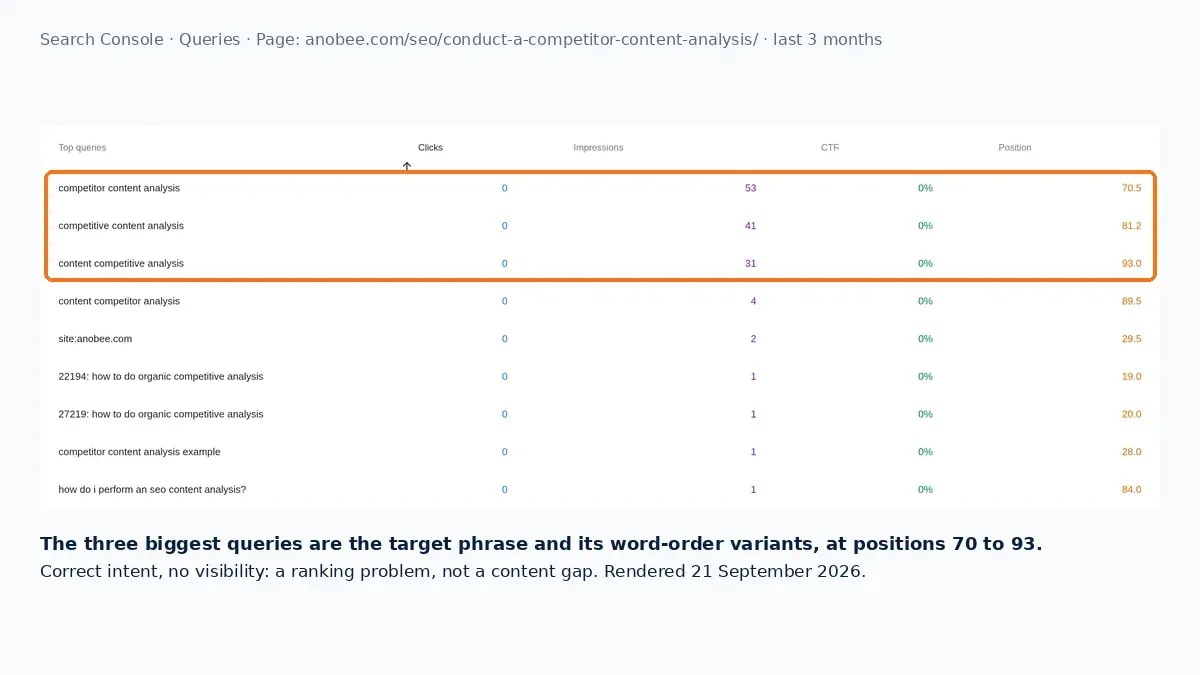
Then this page went on to prove the point about itself. Over the three months to 19 September 2026 it recorded 143 impressions, 0 clicks and an average position of about 75. The queries were exactly right: "competitor content analysis", "competitive content analysis", "content competitive analysis". Thus: correct intent, wrong page of the results. Therefore, a gap analysis on a page at position 75 is a plan for a page that nobody will see. Check your own position first.

Step 1: Check your own position
Open Search Console, filter Performance by the page or the keyword, and read average position over the last three months. Otherwise, if you have not set the property up, the Search Console setup guide comes first.

- Position 1 to 10: go straight to comparing content. The gap is in the page.
- Position 11 to 20: compare content. However, weight internal linking and technical checks equally.
- Position 21 and beyond: gaps are secondary. Instead, indexing, intent match and topical authority come first. The guide to covering a subject properly is the work at this stage.

Do not assume low clicks mean a content problem until you have ruled out a ranking problem. Also, read the Queries report: if the impressions come from the wrong queries, the page has an intent problem, and the search intent analysis guide is the next step rather than this one.
Step 2: Get the real top 10
Search the keyword in a private window from the country you are targeting. Google, ChatGPT, Perplexity and AI Mode can each return a different set for the same words. Moreover, Google's own results shift by market. If your readers are in more than one country, run the search from at least two before deciding what "the top 10" is. Note the ten organic results plus anything cited in an AI Overview. Additionally, note which domains keep appearing across related queries; those are the ones Google already treats as authorities on the topic.
For this article the market is global English, and the query set from Search Console was "competitor content analysis" and its two word-order variants. The pages that came back were guides from StoryChief, Clearscope, Similarweb, Surfer, Socialinsider, Competitors App and HubSpot.
Step 3: Audit each page in a competitor content analysis spreadsheet
For the top five to ten, record the same signals for each page: word count, heading counts, tables, images, publish and update dates, schema types, whether the byline is a named person, and whether there is anything first-hand in it or whether it reads as a summary of other guides. Screaming Frog handles the mechanical part and is free for up to 500 URLs per crawl [3]. If a page blocks crawlers, open it in a browser and note the same things by hand. Incidentally, a crawler block is itself information: the page is usually ranking on domain strength rather than depth.
Do this in a spreadsheet, one row per competitor, one column per signal. Once five or six rows are filled in, patterns show up that you would never see flipping between tabs. This sheet is the competitor content analysis; everything before it is setup and everything after it is interpretation.
Here is the audit for this keyword, run on 21 September 2026. Word counts are estimates from the extracted main content.
| Page | Words | H2 / H3 | Tables | Images | Published | Updated | First-hand data |
|---|---|---|---|---|---|---|---|
| StoryChief | ~2,500 | 4 / 8 | 0 | 16 | May 2024 | Dec 2025 | No |
| Clearscope | ~2,800 | 8 / 11 | 0 | 7 | Sep 2023 | not shown | No |
| Similarweb | ~2,100 | 4 / 6 | 0 | 21 | Oct 2023 | Jul 2025 | No |
| Surfer | ~3,200 | 5 / 15 | 0 | 26 | Sep 2026 | Sep 2026 | No |
| Socialinsider | ~3,100 | 9 / 14 | 0 | 13 | Jul 2026 | Aug 2026 | No |
| Competitors App | ~3,100 | 6 / 22 | 0 | 14 | Apr 2024 | Jan 2025 | No |
| HubSpot | ~7,000 | 21 / 57 | 1 | 33 | Jan 2026 | Jan 2026 | No |
| This page (before) | ~2,600 | 17 / 3 | 0 | 7 | Jul 2026 | Jul 2026 | One GSC figure |
Three things stand out from the sheet that were not obvious from reading the pages. First, length varies threefold and does not track order; HubSpot's 7,000 words is a competitive-analysis kit, not a content-analysis guide. Second, two of the seven pages had not been updated in over a year. Third, none of the seven carried a single first-hand number: no audit table, no Search Console figure, no dated result. Every one describes the process. Meanwhile, none runs it.
Length is the easiest signal to measure and the least useful. Instead, dates, evidence and whether the writer actually did the thing separate a strong page from a mediocre one far more reliably.
Step 4: Sort competitor content analysis gaps into four buckets
- Coverage gap. Nobody covers an angle people search for. Usually it shows up as a People Also Ask question that none of the top 10 answers directly.
- Refresh gap. The whole top 10 is out of date: a tool renamed, a feature gone, a statistic three years old. Here, two of seven pages above qualify.
- Experience gap. Everyone describes it; nobody demonstrates it with specific numbers, dates or outcomes. Here, all seven pages above qualify.
- AI citation gap. An AI system is citing a forum thread or a thin page for the query. Because that source is weak, it is displaceable.

Prioritise the experience gap. A coverage gap closes the moment any competitor notices the missing subtopic. However, an experience gap stays open until someone who has done the work writes it down, which is a much smaller pool. It is also what Google's guidance is pointing at: content that demonstrates "first-hand expertise and a depth of knowledge" [2], and, for its AI features, content that is "unique, compelling, and useful" rather than commodity content that "could originate from anyone" [1].
The buckets overlap. One competitor page can be a refresh gap on its statistics and an experience gap on its process. That only means there is more than one angle to take.
The tools that matter, and what each one does not do
Search Console. Free, and the only source for your own position, impressions and queries. However, it shows nothing about competitors.
Screaming Frog. Free for crawls up to 500 URLs, which covers the audit in Step 3 [3]. It returns word counts, headings, response codes and schema. Similarly to Search Console, it has a blind spot: no search volume or backlinks, and it cannot get past a crawler block.
Ahrefs or Semrush. Paid. Useful for volume, difficulty and backlink counts when deciding whether a keyword is worth the effort at all. However, they are not required for any of the seven steps.
ChatGPT, Perplexity, Gemini, Claude. Free tiers cover Step 5. However, no tool checks all of them at once reliably. Consequently, this stays a manual monthly job.
A spreadsheet. The backbone of any competitor content analysis. Every signal from Step 3 goes into it, and the patterns appear in the sheet, not in any tool's dashboard.
Step 5: Test what AI systems cite
Ask ChatGPT, Perplexity, Gemini and Google AI Mode the keyword directly, in fresh sessions. Note which competitors are cited and copy the exact sentence that was quoted. That tells you two things: which sources these systems currently trust for the topic, and what sentence-level shape earned the citation. If a rival is quoted for one clean definition at the top of a section, match that shape. Do not copy their whole outline.
Keep the prompts fixed and repeat them monthly, because the source sets move. In Anobee's own AI citation index, Perplexity cited the site in three consecutive runs and kept almost none of the same pages between them. Thus a citation is a snapshot. The method for checking AI citations has the recording template.
Step 6: Write the differentiation plan before drafting
Four or five lines, on paper, before you write anything: which coverage gap becomes a new section, which refresh gap fact gets a current source, which experience gap you close with your own account, and which AI-citation sentence you write more cleanly than the one being quoted.
For this article the plan was short. Coverage gap: most guides jump straight to competitor comparison, so "check your own position first" became the first step. Refresh gap: older guides still point to tool features that have moved, so tool claims were re-verified. Experience gap: no competitor shows the analysis actually running. Accordingly, this page now contains its own audit table and its own Search Console figures. AI-citation gap: none found worth targeting for this query.
Skip the plan and the draft drifts toward whatever structure you last read, which produces a rewrite of the top 10 in your own words. That is the commodity content Google's guidance describes [1]. Ultimately, it is the outcome this whole process exists to avoid.
Step 7: Re-check at 90 days
Competitor pages move. A gap found in September can be closed by December if one competitor updates. Therefore, keep the spreadsheet from Step 3 rather than deleting it, and at 90 days re-run Steps 2 to 5 into new columns on the same sheet. Comparing rows across two dates shows which competitors maintain their pages and which published once and left. That is itself a guide to where the next gap will open. In the table above, Surfer and Socialinsider updated within the last two months; Clearscope and Competitors App did not.
Common mistakes
Treating word count as the target. A 3,000-word competitor page got long because it answered more sub-questions. Consequently, copying the length without the reason produces padding that reads like padding.
Comparing only against position one. The gap between positions one and three is often small. Meanwhile, the gap between one and eight tells you more about what separates a strong page from an average one.
Skipping the 90-day re-check. The top 10 is a snapshot. Nevertheless, most people run the analysis once per keyword and never again.
Writing the plan after the draft. Without the plan written first, the draft defaults to the last structure you read. Ultimately, that is a rewrite, not a differentiation.
Ignoring pages that block your crawler. A 403 does not mean the page does not count. Instead, it usually means the site has enough authority to lock down scraping, and a manual look is worth five minutes. The content audit guide has the fuller checklist this feeds into.
Bottom line on competitor content analysis
A competitor content analysis works as a diagnostic, not a copying exercise. Check your own rank, pull the real top 10, put the audit in a spreadsheet, sort the gaps, and go after the experience gap first, because nobody can paste their way into it. Then re-run it in 90 days. Run on its own keyword, this page found seven competitors describing the process and none demonstrating it, and found itself at position 75. The rewrite you are reading is the differentiation plan, executed.
Frequently Asked Questions
What is a competitor content analysis?
It is a structured comparison of your page against the pages currently ranking for the same keyword, done to find what they cover, cite or demonstrate that you do not, and where they are weak. The output is a short list of gaps to close and a plan for how, not a copy of the top result.
How long does a competitor content analysis take?
Thirty to sixty minutes per keyword once you have a spreadsheet template, most of it in the page audit. Competitive commercial terms take longer because the top 10 is larger and more varied. The 90-day re-check is faster, since you only update columns.
What tools do I need for a competitor content analysis?
Google Search Console for your own position, Screaming Frog (free up to 500 URLs per crawl) for the page audit, and a spreadsheet for the comparison. Ahrefs or Semrush add search volume and backlink counts, which help decide whether a keyword is worth the effort, but they are not required to run the analysis.
Should I check my own ranking before analysing competitors?
Yes. If your page is past position 20, the gap between you and the top 10 is usually indexing, topical authority or intent mismatch, not a missing subheading. This page is the example: 143 impressions, 0 clicks and position 75 on exactly the right queries. Content gaps matter once you are close enough to compete for the click.
Which content gap should I prioritise?
The experience gap: a topic everyone describes but nobody demonstrates with their own numbers, dates or outcomes. It is the hardest gap for competitors to close, because it requires having done the thing, and it is what Google's guidance on first-hand expertise and non-commodity content is asking for.
Sources and References
Was this guide helpful?
Your answer helps Anobee improve future updates.

Written by
Bibek Thapa
AI-Powered Digital Growth Strategist
Bibek Thapa works across AI workflows, SEO, AI search optimization, content strategy, website growth, and productivity systems at Anobee.
- AI workflows
- Digital growth
- SEO
- GEO
- AEO
- Content strategy
- Website growth