
Freelancing & Online Business
How to Choose a Profitable Blog Niche: The Checks That Actually Settle It
By Bibek Thapa · Updated · 12 min read
Quick Answer
A profitable blog niche is one where you can answer questions people search for and where somebody already pays to reach that audience. Check the money against published thresholds: AdSense sets no traffic minimum, Journey by Mediavine starts above 1,000 sessions, Mediavine Official wants $5,000 a year in ad revenue, and Raptive needs 25,000 monthly pageviews.

Table of ContentsOn this page
- What actually separates a profitable blog niche from a topic
- The monetisation ceiling is the part you can check today
- Step 1: Start from what you can already answer
- Step 2: Test demand with numbers you can see
- Step 3: Read the competition honestly
- Step 4: Check the money before you commit
- Broad niche or micro-niche
- What to validate before you publish anything
- Common mistakes when picking a profitable blog niche
- Bottom line on choosing a profitable blog niche
- Frequently Asked Questions
- Sources and References
Key Takeaways
- Journey by Mediavine accepts sites above 1,000 sessions; Mediavine Official asks for $5,000+ in annual ad revenue.
- Raptive's minimum is 25,000 monthly pageviews, plus a domain at least six months old and a specific traffic geography.
- AdThrive is now Raptive, so any guide still naming AdThrive is quoting thresholds that have since changed.
- AdSense publishes no traffic minimum, which makes it the realistic first step rather than a goal to aim at.
- Published RPM ranges are self-reported and unaudited; your own advertiser demand is checkable in Keyword Planner.
- Traffic geography now decides monetisation as much as topic does: half of Raptive's entry tier must be US, UK, CA, NZ or AU.
Most advice on picking a profitable blog niche is unfalsifiable. It tells you to find the overlap of passion, demand and profit, which is true and useless, because nothing in it can be checked. However, the ad networks publish numbers that can be checked. Those numbers moved.
This page previously quoted RPM ranges "based on Mediavine and AdThrive publisher reports". AdThrive is now Raptive, and its published requirement today is 25,000 monthly pageviews rather than the six-figure threshold that circulated for years [2]. Mediavine no longer gates on sessions at all for its main tier: Journey by Mediavine takes sites above 1,000 sessions, and Mediavine Official is gated on $5,000 in annual ad revenue [1].
So this refresh replaces the estimate tables with entry requirements you can verify in a browser tab. The invented NICHE MATRIX scoring framework is gone, along with the RPM figures that no published report could be traced to. One unfilled internal link placeholder has been replaced with a live link.
What actually separates a profitable blog niche from a topic
A topic is a subject. A niche is a subject narrowed by audience, angle or application until one reader recognises it as theirs. "Personal finance" is a topic. "Debt payoff for single-income households" is a niche. Furthermore, the narrowing is not cosmetic. It decides whether a small site can cover the question set completely.
Two conditions have to hold at once. People must be searching for things you can answer well, and somebody must already be spending money to reach those people. Demand without spending gives you traffic that never converts. Conversely, spending in a subject you cannot write credibly about gives you pages nobody finishes.
Google's own guidance is explicit about the second half of that. It asks whether content shows "first-hand expertise and a depth of knowledge", and whether it was written by somebody "who demonstrably knows the topic well" [5]. Meanwhile, passion is a staying-power input, not a qualification. It gets you through the months where nothing ranks.
The monetisation ceiling is the part you can check today
Here is what each network publishes as an entry requirement, checked on 27 September 2026. These numbers decide when a niche starts paying. Additionally, they are the part of the decision that needs no guesswork.
| Network | What it takes to get in | Also checked |
|---|---|---|
| Google AdSense | No published traffic minimum. You must be 18+, own the site and have original content [3] | Policy compliance |
| Journey by Mediavine | More than 1,000 sessions [1] | Original content, clean traffic, good standing with Google |
| Mediavine Official | $5,000+ in annual ad revenue [1] | Traffic sources, countries of origin, reader experience |
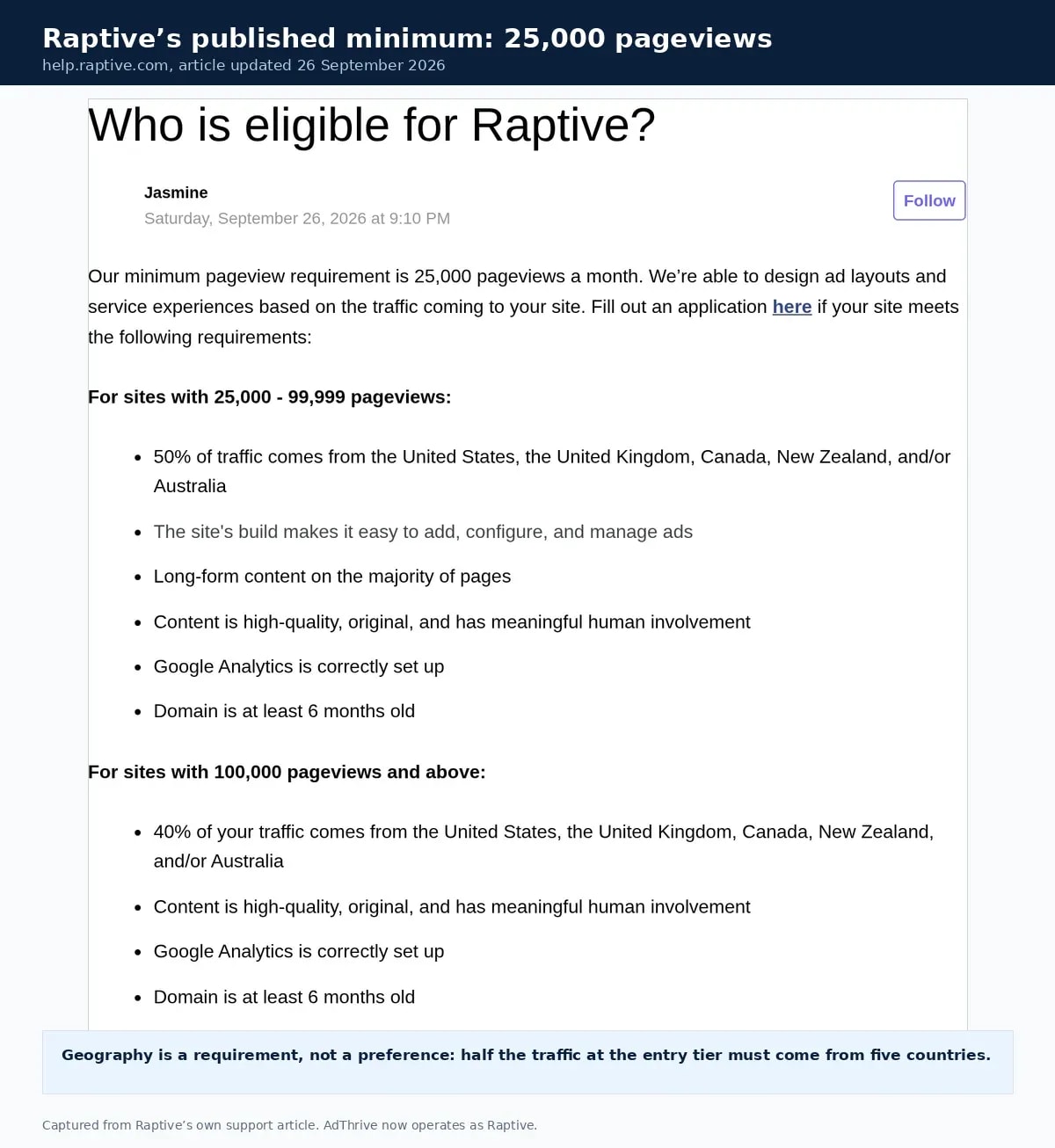
| Raptive (formerly AdThrive) | 25,000 monthly pageviews, and 50% of traffic from the US, UK, Canada, New Zealand or Australia [2] | Domain at least 6 months old, Google Analytics configured, long-form content |
| Raptive, larger tier | 100,000+ pageviews, with the geography requirement relaxed to 40% [2] | Same content standards |
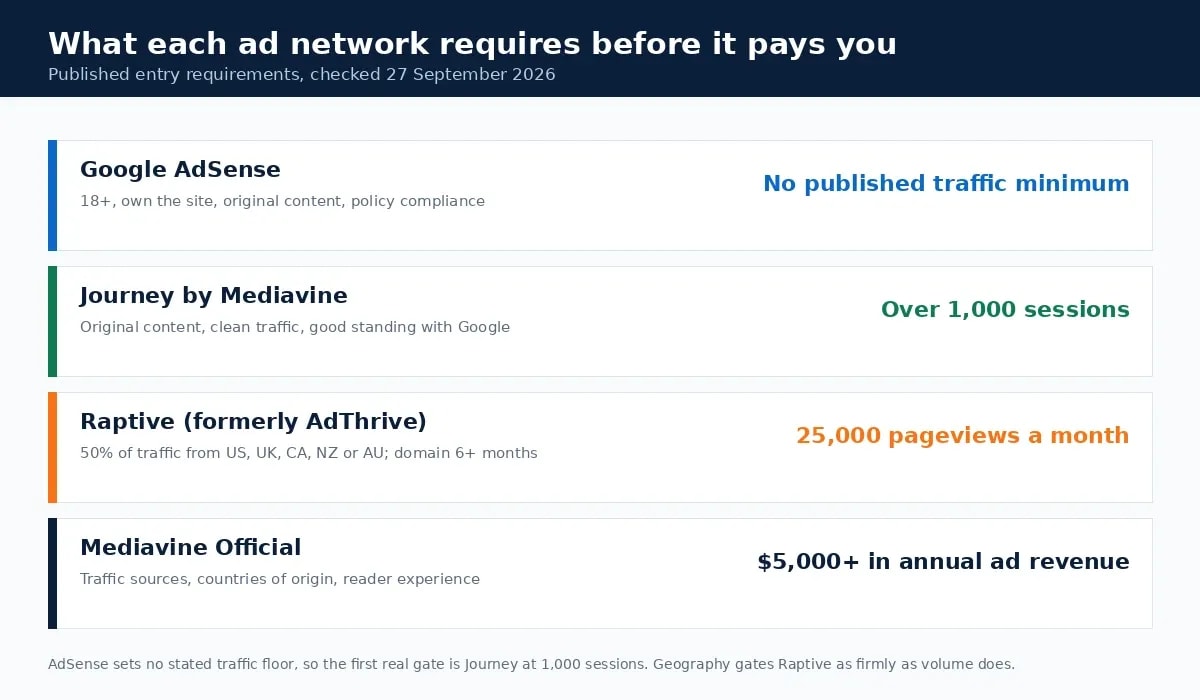
Two things in that table change how a profitable blog niche should be chosen. First, the entry point is far lower than the folklore: 1,000 sessions is a few months of consistent publishing, not a year. Second, geography is now a gating factor at the same level as topic. A niche whose audience sits mostly outside those five countries clears the content bar and fails the traffic bar. Ultimately, no amount of writing fixes that.

What you will not find here is a table of RPM estimates by niche. Those circulate widely, but the figures are self-reported and unaudited. Thus repeating them would be pretending to a precision nobody has.
Step 1: Start from what you can already answer
List the questions people ask you without having to look anything up. Work history counts. Similarly, so does an expensive hobby, or a problem you solved for yourself over several years. This is the input nobody else can copy, and it is the one Google's guidance describes as first-hand expertise [5].
However, be honest about the gap between interest and knowledge. Wanting to learn a subject is a fine reason to read about it and a poor reason to build a site on it. The first fifty articles will read like someone summarising other people's work, which is exactly what a reader can get elsewhere.
Step 2: Test demand with numbers you can see
Search volume tells you whether the questions exist. Meanwhile, bid estimates tell you whether anyone is paying to answer them. Keyword Planner shows both: search estimates per month, and "the average cost for your ad to show on searches for a keyword" [4].
One practical catch to plan around. Basic features need a Google Ads account with billing details on file, though no live campaign is required [4]. Therefore budget a few minutes for setup before you expect numbers, and treat any tool that shows you volume without that step as an estimate of an estimate.
A profitable blog niche has a recognisable shape here: a handful of core terms with real volume, and thirty or forty long-tail questions you could answer properly. Otherwise, if the long tail is thin, the niche is a single article rather than a site. The keyword research tools guide covers what each tool gives you at what price.
Step 3: Read the competition honestly
Open the top ten results for your main term and read them as a reader, not as a competitor. Ask what question each page answers, what it leaves unanswered, and which reader it ignores. High authority is not the wall it looks like. Indeed, thin content ranking on brand strength is displaceable, and specific content is what AI answers tend to quote.
The competitor content analysis guide sets out how to do this systematically. Although the full version is worth running later, the quick check is enough now. If every result already answers the question completely, and better than you could, pick a different angle.
Step 4: Check the money before you commit
Work the monetisation path backwards from the table above. Accordingly, ask at what traffic level this niche clears 1,000 sessions, and what 25,000 pageviews would require. Then ask where the audience lives, since geography is a gate at the Raptive tier. Finally, check which affiliate programmes exist, and whether they pay on things this audience actually buys.
Ads are rarely the whole answer anyway. A niche that supports a $29 template or a short course reaches useful income at a fraction of the traffic a display-only site needs. Consequently, build an email list and eventually a digital product alongside the ads rather than after them.
Broad niche or micro-niche
For a new site, narrow wins. A micro-niche lets forty to sixty articles cover a question set completely. Moreover, that completeness is legible to both search engines and AI systems in a way breadth is not. Broad makes sense when you already have authority, a team, or an audience arriving from somewhere else.
Therefore the practical route into a profitable blog niche is a narrow entry inside a broad subject. Pick the wider area you want to end up in, find the audience segment the existing content ignores, and build there first. Authority earned in the narrow version transfers outward; starting broad gives you nothing to transfer.

What to validate before you publish anything
Ultimately, a profitable blog niche should survive this list before you commit months to it:
- Thirty or more specific article titles you could write without new research.
- Core terms with real search volume, and a long tail you could realistically rank for.
- Bid estimates in Keyword Planner that show advertisers competing for the audience.
- An audience that gathers somewhere findable: a subreddit, a forum, an active community.
- At least two income routes, so the site is not hostage to one network's policy change.
- A traffic geography that matches where the money is, if display ads are the plan.
- A subject whose core survives the trend that made you notice it.
Common mistakes when picking a profitable blog niche
- Treating interest as qualification. Interest keeps you going, but it does not make the content worth reading.
- Quoting RPM tables as fact. Most are self-reported, undated and uncheckable. The network requirements are published; use those instead.
- Ignoring where the audience lives. A niche can pass every content test and still fail Raptive's geography requirement [2].
- Planning around a name that changed. AdThrive became Raptive, and the thresholds moved with the rename.
- Choosing a niche too narrow to sustain sixty articles. If the list stops at fifteen, it is a category inside a site, not a site.
- Building entirely on a platform or product. Cover the trend; do not let it be the subject.
Bottom line on choosing a profitable blog niche
The unfalsifiable half of this decision will always be yours: what you know, and what you will still be writing about in two years. Nevertheless, the falsifiable half is published, and it is more generous than most guides admit. Journey by Mediavine opens above 1,000 sessions, Raptive at 25,000 pageviews with the right traffic mix, AdSense at no stated minimum at all. Pick the subject you can cover completely, check the geography and the bid estimates before you commit, and plan a second income route from the start. That combination, rather than a niche list, is what makes a blog niche profitable.
Frequently Asked Questions
What makes a blog niche profitable?
Two things together: people search for answers you can genuinely give, and somebody already spends money to reach those people. Search demand without advertiser or affiliate spending produces traffic that never converts. Advertiser spending in a subject you cannot write about credibly produces content nobody stays on. You need the overlap, not either half.
How much traffic do you need before a blog earns from ads?
Less than the usual folklore suggests. AdSense publishes no traffic minimum. Journey by Mediavine accepts sites above 1,000 sessions, Raptive starts at 25,000 monthly pageviews, and Mediavine Official is gated on $5,000 a year in ad revenue rather than on sessions at all.
Is AdThrive still a separate ad network?
No. AdThrive now operates as Raptive, and its published entry requirement is 25,000 pageviews a month, with at least half of traffic from the United States, United Kingdom, Canada, New Zealand or Australia at that tier. Guides that still quote AdThrive figures are quoting a name that changed, and thresholds that changed with it.
Should a new blog pick a broad niche or a micro-niche?
A micro-niche, in almost every case. A narrow subject lets a small site cover a question set completely, which is what both search engines and AI answers reward. Broad works when you already have authority, a team, or an audience to bring with you.
How do you check whether advertisers spend money in a niche?
Google's Keyword Planner shows bid estimates, described as the average cost for an ad to show on searches for a keyword. Note that basic features need a Google Ads account with billing details on file, even though no live campaign is required.
Sources and References
Was this guide helpful?
Your answer helps Anobee improve future updates.

Written by
Bibek Thapa
AI-Powered Digital Growth Strategist
Bibek Thapa works across AI workflows, SEO, AI search optimization, content strategy, website growth, and productivity systems. Anobee documents practical lessons, tools, experiments, and systems for improving digital presence.
- AI workflows
- Digital growth
- SEO
- GEO
- AEO
- Content strategy
- Website growth