Content & Marketing
Social Media Marketing Guide: A Strategy You Can Actually Check
By Bibek Thapa · Updated · 11 min read
Quick Answer
Social media marketing is using social platforms to reach an audience and move it toward a business outcome you can measure. Pick one goal, choose the two platforms where your audience already is, publish at a cadence you can hold, and measure in GA4 rather than in platform dashboards. Tool costs vary enormously: Buffer starts at $5 per channel a month, Hootsuite at $99 per user.
Table of ContentsOn this page
- What social media marketing is, and what it is not
- The scale, in numbers you can check
- Step 1: Choose one goal you can measure
- Step 2: Choose platforms by where the audience already is
- Step 3: Build a content mix you can sustain
- Step 4: Measure outside the platform dashboards
- What the tools actually cost
- Common social media marketing mistakes
- Bottom line on social media marketing
- Frequently Asked Questions
- Sources and References
Key Takeaways
- 5.79 billion social media user identities existed in April 2026, growing 5.4% year on year per DataReportal.
- The typical user spends 18 hours 36 minutes a week on social media, which is where attention budgets get decided.
- Buffer starts at $5 per channel per month; Hootsuite's entry plan is $99 per user per month billed annually.
- Sprout Social Essentials is $79 per seat monthly on annual billing, or $99 billed month to month.
- GA4 removed first-click, linear, time-decay and position-based attribution models in November 2023.
- LinkedIn reports more than 1 billion members across more than 200 countries and territories.
This social media marketing guide needed more removing than adding. The previous version published three sections that were never meant for readers: an "Entity Ecosystem" note about how AI systems parse content, a set of "Expert Insights" quotes attributed to nobody, and "Research Notes" carrying precise statistics with no source behind any of them.
Those quotes were the worst of it. Presenting invented lines in quotation marks implies a person said them. Nevertheless, nobody did. The statistics went with them, including several suspiciously exact claims about reach percentages and conversion multiples that no published study could be matched to.
The ORBIT framework is also gone, along with a section headed "Trends Shaping 2025" sitting inside a 2026 article. What replaces all of it is shorter and checkable: current audience figures from DataReportal, the actual prices on four vendors' pricing pages, and Google's own documentation on how attribution works in GA4 today.
What social media marketing is, and what it is not
Social media marketing is the use of social platforms to reach an audience and move some part of it toward a business outcome. That outcome might be a sale, a subscription, an enquiry or a booked call, but it has to be nameable.
The distinction matters because most accounts that feel unsuccessful are not failing at content. Instead, they are publishing without a destination. Posting consistently while nothing downstream is set up produces engagement that goes nowhere, and then the conclusion that social media does not work.
Organic and paid are the same discipline seen at two speeds. Organic tests what resonates slowly and at no media cost, while paid buys distribution for what already resonated. Consequently, running paid before anything has resonated is how budgets disappear.
The scale, in numbers you can check
DataReportal counted 5.79 billion social media user identities at the start of April 2026, an increase of 294 million in a year, which is annualised growth of 5.4% [1]. The typical user spends 18 hours and 36 minutes a week on social platforms [1].

However, one caveat most guides skip is that identities are not people. Anyone holding accounts on four platforms counts four times. Therefore the figure is a ceiling on reach rather than a population count.
For business-to-business work, LinkedIn's own figure is more than 1 billion members in more than 200 countries and territories [2]. Meanwhile, the older claim that four in five members drive business decisions has quietly disappeared from LinkedIn's public materials, so it is not repeated here.
Step 1: Choose one goal you can measure
Pick a single primary goal for the next quarter. Awareness, audience growth, traffic, leads and sales each need different content and different measurement. Ultimately, a strategy chasing all five produces a feed that reads like five strategies.
Then write down what a good month looks like in a number. Not "more engagement", but a figure you would be satisfied with. Otherwise nothing tells you at the end of the quarter whether the effort earned its place.
Although the honest test comes later, the question is simple. In the content ROI framework terms: what did this produce, against what it cost in hours?
Step 2: Choose platforms by where the audience already is
Two platforms, run properly, beat five run thinly. Moreover, the selection rule is not which platform is growing. It is where the people you sell to already spend those 18-odd hours a week.
- LinkedIn for business-to-business, professional services and recruiting.
- Instagram for visual consumer products, local businesses and lifestyle categories.
- TikTok and short-form video where the product can be demonstrated rather than described.
- YouTube when the buying decision needs explanation and the content has a long shelf life.
- Pinterest for planning-driven categories: interiors, weddings, recipes, craft.
Whichever two you pick, plan for the fact that reach on any platform belongs to the platform. Thus the point of social media marketing is to build something you own, which is why the email list building guide is the natural companion to this one.
Step 3: Build a content mix you can sustain
Cadence beats intensity. Three good posts a week held for a year will outperform daily posting abandoned in week six. Indeed, every platform rewards consistency, and none of them reward a gap.
A workable mix for most accounts:
- Useful content that solves a small problem completely, which is what gets saved and shared.
- Proof content: results, process, work in progress, the parts that show competence rather than claim it.
- Conversation: replies, questions, comments on other people's work. This is where audiences actually form.
- Offers, infrequently and clearly, so people know what you sell without being sold to constantly.
Repurposing is the only way a small team keeps this up. One substantial article becomes several posts, a short video and a newsletter section. Similarly, the content distribution checklist covers that sequence in order.
Step 4: Measure outside the platform dashboards
Every platform reports the conversions it was involved in, which is why the numbers never add up across dashboards. Instead, tag links with UTM parameters and read the result in GA4.
One change most guides have not caught up with: GA4 removed the first-click, linear, time-decay and position-based attribution models in November 2023 [7]. Advice about comparing those models against last click is describing a feature that no longer exists.

What remains is worth knowing. Lookback windows default to 30 days for acquisition events such as first_visit, and 90 days for other key events, with shorter options available [7]. Consequently, if your sales cycle runs longer than the window, the report will credit the last touch and hide the social post that started it.
Three numbers are usually enough: sessions arriving from each platform, key events completed by those sessions, and hours spent producing the content. Meanwhile, everything else is detail.
What the tools actually cost
The previous version of this social media marketing guide described these tools as "premium", "higher price point" and "worth the cost" without a single figure. Accordingly, here is what each vendor's own pricing page said on 27 September 2026.
| Tool | Entry price | What that buys |
|---|---|---|
| Buffer | Free for 3 channels, then $5 per channel/month [3] | Free tier allows 10 scheduled posts per channel; Team is $10 per channel |
| Later | $18.75/month billed yearly [6] | 1 social set of 8 profiles, 1 user, 30 posts per profile. Price shown during a 25%-off promotion |
| Sprout Social | $79 per seat/month billed annually, $99 monthly [5] | Essentials: 5 profiles. Standard $199, Professional $299, Advanced $399 |
| Hootsuite | $99 per user/month billed annually [4] | Standard: up to 10 accounts. Professional $199, Advanced $399 |
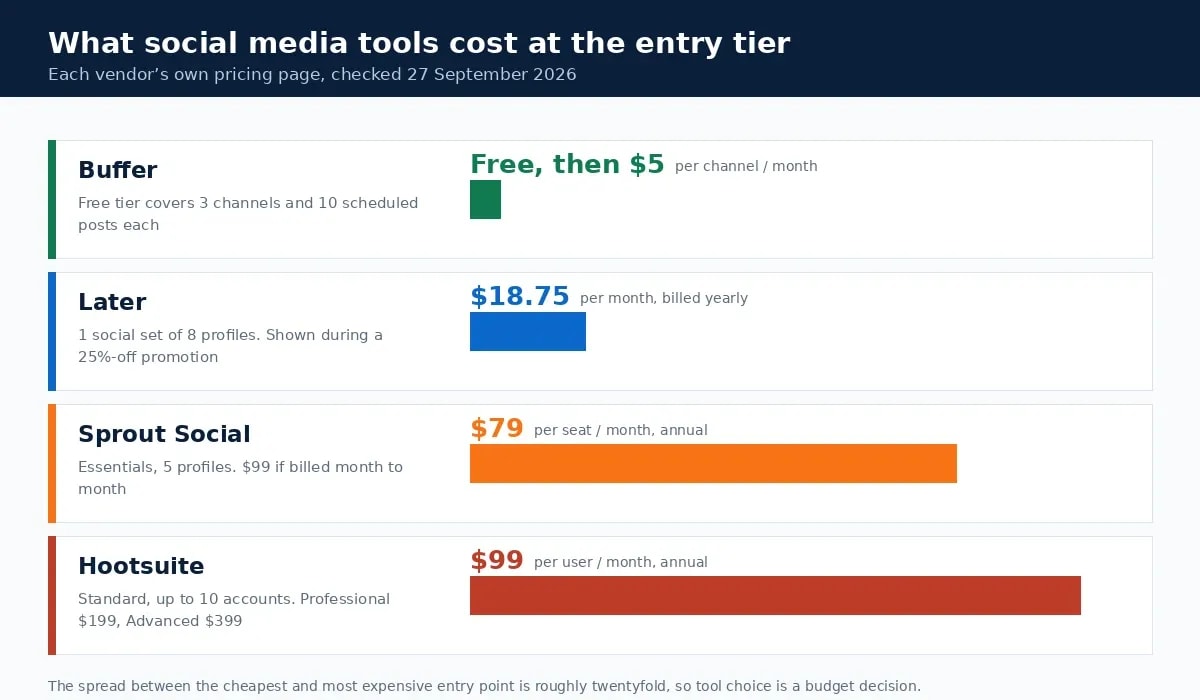
Two observations follow from that table. First, the spread between the cheapest and most expensive entry point is roughly twentyfold, which makes tool choice a budget decision rather than a preference. Second, per-seat pricing at the top end adds up fast. A three-person team on Hootsuite Standard commits to around $3,500 a year before anyone has written a post.

For most small businesses, the free tier or a $5-per-channel plan is enough until scheduling genuinely becomes the bottleneck. Additionally, native platform analytics and Meta Business Suite cost nothing, and they report first-party data that aggregated dashboards sometimes only approximate.
Common social media marketing mistakes
- Publishing with no destination. If nothing downstream is set up, engagement has nowhere to go.
- Running five platforms with one person. Two done properly beat five done thinly.
- Buying the tool before the habit. Scheduling software does not fix an inconsistent cadence.
- Trusting platform dashboards on attribution. Each one counts conversions it touched; GA4 is the tiebreaker.
- Treating follower count as the score. A small engaged audience outperforms a large indifferent one on every commercial metric.
- Quoting statistics without a source. If a number cannot be traced to a published study, it should not be in the strategy deck either.
Bottom line on social media marketing
The strategy fits on one page. Name a goal with a number attached, pick the two platforms where your audience already is, publish a mix you can hold for a year, keep links tagged so GA4 can tell you what happened, and spend on tools only when the workload demands it. The audience is genuinely enormous, at 5.79 billion identities and more than eighteen hours a week each [1]. What is scarce is the discipline to connect any of it to an outcome you can name.
Frequently Asked Questions
What is social media marketing?
It is the use of social platforms to reach an audience and move some part of it toward a business outcome, through a mix of published content, conversation in comments and messages, and paid promotion. The word marketing is doing real work there: activity that never connects to an outcome you can name is publishing, not marketing.
How many people use social media?
DataReportal counted 5.79 billion social media user identities at the start of April 2026, up 294 million year on year, which is annual growth of 5.4%. Identities are not people, since many users hold accounts on several platforms, so treat it as a ceiling rather than a headcount.
Which social media platform should a small business choose?
Two at most, chosen by where the audience already is rather than by which is growing fastest. A business selling to other businesses will usually find LinkedIn worth more than TikTok; a visual consumer product often finds the reverse. Running five platforms badly is the most common way a small team wastes a year.
How much do social media management tools cost?
The range is wide. Buffer has a free tier for three channels and charges $5 per channel per month on Essentials. Later's Starter plan was $18.75 a month billed yearly at the time of checking. Sprout Social Essentials is $79 per seat per month on annual billing, and Hootsuite's entry plan is $99 per user per month.
How do you measure social media ROI?
Tag every link with UTM parameters and read the result in GA4 rather than in each platform's own dashboard, because platforms count conversions they were involved in. Note that GA4 removed first-click, linear, time-decay and position-based attribution models in November 2023, so comparisons across those models are no longer available.
Sources and References
Was this guide helpful?
Your answer helps Anobee improve future updates.

Written by
Bibek Thapa
AI-Powered Digital Growth Strategist
Bibek Thapa works across AI workflows, SEO, AI search optimization, content strategy, website growth, and productivity systems. Anobee documents practical lessons, tools, experiments, and systems for improving digital presence.
- AI workflows
- Digital growth
- SEO
- GEO
- AEO
- Content strategy
- Website growth