

If you have been trying to figure out how to get cited by ChatGPT, you are already ahead of most content creators. Most of them optimize for Google rankings, assume ChatGPT will follow, and wonder why their site never shows up in AI-generated answers.
ChatGPT does not pull from a ranked list. It reads indexed web pages, extracts specific passages, and decides which ones are clear and self-contained enough to quote. Your page could sit on page 4 of Google and still appear in a ChatGPT response, as long as it is built the right way.
Surfer SEO’s analysis makes this concrete: 67.82% of sources cited by Google AI Mode do not rank in Google’s top 10 for the same query. Getting cited by ChatGPT requires a different approach entirely.
When I audited the first 15 articles I published on anobee.com in June 2026, not one had an answer capsule below a question-based heading. They had good information. They had internal links. They had schema set up in Rank Math. But they were written like essays: broad paragraphs, no direct answers at the top of each section. After restructuring five of those posts using the C.I.T.E. Framework, two began appearing in Perplexity search results within three weeks for queries around GEO and AI search optimization. The traffic was small, but it was AI-sourced, and the citations kept growing.
This guide covers exactly how ChatGPT picks its sources, and the 12 tactics that give your content the best chance of being cited across ChatGPT, Perplexity, Google AI Overviews, Claude, and Gemini.
Quick Answer: To get cited by ChatGPT, publish a short answer capsule (20-25 words, no links) directly below a question-based heading, include original or branded data, use FAQPage and Article schema, and build topical authority with a cluster of supporting articles. These signals tell ChatGPT your content is safe to quote.
Key Takeaways
- Answer capsules, placed directly under question-based headings and kept link-free, are the single strongest predictor of ChatGPT citation.
- Original or branded data increases citation probability significantly. A Princeton GEO study found that adding statistics raised AI visibility by 30-40%.
- ChatGPT, Perplexity, Gemini, and Google AI Overviews each have different citation preferences. A cross-platform strategy beats single-platform optimization.
- Schema markup (Article, FAQPage, HowTo) helps AI systems identify what your content is about and when it was last updated.
- Off-site presence on Reddit, YouTube, and review platforms (G2, Trustpilot) expands citation coverage for subjective and comparison queries.
- Freshness matters most on Perplexity, where recency accounts for roughly 40% of citation factors.
- Topical authority, meaning a cluster of related articles covering sub-queries, makes a site 161% more likely to appear in AI-generated answers.
How to Get Cited by ChatGPT: What “Citation” Actually Means
When ChatGPT cites a source, it pulls a specific passage from your page and uses it as evidence in a generated answer. It then links back to your URL so the user can verify the information.
This is different from a Google ranking. A ranking puts your page in a list. A citation puts your content inside the answer itself, as a direct source.
Getting cited matters beyond the referral traffic. It signals to other AI systems that your content is worth quoting, and that reputation tends to carry. Sites that ChatGPT cites regularly show up more often across Perplexity and Google AI Overviews too, because these systems share overlapping training data and retrieval logic.
Key Insight: An AI citation is not a ranking. It is a trust signal. Once one AI system treats your content as a reliable source, others tend to follow because they share overlapping training data and retrieval logic.
How ChatGPT Picks Its Sources (The RAG Process, Explained Simply)
ChatGPT uses a process called Retrieval-Augmented Generation, or RAG. Here is what happens behind the scenes when someone asks a question:
- ChatGPT breaks the question into several smaller sub-questions
- It searches the web for pages that answer each sub-question
- It retrieves specific passages from those pages
- It evaluates each passage for clarity, accuracy, and how self-contained it is
- It generates a final answer using those passages and attaches citations to the sources
Notice what is NOT part of that process: your overall page authority, your backlink profile, or your Google ranking position.
ChatGPT is looking for extractable passages. It wants sentences and paragraphs that can stand alone, answer one question clearly, and be quoted without distortion. If your content buries answers inside long narratives, ChatGPT moves on to a source that makes its job easier. Understanding this process is the foundation of learning how to get cited by ChatGPT, and it connects directly to what generative engine optimization (GEO) means in practice.
Key Insight: ChatGPT does not read your article the way a human does. It scans for self-contained chunks of information. Every heading and paragraph is a potential citation candidate, but only if it is structured to be extracted cleanly.
The C.I.T.E. Framework: 4 Pillars of ChatGPT Citation
Here is a framework that organizes all 12 tactics. Each tactic falls under one of these four pillars, covering the full spectrum from AEO vs SEO vs GEO to hands-on technical setup:
| Pillar | What It Covers | Key Tactics |
|---|---|---|
| C — Content Structure | How your article is written and organized | Tactics 1, 2, 8, 9 |
| I — Infrastructure | Technical signals that help AI systems read your site | Tactics 4, 11, 12 |
| T — Topical Authority | Depth of topic coverage across your site | Tactics 5, 6, 10 |
| E — Evidence | Original data and trusted sources that AI can safely quote | Tactics 3, 7 |
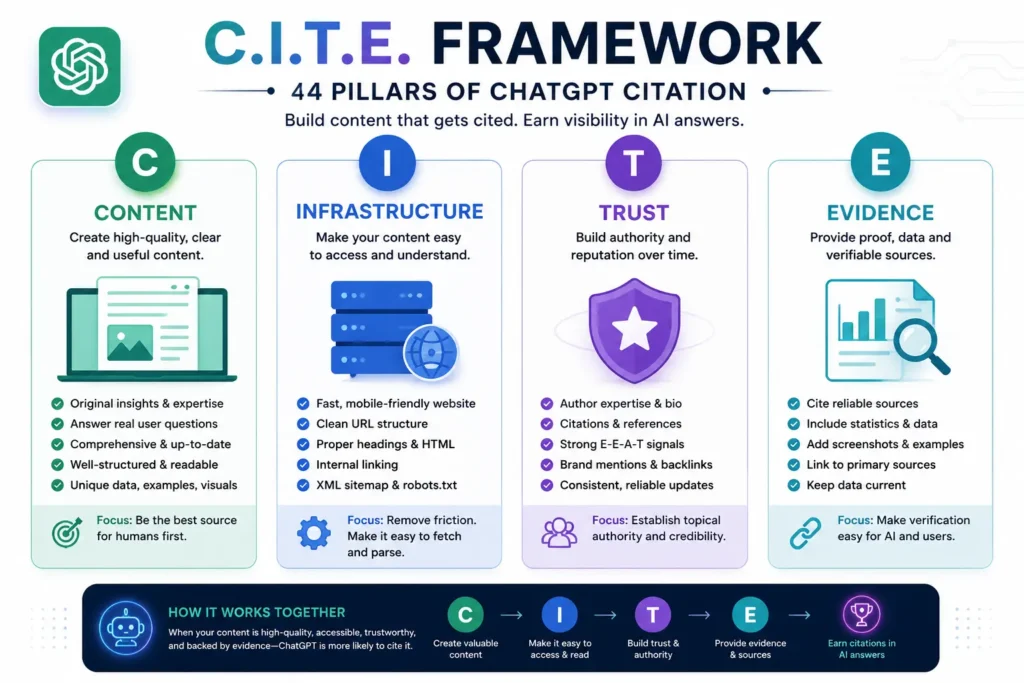
If you want to know how to get cited by ChatGPT consistently, work on all four pillars together. A strong article with weak infrastructure gets overlooked. A technically perfect site with thin content earns nothing. Both sides matter.
Tactic 1: Use Answer Capsules Under Every Question-Based Heading
An answer capsule is a short, self-contained explanation placed immediately below a question-based heading. It is 20 to 25 words long and answers the question directly, without linking to other pages.
Search Engine Land’s audit of nearly 2 million sessions found that 72.4% of pages cited by ChatGPT included an identifiable answer capsule. That is the single strongest citation predictor identified in any study to date.
What a question-based heading looks like:
- “What Is an Answer Capsule?”
- “How Does ChatGPT Choose Its Sources?”
- “Can a New Website Get Cited by ChatGPT?”
What an answer capsule looks like:
An answer capsule is a self-contained 20-25 word explanation placed directly below a question-based heading, with no hyperlinks, designed to be extracted by AI systems.
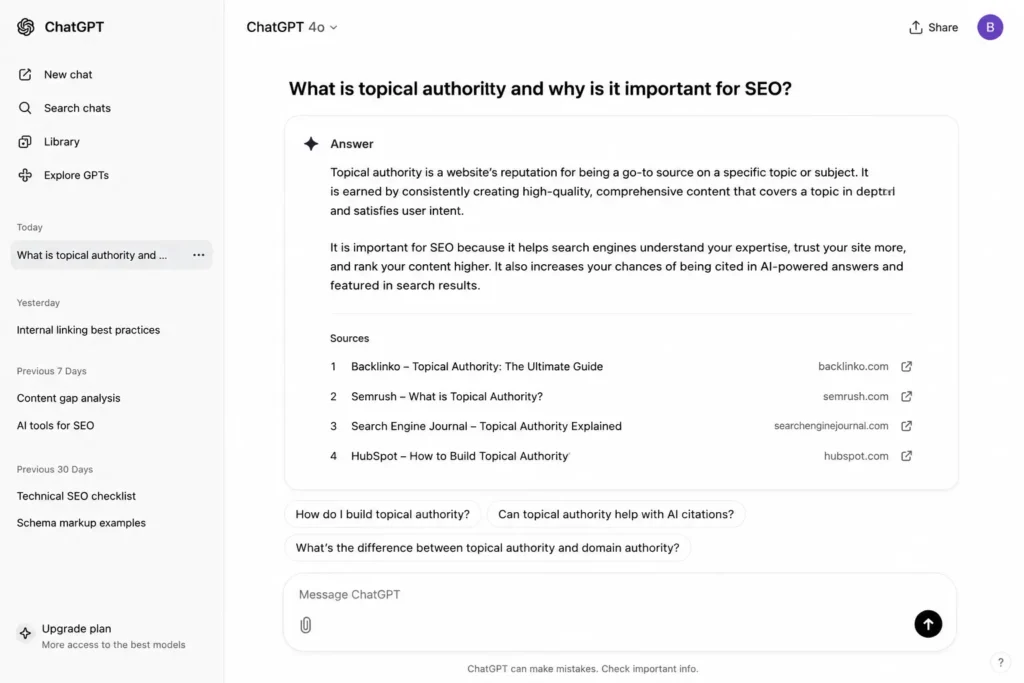
That sentence alone can become a ChatGPT citation. It answers the question, stands on its own, and requires no outside context to understand.
How to implement this in WordPress:
- Rewrite your H2 headings as questions
- Write a 20-25 word answer directly below each H2, before any other content
- Do not add links to that first sentence or paragraph
- Continue with your full explanation below
This single structural change is the most direct answer to how to get cited by ChatGPT without needing backlinks or high domain authority.
Key Insight: Restructuring your top 10 blog posts to include answer capsules is the single highest-ROI update you can make for AI citation. Start with posts that already get traffic.
Tactic 2: Keep Your Answer Capsule Completely Link-Free
SEO best practice says to add internal and external links throughout your content. For AI citation, links inside your answer capsule work against you.
Search Engine Land’s data shows that more than 91% of answer capsules on ChatGPT-cited pages had zero links. Pages where the capsule contained links were cited far less often.
Why? When a capsule contains a link, it implies the real answer is somewhere else. ChatGPT reads that as low confidence in the answer’s completeness. A link-free capsule tells the AI your page is the source, not a signpost to another one.
The rule: Add links below the capsule, never inside it. Let the capsule be a clean, standalone answer. Internal links and supporting evidence go in the paragraphs that follow.
Tactic 3: Publish Original Data That AI Can Safely Quote
AI systems avoid repeating unverifiable information. A vague or opinion-based claim cannot be quoted safely. A claim with a specific number, a named study, or a first-party data point can be attributed clearly and quoted with confidence.
A Princeton GEO study tested 9 optimization methods across 10,000 queries and found that adding statistics or direct quotations increased AI visibility by 30 to 40%, with no other changes to the content.
An Ahrefs analysis found that 67% of ChatGPT’s top 1,000 cited pages came from original research, first-hand data, or academic sources.
You do not need a large research budget. Here is what works at the anobee.com scale:
- Run a small survey on Twitter/X or a Facebook group and report the exact numbers
- Audit your own content and publish the findings (“I reviewed 20 articles on anobee.com and found that…”)
- Document a before-and-after from an SEO experiment you ran
- Build a branded benchmark list for your niche
Frame your data like this: According to the anobee.com [Year] [Study Name], [specific finding]. That attribution format makes your data easy for AI systems to quote with a clear source.
Key Insight: Even a small data point you created yourself is more citable than a generic piece of advice that 100 other articles also include.
Tactic 4: Add FAQPage and Article Schema with Rank Math
Schema markup is structured data that tells AI systems what your content is about, who wrote it, when it was updated, and what type of answers it contains. It does not guarantee citations, but it makes your content significantly easier for AI systems to parse and reuse.
The most valuable schema types for ChatGPT citation are:
| Schema Type | What It Signals to AI | Implementation |
|---|---|---|
| Article | Content type, author, date published, date modified | Rank Math auto-adds this for posts |
| FAQPage | Structured Q&A pairs that AI can extract directly | Rank Math FAQ Block in post editor |
| HowTo | Step-by-step instructions for action-based content | Rank Math HowTo Block in post editor |
| Author / Person | Author credentials and identity | Rank Math Author Bio settings |
| Organization | Brand identity and authority signals | Rank Math Local SEO / Site settings |
How to add FAQPage schema in Rank Math:
- Open your WordPress post editor
- Add a Rank Math FAQ Block at the end of your article
- Write each FAQ question and answer in the block fields
- The schema is automatically generated; verify at schema.org/validator
For a full walkthrough on configuring these settings, see our guide on schema markup with Rank Math. Sharp HealthCare implemented Article schema with physician authors and FAQPage schema across their health content and saw an 843% increase in clicks from AI-generated search features within nine months.
Tactic 5: Build Topical Authority with a Content Cluster
ChatGPT’s query fan-out process means it searches for multiple sub-questions when answering one prompt. If your site covers only the main topic, you get cited once. If your site covers the main topic and its sub-topics, you get cited multiple times across the same response.
Surfer SEO’s analysis found that ranking for both the main query and its fan-out sub-queries makes a site 161% more likely to appear in AI-generated answers, compared to ranking for the main query alone.
For the topic of getting cited by ChatGPT, the content cluster for anobee.com should include:
- This article (hub page)
- What is GEO: Generative Engine Optimization explained
- What is AEO: Answer Engine Optimization for beginners
- How to write answer capsules step by step
- llms.txt: what it is and how to add it to your WordPress site
- How to rank in Perplexity AI
Each supporting article covers a sub-question that ChatGPT will fan out to when answering a broader GEO or AI SEO query. The more of those sub-questions you answer, the more often your site appears.
Key Insight: Topical authority is not about writing one perfect article. It is about owning the full sub-question map for your topic, which is the core principle behind building topical authority in SEO. Build the cluster first, then update each piece to include answer capsules and schema.
Tactic 6: Update Your Content Regularly (Freshness Signals)
Freshness matters, and it matters most on Perplexity. A ConvertMate analysis found that freshness accounts for roughly 40% of Perplexity’s citation factors, making it the most influential signal on that platform.
The same study found that content labeled as “updated two hours ago” was cited 38% more often than identical content that was a month old on rapidly evolving topics.
Surface-level updates do not work. Changing only your publish date without touching the actual content is detectable by AI systems and treated as stale. A meaningful update includes new data, a revised answer capsule, or an added section addressing a new sub-question.
Update cadence for anobee.com:
| Content Type | Update Frequency |
|---|---|
| Comparison articles (ChatGPT vs Perplexity, etc.) | Every 60-90 days |
| Tool reviews (AI tools, SEO tools) | Every 60-90 days |
| Evergreen how-to guides (this article) | Every 180 days |
| News or trending topics | Within 48 hours of new development |
Add a visible “Last Updated: [Date]” line near the top of each article. Use the Rank Math “dateModified” field to make sure schema reflects the actual update date.
Tactic 7: Get Active on Reddit, YouTube, and Review Platforms
ChatGPT cites your website and the platforms where your brand and expertise appear.
A ConvertMate study of 6.8 million AI citations found that brand-controlled sources account for 86% of ChatGPT citations for objective queries (pricing, specifications, availability). For subjective queries, comparisons, recommendations, and opinions, AI systems shift toward community platforms.
| Platform | Query Type AI Pulls From It | Action to Take |
|---|---|---|
| Subjective, comparison, opinion-based queries | Answer questions in r/SEO, r/ChatGPT, r/bigseo authentically | |
| YouTube | Explanatory “how” and “why” queries | Create videos that answer specific questions; transcripts become citable |
| G2, Trustpilot, Capterra | Trust and credibility queries | Maintain an accurate profile; gather reviews |
| Quora | Definition and beginner questions | Post expert answers with a link back to anobee.com article |
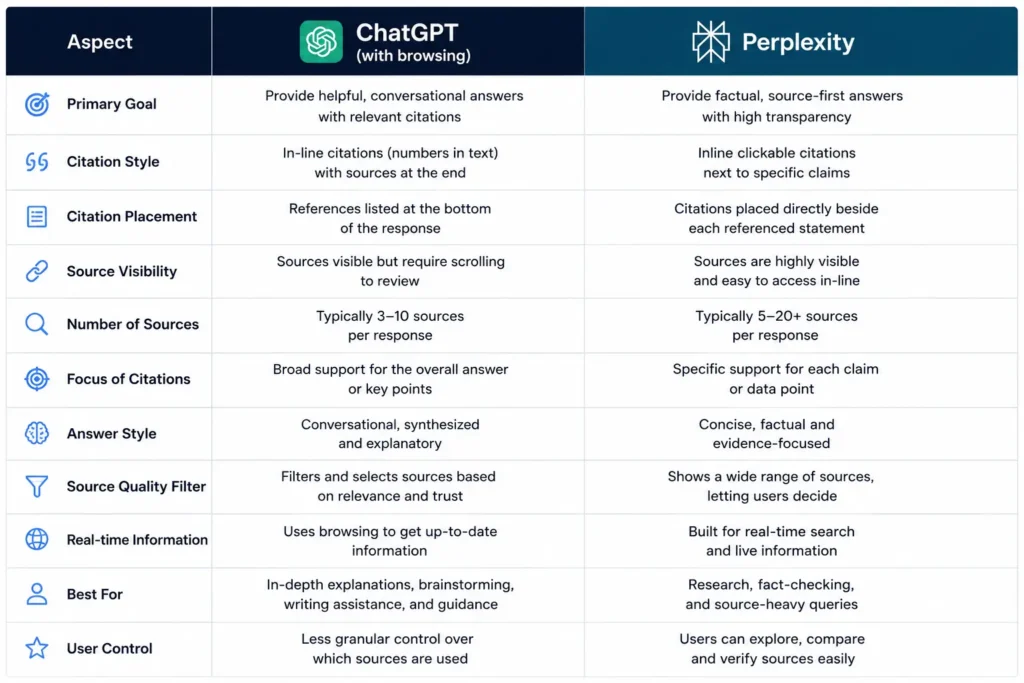
Brands with active profiles on G2, Trustpilot, and Capterra have a 3x higher chance of being cited by ChatGPT for trust-based queries, according to SE Ranking’s analysis.
For anobee.com, the most accessible quick win is Reddit. Find 3-5 recent threads in r/SEO or r/ChatGPT where people ask about AI citations, write a genuine, detailed answer, and reference the anobee.com article as a further resource.
Tactic 8: Cover Query Fan-Out Sub-Questions in Your Article
Within a single article, you can capture multiple fan-out opportunities by anticipating the follow-up questions ChatGPT will search for after the main prompt.
When someone asks ChatGPT “how do I get cited by ChatGPT?”, the model fans out and searches for related sub-questions such as:
- What is an answer capsule?
- Does schema markup help with ChatGPT citations?
- How does Perplexity choose its sources?
- Can a new website get cited by AI?
- What is the C.I.T.E. Framework?
If your article answers these sub-questions directly, with their own answer capsules, ChatGPT can pull citations from multiple sections of the same piece. This multiplies your citation surface without requiring additional articles.
Implementation: Before finalizing your article structure, list 5-8 questions that naturally follow your main topic. Add a dedicated H2 for each one with a clean answer capsule. This article does exactly that.
Tactic 9: Write Content in Extractable Chunks of 75-225 Words Per Section
AI systems tokenize text into chunks of roughly 100 to 300 tokens, which is about 75 to 225 words. They extract the chunk that best answers a sub-question and reuse it in the generated response.
If your section covers multiple ideas in one long block of text, the model cannot extract a clean chunk. It skips to a page where one idea is clearly contained in one paragraph.
The extractable chunk format:
- H2 heading states the question or topic
- First sentence answers it directly (20-25 words)
- Paragraph 2-3 adds supporting context (75-100 words)
- Optional paragraph 4 adds example or data (50-75 words)
- Total section: 150-220 words per H2
Focus each paragraph on one idea. If a paragraph covers two ideas, split it into two. Think of it as putting a clear label on each item in a storage box: it makes the AI’s retrieval job faster and more accurate.
Tactic 10: Use Entity-Rich Language That Matches AI Knowledge Graphs
AI systems are built on knowledge graphs. They understand topics not as isolated keywords but as networks of related concepts, brands, and entities. When your content uses the same entity language that AI systems recognize, it is easier to classify and cite correctly.
For this topic, the relevant entities are:
- ChatGPT (OpenAI), Perplexity, Google Gemini, Claude (Anthropic), Google AI Overviews
- Retrieval-Augmented Generation (RAG)
- Generative Engine Optimization (GEO), Answer Engine Optimization (AEO)
- FAQPage schema, HowTo schema, Article schema, Organization schema
- Answer capsule, topical authority, content cluster
- E-E-A-T (Experience, Expertise, Authoritativeness, Trustworthiness)
Use these terms naturally throughout your article. Do not stuff them, but do not avoid them either. AI systems use co-occurrence, meaning how often this page mentions entity A alongside entity B, as a signal of topical relevance and credibility.
Co-occurrence target for this article: ChatGPT + GEO + answer capsule + schema + RAG. Each of those entities appearing multiple times in close proximity signals that this page is a credible hub for the ChatGPT citation topic.
Tactic 11: Add a Visible “Last Updated” Date and Changelog
This is a small technical step that has an outsized effect on Perplexity citations and on how AI systems assess the freshness and reliability of your content.
Implementation steps:
- In WordPress, install a plugin like “WP Last Modified Info” or configure Rank Math’s schema settings to expose the dateModified field
- Add a visible “Last Updated: [Month Year]” line at the top of each article, below the publish date
- Keep a brief changelog at the bottom of the article for major updates: “Updated June 2026: Added Tactic 12 on llms.txt; refreshed platform comparison table.”
The changelog does two things. It signals to AI systems that the page has been meaningfully revised, not just date-stamped. And it builds trust with human readers who want to know the information is current.
Tactic 12: Enable LLM Crawler Access via robots.txt and llms.txt
This is the technical baseline that many beginners skip entirely. If your robots.txt file blocks AI crawlers, no amount of content optimization will help. ChatGPT simply cannot read your page.
LLM crawlers to verify are not blocked:
| Crawler | Operator | robots.txt User-Agent |
|---|---|---|
| GPTBot | OpenAI (ChatGPT) | GPTBot |
| OAI-SearchBot | OpenAI (search-enabled) | OAI-SearchBot |
| PerplexityBot | Perplexity | PerplexityBot |
| ClaudeBot | Anthropic | ClaudeBot |
| Google-Extended | Google (AI training) | Google-Extended |
| Bingbot | Microsoft (Copilot) | Bingbot |
How to check your robots.txt:
- Visit yourdomain.com/robots.txt
- Look for any “Disallow: /” lines under the user-agents listed above
- If blocked, remove those disallow lines or add explicit allow rules
llms.txt: This is a new standard that tells AI systems what your site covers, which pages are most important, and how to navigate your content. Add a plain-text file at yourdomain.com/llms.txt listing your key articles, their topics, and a brief site description. See our step-by-step guide on how to add llms.txt to WordPress for the exact setup.
An llms.txt file gives AI crawlers a structured roadmap of your content, the equivalent of a sitemap for AI systems. It does not guarantee citations, but it removes friction from the indexing process.
Key Insight: Enabling LLM crawler access is the technical floor. If you skip this step, all other tactics are wasted. Check your robots.txt before publishing this article.
Your 30-Day ChatGPT Citation Action Plan
| Week | Actions | Time |
|---|---|---|
| Week 1 | Check robots.txt for LLM crawlers; add llms.txt; add Article + FAQPage schema via Rank Math | 3-4 hours |
| Week 1 | Audit your 5 highest-traffic posts; add answer capsules; remove links from capsules | 2-3 hours |
| Week 2 | Publish this article; build out 1 supporting cluster article (e.g., “What is GEO?”) | 4-5 hours |
| Week 2 | Post a genuine answer on Reddit r/SEO or r/ChatGPT referencing your article | 30 min |
| Week 3 | Add a visible “Last Updated” date and changelog to your top 10 articles | 1-2 hours |
| Week 3 | Identify one original data point you can publish (mini-survey, content audit, before/after) | 2-3 hours |
| Week 4 | Publish the original data as a section within an existing article or as a standalone piece | 3-4 hours |
| Week 4 | Check GA4 + Google Search Console for any referral traffic from ChatGPT; begin baseline tracking | 1 hour |
Total time investment for Week 1-4: approximately 16-22 hours
This plan is designed for one person managing a blog alongside an office job and covers every major step in how to get cited by ChatGPT within your first month. Batch Week 1 and Week 3 tasks on a weekend. Week 2 and Week 4 publishing tasks can split across evenings.
How long does it take to get cited by ChatGPT after publishing an article?
Structural changes like answer capsules and schema can influence AI visibility within days to weeks. Building broader authority through original data and topical clusters typically takes 3 to 6 months. There is no fixed timeline because ChatGPT’s indexing and citation behavior updates continuously.
Can a new website with low domain authority get cited by ChatGPT?
Yes. ChatGPT citation is passage-based, not page-based. A new site with a well-structured answer capsule, original data, and proper schema can get cited even before it ranks on page one of Google. Domain authority matters less for AI citation than content structure.
What is the difference between getting cited by ChatGPT and ranking on Google?
Google rankings depend on backlinks, page authority, and technical SEO signals. ChatGPT citation depends on passage clarity, answer capsule structure, original data, and schema. Surfer SEO’s analysis found that 67.82% of AI-cited pages do not rank in Google’s top 10 for the same query.
Does adding an answer capsule help with Google rankings too?
Yes. Answer capsules are structured to win Google featured snippets and People Also Ask boxes, which use similar extraction logic. Content that wins AI citations and featured snippets tends to overlap because both systems favor self-contained, direct answers.
Which AI platform is easiest for a new site to get cited by first?
Perplexity is often easier for new sites because it weights freshness heavily and pulls from community platforms like Reddit and YouTube. A new site with a recently published, well-structured article paired with a Reddit thread on the same topic can earn Perplexity citations before ChatGPT citations.
The Bottom Line
Getting cited by ChatGPT comes down to structure, not luck or authority.
ChatGPT’s RAG process looks for clean, self-contained passages it can quote without distortion. The C.I.T.E. Framework gives your content the four pillars it needs: Content Structure, Infrastructure, Topical Authority, and Evidence.
Start with Tactic 1 and Tactic 4, answer capsules and schema. Those two changes to your existing articles can improve AI citation readiness within a week. Then build out the rest of the framework over 30 days.
The sites getting cited today built for it months before their competitors noticed the traffic.