Freelancing & Online Business
Is Payoneer Safe? Regulation, Fees and Real Complaints, Checked
By Bibek Thapa · Published · 9 min read
Quick Answer
Yes, Payoneer is a legitimate, regulated payment company. It is listed on Nasdaq and holds e-money licences in the UK and Ireland plus money transmitter licences across the US. Your balance is safeguarded but is not a bank deposit or covered by deposit insurance. The real risks are account holds during verification, slow support and fees that add up.
Table of ContentsOn this page
Key Takeaways
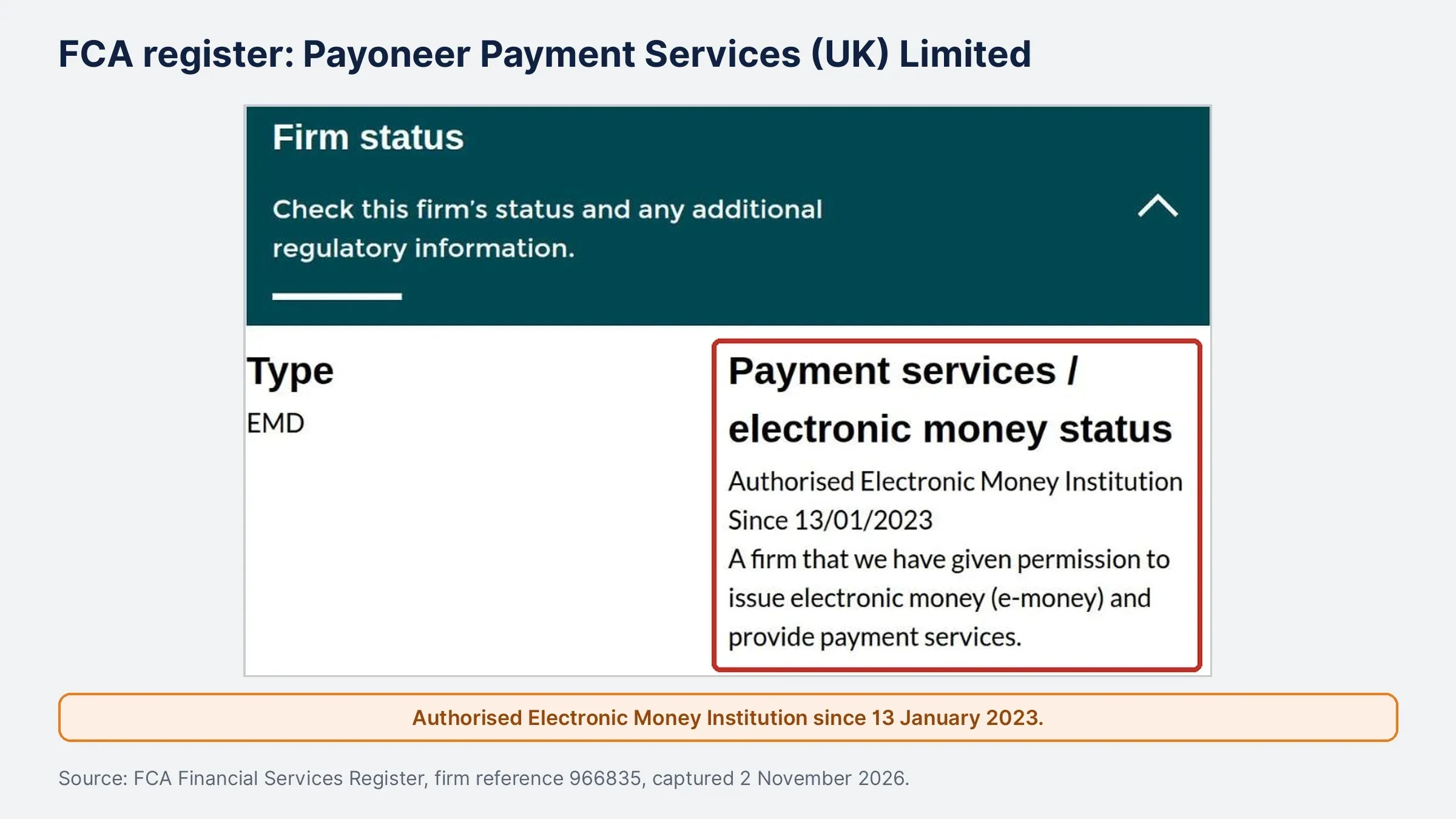
- Payoneer is regulated: the FCA register lists its UK firm as an authorised e-money institution since 13 January 2023.
- Balances are safeguarded and segregated, but they are not bank deposits and the UK FSCS does not cover them.
- Common fees: 1.2% to 4% to withdraw in another currency, and 29.95 USD a year if you receive under 6,000 USD.
- In 80 one- and two-star Trustpilot reviews from October 2026, support delays and verification problems led.
- Trustpilot hides Payoneer's rating after removing fake reviews, so treat star scores with caution.
Is Payoneer safe? Yes, as a company. Payoneer is a regulated payment provider listed on Nasdaq under the ticker PAYO [7], and its subsidiaries hold e-money and money transmitter licences in the US, UK, EU and Asia [1]. Your balance is safeguarded, but it is not a bank deposit and is not covered by deposit insurance [2] [3]. The risks people actually run into are different: accounts held during verification, slow support and fees that add up.
This guide checks each of those on primary sources: the licences against a regulator's own register, the fee table on Payoneer's pricing page, and the complaint patterns in recent reviews.
Method note: everything here was checked on 2 November 2026 on Payoneer's own pages, the FCA register, Trustpilot and the US Consumer Financial Protection Bureau's complaint database. Anobee did not open a Payoneer account for this review. This is general information, not financial advice.
Is Payoneer safe and legit? The short answer
- It is a real, regulated company. Payoneer lists licences in eight jurisdictions [1], and the UK one checks out on the FCA's register [2].
- It is publicly listed. Payoneer Global Inc. trades on Nasdaq as PAYO and publishes quarterly results [7].
- It is not a bank. Payoneer's terms say its services are not a bank account and that balances are not deposits [3].
- The main risk is access, not theft. Most recent complaints are about frozen or closed accounts and support delays, not about the company taking money.
Payoneer regulation: the licences, checked
Payoneer publishes the licence of each regulated entity [1]:
| Entity | Regulator | Licence or registration |
|---|---|---|
| Payoneer Inc. (US) | FinCEN; US state regulators | Money services business; licensed in all US states and territories where required |
| Payoneer Europe Limited | Central Bank of Ireland | E-money institution C189473, passported across the EEA |
| Payoneer Payment Services (UK) Limited | Financial Conduct Authority | E-money institution 966835 |
| Payoneer Hong Kong Limited | Customs and Excise Department | Money service operator 15-10-01734 |
| Payoneer Japan Limited | Kanto Finance Bureau | Fund transfer service provider 00045 |
| Payoneer Australia Pty Limited | ASIC | Licence 504803 for non-cash payment products |
| Payoneer for India | Reserve Bank of India | Online payment gateway service provider |
| Payoneer Singapore Pte Limited | Monetary Authority of Singapore | Major payment institution PS20200604 |
A company's own list is a starting point, not proof. For that reason, Anobee checked the UK entry on the FCA's public register. Reference 966835 belongs to Payoneer Payment Services (UK) Limited, listed as an authorised electronic money institution since 13 January 2023 [2]. The register also shows one requirement on the firm. It must not offer account information or payment initiation services, the open-banking features some other providers sell [2]. That limits what Payoneer UK can do, but it is not a warning about safety.
Also, Payoneer is still adding licences. In October 2026 it announced that Payoneer Canada had registered with the Bank of Canada as a payment service provider [7].
Is your money protected in Payoneer?
So is Payoneer safe for the money sitting in your balance? This is where the answer needs to be precise. Payoneer's EU terms say three things about your balance [3]:
- The services are payment and e-money services, not a bank account.
- Funds are not deposits and earn no interest.
- Payoneer follows safeguarding rules, including keeping customer funds segregated, to protect them if the company becomes insolvent.
Safeguarding is the main protection for e-money balances. However, you do not get deposit insurance. The FCA register states plainly that the Financial Services Compensation Scheme would not compensate customers if the UK firm went out of business owing them money [2].
Still, you do have somewhere to complain. The FCA register says the Financial Ombudsman Service may be able to help if Payoneer UK does not resolve a complaint properly [2]. For Payoneer's Irish entity, the terms name the Financial Services and Pensions Ombudsman in Dublin [3].
In practice: treat Payoneer as a place money passes through, not a place to store savings. Withdraw to your bank once a payment clears.
Payoneer fees and charges
These are Payoneer's standard published fees, from a pricing page last updated on 1 January 2026 [4]. Fees can differ by territory, account type and onboarding channel, Payoneer notes. Your own account's Fees page is the final word [4].
| What you do | Payoneer fee |
|---|---|
| Receive from another Payoneer customer | Free |
| Receive from a marketplace or platform | Varies by marketplace |
| Receive via a receiving account in your local currency | Free |
| Receive via a receiving account in another currency | 1%, minimum 1.00 USD |
| Get paid by a client's credit card | Up to 3.99% + 0.49 USD |
| Get paid by ACH (US) or an EU or UK bank account | 1% |
| Withdraw to a bank in your own country and currency | 1.50 USD (in supported countries) |
| Withdraw to a bank in another currency | 1.2% to 4% |
| Convert between your Payoneer balances | 0.50% |
| Annual account fee | 29.95 USD, only if you receive less than 6,000 USD in any 12 consecutive months |
| Payoneer card, annual fee | 29.95 USD |
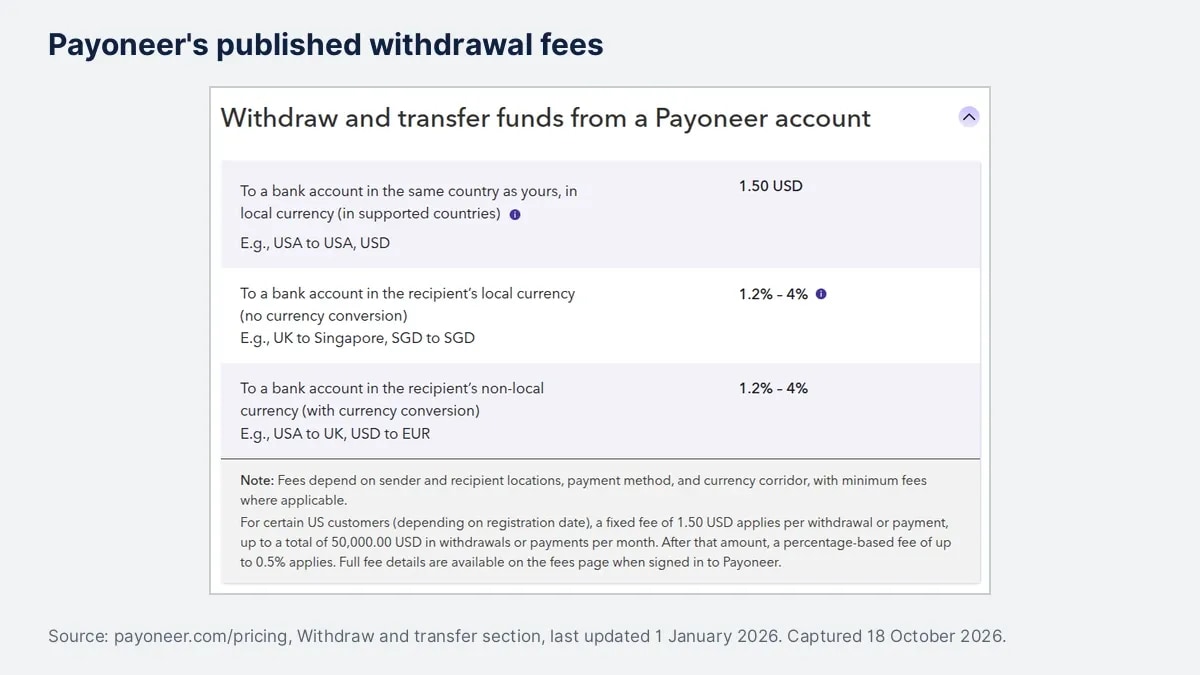
A worked example. Say a freelancer receives 1,000 USD from a marketplace and withdraws it to a bank account in another currency. At the published range, the withdrawal costs 12 to 40 USD. That is before the marketplace's own payout fee and the bank's charges. If they receive less than 6,000 USD over a year, the 29.95 USD annual fee applies as well.
What Payoneer users complain about
Two warnings come before any numbers.
First, Trustpilot does not show a rating for Payoneer at all. Its page says the rating "is unavailable due to a breach of our guidelines" and that it has "removed a number of fake reviews for this company" [5]. The page still lists 63,471 reviews, 69% of them five-star and 16% one-star [5]. As a result, star averages for Payoneer are unreliable.

Second, the US Consumer Financial Protection Bureau's database returned no complaints for Payoneer on 2 November 2026, against 44,036 for PayPal [6]. That may reflect Payoneer's focus on business customers rather than a perfect record, so it proves little either way.
To see what actually goes wrong, Anobee read the 80 one- and two-star Trustpilot reviews posted between 1 and 31 October 2026 [5]. Each review was tagged by the problems it named. One review can therefore count more than once:
| Problem named in the review | Reviews (of 80) |
|---|---|
| Support slow, automated or not responding | 43 |
| Identity or document verification | 36 |
| Account blocked, suspended or closed | 32 |
| Funds held, frozen or delayed | 29 |
| Fees or exchange rates | 12 |

The pattern is consistent. A typical complaint describes an account review, a request for documents, a hold on funds while it runs, and slow answers from support. For example, reviews featured on the page describe an account closed over an address format on a utility bill, and another blocked because of old duplicate accounts. Fees come up far less often.
These are self-selected unhappy reviews from one month, tagged by keyword. They show what goes wrong, not how often. So on their own, they cannot tell you whether a service like this is safe for you.
Why Payoneer holds or closes accounts
Payoneer's terms explain most of the complaints above. If Payoneer cannot verify the information you give it, it may deny, terminate or suspend the service [3]. It may also reject or limit payments for anti-money-laundering or risk-management reasons [3]. Every regulated payment company works under similar rules. In practice, the difference between a smooth account and a frozen one is usually the paperwork.
How to lower your risk:
- Register with your legal name exactly as it appears on your ID, and keep one account only.
- Use an address that matches your proof-of-address document word for word.
- Answer document requests quickly, and keep copies of invoices and contracts for each payment you receive.
- Withdraw cleared funds regularly instead of keeping a large balance.
- Use Payoneer's formal complaint route in writing if support stalls, then the ombudsman named in your terms.
Is Payoneer safe for freelancers?
So is Payoneer safe for freelancers? For receiving marketplace payouts and client payments, it is a trustworthy, regulated option and often the default on platforms that pay freelancers. However, it is less suitable as a place to hold money for long periods. Its withdrawal fee range is also wide, so check your own rate before each transfer.
If you are in Nepal, the Payoneer in Nepal guide covers withdrawals to a Nepali bank and the local rules. For the wider picture of getting paid as a beginner, see freelancing in Nepal for beginners.
Frequently Asked Questions
Is Payoneer legit or a scam?
Payoneer is legitimate. It is a Nasdaq-listed company, and regulators such as the UK Financial Conduct Authority and the Central Bank of Ireland list its subsidiaries as authorised e-money institutions. Complaints about it are mostly about account reviews and support, not about fraud by the company.
Is money in Payoneer insured?
No, not in the way a bank deposit is. Payoneer says customer funds are safeguarded and segregated, but they are not deposits and earn no interest. The FCA register states that the UK Financial Services Compensation Scheme would not compensate customers if the firm failed.
Can Payoneer freeze my money?
Yes, in some cases. Payoneer's terms allow it to suspend or terminate service if it cannot verify your information, and to reject or limit payments for anti-money-laundering or risk reasons. Holds during document checks are the most common complaint.
How much does Payoneer charge?
Receiving from another Payoneer user is free. Withdrawing to a bank in another currency costs 1.2% to 4%, and an annual 29.95 USD account fee applies if you receive less than 6,000 USD in 12 months. Your account's Fees page shows your exact rates.
Sources and References
- Payoneer: Multi-jurisdictional licenses ↩
- FCA Financial Services Register: Payoneer Payment Services (UK) Limited, reference 966835 ↩
- Payoneer: Terms and Conditions (EU, January 2025) ↩
- Payoneer: Pricing ↩
- Trustpilot: Payoneer reviews ↩
- Consumer Financial Protection Bureau: Consumer Complaint Database ↩
- Payoneer Investor Relations ↩
Was this guide helpful?
Your answer helps Anobee improve future updates.

Written by
Bibek Thapa
AI-Powered Digital Growth Strategist
Bibek Thapa works across AI workflows, SEO, AI search optimization, content strategy, website growth, and productivity systems at Anobee.
- AI workflows
- Digital growth
- SEO
- GEO
- AEO
- Content strategy
- Website growth