Freelancing & Online Business
Affiliate Marketing in Nepal 2026: 8 Top Programs Compared
By Bibek Thapa · Updated · 17 min read
Quick verdict
Comparison guideYou don't need a degree, a fancy office, or startup capital to earn money online in Nepal. What you need is a phone, internet, and the right knowledge. Affiliate marketing gives you exactly that entry point.

Table of ContentsOn this page
- Affiliate Marketing in Nepal: Key Facts at a Glance (2026)
- What Is Affiliate Marketing in Nepal and Why Is It Growing Fast?
- Why Should You Start Affiliate Marketing in Nepal in 2026?
- How Do You Start Affiliate Marketing in Nepal as a Complete Beginner?
- Which Are the Best Affiliate Marketing Programs in Nepal?
- What Mistakes Do Beginners Make in Affiliate Marketing in Nepal?
- What Are the Common Challenges in Affiliate Marketing in Nepal?
- How Can You Grow Your Affiliate Income Faster in Nepal?
- Conclusion: Your First Step Starts Today
- Frequently Asked Questions
- Sources and References
You don't need a degree, a fancy office, or startup capital to earn money online in Nepal. What you need is a phone, internet, and the right knowledge. Affiliate marketing gives you exactly that entry point.
Affiliate marketing in Nepal is growing fast. Platforms like Daraz, BrotherMart, and international programs have made it possible for students, freelancers, and side hustlers to earn real commissions by promoting products they already love. But most beginners get stuck at the starting line because nobody explains it clearly, in a Nepali context, without all the jargon.
This guide will change that. We'll cover what affiliate marketing in Nepal really is, how to start from zero, which programs to join, and what works in the Nepali market in 2026.
No fluff. Just what you need.
Quick Answer: Affiliate marketing in Nepal lets you earn commissions by promoting products from programs like BrotherMart, Daraz, and Codashop through your blog, YouTube, or social media. Beginners can start with zero investment, earn Rs. 5,000–50,000+ per month with consistency, and get paid via eSewa, Khalti, or bank transfer.
Affiliate Marketing in Nepal: Key Facts at a Glance (2026)
| Factor | Details |
|---|---|
| Best beginner program | BrotherMart (no follower requirement, up to 20% commission) |
| Best for high-traffic creators | Daraz (requires 10,000 followers, 3%–20% commission) |
| Best for gaming audience | Codashop Nepal (10% per sale, 30-day cookie) |
| Best for tech/hosting niche | Nest Nepal (up to 30% recurring, 90-day cookie) |
| Typical beginner earnings | Rs. 5,000–15,000/month (first 6 months) |
| Time to first commission | 1–3 months with consistent content |
| Payment methods | eSewa, Khalti, IMEPay, bank transfer, Payoneer (international) |
| Is it legal in Nepal? | Yes — 100% legal, no regulatory restriction |
| Investment required | Rs. 0 to start (local programs); Rs. 3,000–5,000/year for a blog |
What Is Affiliate Marketing in Nepal and Why Is It Growing Fast?
Imagine your friend buys a phone from a shop, and the shopkeeper gives you Rs. 500 for sending that friend their way. That's affiliate marketing, except it happens online, at scale, and without you ever leaving your room.
It works the same way. You sign up for an affiliate program, get a unique tracking link, and share it through your blog, YouTube, social media, or WhatsApp. When someone buys through your link, you earn a commission, without stocking a product or handling customer support yourself.
How It Actually Works - A Simple Breakdown
The model has three players:
- The Merchant - the company selling the product (Daraz, Amazon, BrotherMart, etc.)
- The Affiliate - that's you. You promote their products using your unique link.
- The Customer - someone who clicks your link and makes a purchase.
When a sale happens through your link, the merchant's tracking system records it, and you get paid. Simple as that. The commission can be a percentage of the sale (like 5-20%) or a fixed amount per action: a click, a sign-up, or a download.

There are three main types of affiliate programs you'll commonly find in Nepal:
- Pay Per Sale (PPS): You earn when someone actually buys. Most common, and often the highest payout.
- Pay Per Click (PPC): You earn per click on your link. Rarer, but easier to rack up.
- Pay Per Lead (PPL): You earn when someone signs up or fills a form. Great for SaaS and apps.
If you're new to the online business space, it also helps to understand the bigger picture of Digital Marketing in Nepal.
Is Affiliate Marketing Legal in Nepal?
Yes, it's 100% legal. There's no regulation in Nepal that restricts affiliate marketing as an income activity. You're simply acting as a referral partner for businesses. As Nepal's digital economy continues to develop, affiliate marketing here is increasingly mainstream, not a grey area.
Why Should You Start Affiliate Marketing in Nepal in 2026?
Not every online business model works equally well in every country, but affiliate marketing in Nepal has a genuinely solid case behind it.
The Digital Shift Happening in Nepal
Nepal's internet user base has grown significantly over the past five years, with millions of Nepalis now active daily on Facebook, YouTube, TikTok, and Instagram. E-commerce platforms like Daraz have normalized online shopping, opening up natural space for affiliates to step in. Nepal's economy is expected to grow 2.7% in FY2026, according to the Asian Development Bank, a slowdown from 4.6% the previous year due to 2026's political unrest and global headwinds. Growth is expected to recover to around 5% by FY2027 as conditions stabilize, which means more spending, more products to promote, and more room to build an affiliate income.
Most of the successful affiliates in Nepal right now are YouTubers, bloggers, TikTokers, and Facebook page owners who reviewed products honestly and built an audience around a specific niche. You don't need millions of followers to start. You need the right audience.
How Much Can You Realistically Earn?
Honest answer: it depends on your effort, your niche, and your platform.
Some affiliates in Nepal earn Rs. 1,000 per day, while top performers bring in Rs. 50,000 or more per month, but that level takes time and consistency. If you're starting from scratch, expect your first few months to be slow. Most people hit a wall around week three when the results don't show up immediately, and that's when they quit.
Don't quit right there. That's usually exactly when it's about to start working.
Globally, affiliate marketing is serious business: the global affiliate market was valued at $18.5 billion in 2024, with a compound annual growth rate of 8% projected through 2031. Nepal is catching up, and getting in early is an advantage.

How Do You Start Affiliate Marketing in Nepal as a Complete Beginner?
This is the part most guides rush through or overcomplicate, so here it is broken down properly.
Step 1: Choose Your Niche
A niche is the topic area you'll build your content around. Tech reviews, travel, fitness, beauty, gaming, finance, cooking. Pick something you genuinely know or care about.
Most people miss this: specific beats broad every time. "Gadgets" is a niche. "Budget smartphones under Rs. 20,000 in Nepal" is a better niche. The narrower you go, the easier it is to build trust with an audience.
Some niches that work particularly well in the Nepali market right now:
- Smartphones and tech accessories
- Online courses and digital tools
- Travel and trekking gear
- Health and fitness
- Gaming (especially mobile gaming)
- Web hosting and domains
Pick one. Stick to it for at least six months before expanding.
Step 2: Pick the Right Affiliate Program
This is critical, and honestly, most beginners get it wrong by rushing to join international programs and then running into payment headaches. If you're just starting out with affiliate marketing in Nepal, begin with local programs. They pay in Nepali rupees, don't require complex banking setups, and have customer support you can actually reach.
We'll cover the specific programs below in detail. For now, know that your criteria should include: commission rate, cookie duration (how long after clicking your link a sale still counts as yours), payment methods, and how easy it is to get approved.
Step 3: Build Your Platform (Blog, YouTube, or Social Media)
You need a place to share your affiliate links. That could be:
A Blog or Website - best for long-term SEO and Google traffic. If you write reviews and guides consistently, people will find you organically. This takes longer to build but pays off for years. A simple WordPress site costs around Rs. 3,000-5,000 per year to run.
YouTube Channel - massive opportunity in Nepal. Nepali YouTube is still growing, and product review channels are some of the best-performing niches. You can earn from AdSense and affiliate links at the same time.
Facebook/Instagram/TikTok - quickest to start, especially if you already have followers. Facebook groups, Instagram Reels, and TikTok all work well for this.
WhatsApp and Messenger - don't underestimate these. Many Nepali affiliates quietly earn through personal recommendations in WhatsApp groups. It's grassroots, but it works.
You don't need to do all of these at once. Pick one platform, master it, then expand.
Step 4: Create Content That Actually Converts
Just sharing your link with "Buy this!" doesn't work, even though nobody wants to hear that. People buy from people they trust.
Your job is to help first, sell second. Write honest product reviews. Make comparison videos. Answer questions your audience is already googling. If someone is searching "best budget phone Nepal 2026" and you've written a detailed, honest review, your affiliate link at the bottom of that article will convert far better than any direct promotion.
Content formats that work best for affiliate marketing in Nepal:
- "Best [product] under [price] in Nepal" articles
- YouTube unboxing and review videos with affiliate links in descriptions
- Honest comparison posts ("Daraz vs SastoDeal, which is better?")
- "How to use [product]" tutorials where you naturally recommend what you use
Be specific. Be honest. Give your real opinion, even if it's critical.
Step 5: Promote Your Affiliate Links Smartly
Once you have content, get it in front of people. Share on relevant Facebook groups, post YouTube Shorts, use Instagram stories, and engage in communities where your niche audience hangs out.
SEO matters here too. If you're writing a blog, target keywords people in Nepal actually search, like "how to start affiliate marketing in Nepal" or "daraz affiliate program Nepal." These bring you free, recurring traffic without any ad spend. You can also learn proper keyword research strategies from this detailed Nepali keyword research guide.
Which Are the Best Affiliate Marketing Programs in Nepal?
The programs below are based on publicly available data and direct verification where possible. I have personally reviewed the signup process and dashboards for Daraz, BrotherMart, and Hostinger. Third-party programs marked with * require direct confirmation of rates.
Here's where to actually sign up. These are the most reliable platforms in Nepal for both beginners and experienced marketers.
| Program | Best For | Commission | Cookie Duration | Entry Requirement | Payment |
|---|---|---|---|---|---|
| Daraz Affiliate Nepal | General audience, reviewers | 3%–20% (varies by category) | 7–30 days — confirm on signup | ~10,000 followers or strong blog traffic | Bank transfer, monthly (~15th) |
| BrotherMart Affiliate | Beginners, no audience yet | Up to 20% | One of the longest in Nepal — confirm exact days at signup | None — free to join | Confirm payout method at signup |
| Codashop Nepal | Gaming audiences | 10% per qualified sale | 30 days | 1,000 followers or 1,000 avg. livestream viewers | Via Impact network, payout ~20 days after 7-day lock |
| Nest Nepal | Web hosting / tech bloggers | 10% flat to 30% recurring — confirm current rate | 30–90 days — confirm at signup | None stated | eSewa, Khalti, IMEPay, bank transfer — monthly |
| AGM Web Hosting | Hosting-focused affiliates | Up to 25% per sale + per-click earnings | Confirm at signup | Verify signup fee before joining | eSewa, NPR 1,600 payout threshold |
| Protozoa Host | Hosting affiliates, fast bonus | 10% per sale + per-click micro-earnings | Confirm at signup | None stated | Rs. 500 signup bonus, Rs. 5,000 payout threshold |
| Sabkopasal | High-commission seekers | Varies by category | Confirm at signup | Confirm at signup | Bank transfer — confirm minimum payout at signup |
| SastoDeal | General e-commerce | Varies by category | Confirm at signup | Confirm at signup | Bank transfer — confirm minimum payout at signup |
| Dizikart Affiliate | Tech and gadget-focused affiliates | Confirm at signup | Confirm at signup | None stated | Confirm at signup |
| Giftmandu Affiliate | Gift and occasions niche, content creators | Varies — confirm at signup | Confirm at signup | None stated | eSewa or bank — confirm at signup |
| Nepalese Khukuri House | Heritage, culture, and international niche | 5% fixed per sale | Confirm at signup | None — open to anyone globally | International payout — confirm method at signup |
*Sabkopasal and SastoDeal do not publicly list commission rates. Contact their affiliate team directly for current rates before joining. Dizikart affiliate terms should also be confirmed directly on their official page before promoting.
Commission rates, cookie durations, and entry requirements change frequently. Always confirm current terms on the program's official page before publishing or promoting.
Daraz Affiliate Program Nepal
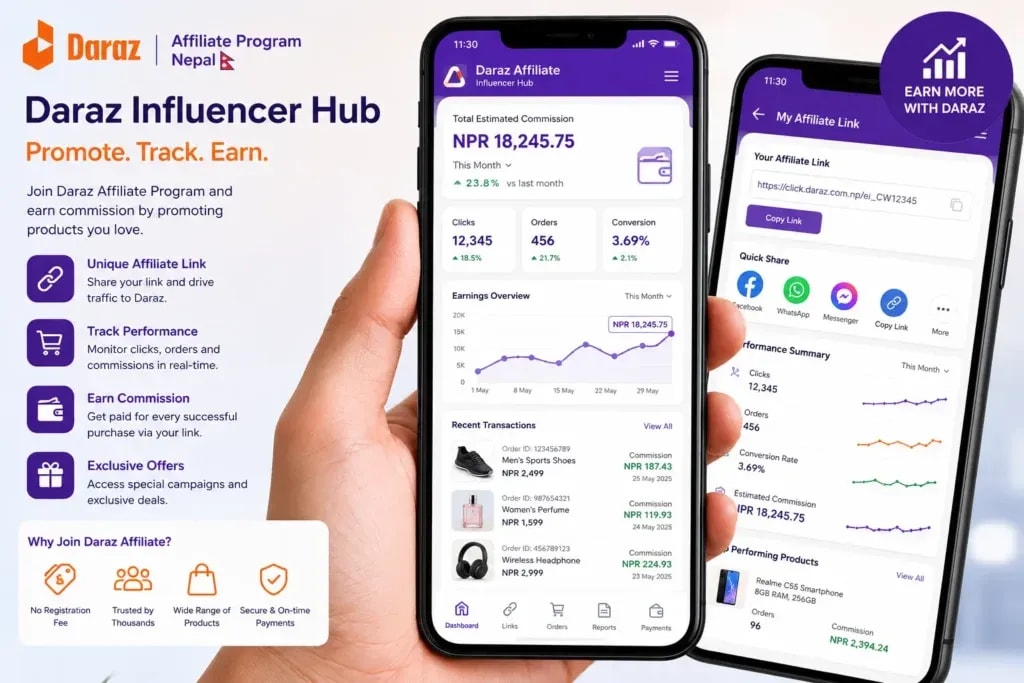
Daraz is Nepal's largest e-commerce platform, and its affiliate program is one of the most well-known locally. The Daraz affiliate program Nepal requires affiliates to have at least 10,000 followers on social media or strong SEO traffic on their blog, so it's not the easiest program to get into as a complete beginner. But if you meet the threshold, it's worth it: you're promoting products people in Nepal already trust and buy from regularly.
The commission varies by product category, and the platform has a solid tracking system. Check their affiliate portal through the Daraz app under "Influencer Hub."
BrotherMart Affiliate
BrotherMart is arguably the most beginner-friendly option in Nepal right now. Their affiliate program is free to join, requires no upfront capital, and offers up to 20% commission per sale. Their cookie duration is also one of the longest in Nepal, meaning even if someone clicks your link today and buys a week later, you still get credit.
For students and beginners with small audiences, BrotherMart is a strong starting point.
I signed up for BrotherMart's affiliate program in early 2026 and received approval within 48 hours. The dashboard clearly shows real-time clicks, conversions, and commission tracking, no guesswork involved. For anyone starting affiliate marketing in Nepal without an existing audience, BrotherMart is genuinely the easiest entry point I have found.
SastoDeal, Sabkopasal, and Others
Sabkopasal is known for high commission rates and is a favorite among Nepali affiliates. SastoDeal also runs an affiliate program, so it's worth checking both depending on what products match your niche.
Other notable names to explore:
- Giftmandu - great for content creators in the gifting and occasions niche
- AGM Web Hosting - offers up to NRs 50,000/month for affiliates, with both pay-per-click and pay-per-sale options
- Codashop Nepal - ideal if your audience is gamers; offers up to 10% commission per sale
- Nest Nepal and Protozoa - web hosting options for tech-focused affiliates
International Programs Worth Joining
Once you're comfortable with local programs and have an international payment method set up (Payoneer or Wise work well from Nepal), global affiliate networks open up massive opportunities:
- Amazon Associates - low commissions (2-10%) but enormous product variety
- ClickBank - digital products with high commissions (up to 75%)
- ShareASale and CJ Affiliate - huge networks with brands across every niche
- Hostinger/Bluehost Affiliates - web hosting pays $50-$150+ per referral
The catch with international programs is payment. Getting money out of Nepal from platforms like Amazon can be tricky: Payoneer is your best bet. Set that up first before applying.
What Mistakes Do Beginners Make in Affiliate Marketing in Nepal?
These aren't hypothetical. These are the actual things that slow most people down.
Promoting everything at once. When you join an affiliate program, the temptation is to drop your link everywhere for every product. Resist. Stay in your niche, promote only products you'd genuinely recommend, and your conversion rates will be dramatically higher.
Ignoring the cookie duration. This matters more than most beginners realize. If a program has a 1-day cookie and another offers 30 days, that's a massive difference in how likely you are to get credit for a sale. Always check this before joining.
Expecting fast results. Scratch that. It's not just expecting fast results, it's quitting when they don't come. Affiliate marketing takes 3-6 months before most people see consistent income. The people who succeed are simply the ones who kept going past that stage.
Not disclosing affiliate links. This is both an ethical issue and increasingly a practical one. Being transparent builds trust. Something as simple as "This post contains affiliate links, I may earn a commission if you buy through them" is enough.
Choosing a niche they don't care about. You'll run out of things to say. Pick something you'd talk about even if you weren't being paid.
What Are the Common Challenges in Affiliate Marketing in Nepal?
Most beginners run into the same handful of walls. Here's how to push through each one.
Limited local programs. Compared to the US or India, Nepal has a smaller pool of affiliate programs outside e-commerce and hosting. Don't wait for a "perfect fit" local option. Combine one or two local programs (Daraz or BrotherMart) for everyday income with one international program (Amazon Associates, ClickBank) once your Payoneer is set up, so you're not boxed into Nepal-only inventory.
Getting paid from international programs. This is the single biggest friction point Nepali affiliates run into. Set up Payoneer or Wise before you apply anywhere international, not after your first sale. Approval and bank-linking can take one to two weeks, and a delayed payout setup means money sitting uncollected.
Follower or traffic thresholds. Programs like Daraz's affiliate tier require a meaningful audience or blog traffic before approval, which locks out true beginners. Start with a program that has no minimum (BrotherMart is the obvious entry point), build three to six months of consistent content and traffic, then apply to the higher-threshold programs once you qualify.
Niche saturation. Tech reviews and "best phone under X" content are crowded in Nepal's affiliate space. Go narrower than your competitors. Instead of "budget smartphones," try "budget smartphones for college students in Kathmandu" or "best gaming phones under Rs. 30,000." Specificity is still the cheapest way to rank and convert in a crowded niche.
A slow first 90 days. This isn't a technical problem, it's a patience problem, but it's the reason most people quit. Track leading indicators (content published, clicks generated) instead of income in month one. Commission income lags content output by weeks, not days.
How Can You Grow Your Affiliate Income Faster in Nepal?
A few things that actually move the needle, especially for Nepali content creators:
Write in Nepali sometimes. Seriously. There's far less competition for Nepali-language content online, and the audience is growing fast. If you can write affiliate content in Nepali, you'll reach a completely different, underserved audience. You can also learn how to properly create Nepali SEO content here: How to write SEO content in Nepali language.
Build an email list early. Even a small list of 500 engaged subscribers will outperform 5,000 passive followers on social media. Use a free tool like Mailchimp or Brevo to start.
Track everything. Most affiliate programs give you performance dashboards. Use them. Figure out which content drives clicks and which doesn't. Double down on what works.
Combine AdSense with affiliate income. If you're running a blog, don't choose one or the other. Both revenue streams working together is how Nepali bloggers build sustainable income.
Be patient with international programs. Payment setup takes time in Nepal: Payoneer approval, bank linkages, minimum payout thresholds. Plan for this before you start promoting, not after.
For a broader understanding of the concept, you can also refer to Affiliate marketing (Wikipedia).
Conclusion: Your First Step Starts Today
Here's what to take from this: affiliate marketing in Nepal isn't a get-rich-quick scheme. But it also isn't some impossible dream locked behind expensive courses or years of experience.
It's a skill, and like any skill (cooking, driving, coding), the first few weeks feel awkward and slow. Then something clicks, and it starts to compound.
The best time to start affiliate marketing in Nepal was two years ago. The second-best time is right now.
Pick your niche. Sign up for one affiliate program, BrotherMart if you want easy entry, Daraz if you've already got an audience. Create your first piece of content. Share it. Learn from what happens.
Affiliate marketing in Nepal works. The real question is how long you're willing to stick with it before it starts working for you.
Frequently Asked Questions
What is affiliate marketing in Nepal?
Affiliate marketing in Nepal is a way to earn money online by promoting products or services through a unique tracking link. When someone buys through your link, you earn a commission. No investment, no inventory, no office needed.
How do I start affiliate marketing in Nepal as a beginner?
Start by choosing a niche you know well, then sign up for a local program like BrotherMart or Daraz affiliate program Nepal. Build a platform, whether that's a blog, YouTube channel, or Facebook page, create honest content, and share your affiliate links naturally within that content.
How much can I earn from affiliate marketing in Nepal?
Earnings vary widely. Beginners typically earn Rs. 5,000-15,000 per month in the first six months. Established affiliates with good traffic earn Rs. 50,000 or more per month. Your niche, platform, and consistency are the biggest factors.
Is the Daraz affiliate program Nepal good for beginners?
The Daraz affiliate program Nepal is excellent, but it requires at least 10,000 social media followers or strong blog traffic to get approved. If you're just starting, BrotherMart is easier to join with no minimum follower requirement.
Can I do affiliate marketing in Nepal without a website?
Yes. You can use YouTube, Facebook pages, Instagram, TikTok, or even WhatsApp groups to share affiliate links. A website helps long-term with SEO, but it's not required to start.
Which are the best affiliate marketing websites in Nepal?
The best affiliate marketing websites in Nepal for beginners include BrotherMart, Sabkopasal, Giftmandu, and Codashop Nepal. For experienced marketers with international payment setup, Amazon Associates and ClickBank also work well.
Do I need to pay tax on affiliate income in Nepal?
Affiliate income is considered personal income in Nepal. If your total annual income crosses the taxable threshold set by the Inland Revenue Department, you are required to file taxes. Consult a local tax advisor if your affiliate earnings become significant.
How long does it take to make money from affiliate marketing in Nepal?
Most beginners see their first commission within 1-3 months. Consistent income, Rs. 10,000+ per month, typically takes 3-6 months of regular content creation and promotion. Treat it like a skill, not a lottery.
Sources and References
Was this guide helpful?
Your answer helps Anobee improve future updates.

Written by
Bibek Thapa
AI-Powered Digital Growth Strategist
Bibek Thapa works across AI workflows, SEO, AI search optimization, content strategy, website growth, and productivity systems. Anobee documents practical lessons, tools, experiments, and systems for improving digital presence.
- AI workflows
- Digital growth
- SEO
- GEO
- AEO
- Content strategy
- Website growth