AI Tools & Workflows
ChatGPT vs Claude for Writing: Which Task Goes Where?
A practical ChatGPT versus Claude writing comparison based on one identical brief, current features, and the editing work each output required.
By Bibek Thapa · Published Aug 26, 2026 · 12 min read

Quick Answer
Use ChatGPT when the writing job depends on web research, citations, visual ideation, or iterative editing in Canvas. Use Claude when you want a concise first draft or a strong decision-led angle. For repeat work, either tool needs project instructions, source material, and human editing. The best choice is the one that reduces your total editing time.
Table of ContentsOn this page
- ChatGPT vs Claude for writing at a glance
- How Anobee tested ChatGPT and Claude
- When ChatGPT fits the writing workflow better
- When Claude fits the writing workflow better
- Which tool is better for specific writing tasks?
- ChatGPT vs Claude pricing for individual writers
- A better two-tool writing workflow
- How to run your own ChatGPT vs Claude writing test
- Is Claude better than ChatGPT for writing?
- The bottom line
Key Takeaways
- Neither tool is simply better at writing; the useful choice changes by task, workflow, model, and instructions.
- In Anobee's dated same-brief test, Claude was tighter; ChatGPT was more exhaustive but exceeded the requested length.
- ChatGPT offers a broader built-in workflow around search, citations, Canvas, images, and projects.
- Claude offers project context and reusable instructions that suit focused drafting and brand-voice workflows.
- Run your own test with a real brief and score the editing work, not how impressive the first output sounds.
Ask which AI writes better and you will get a confident answer in both directions. Claude is often praised for natural prose. ChatGPT is usually praised for flexibility. Neither claim tells you which tool should handle the draft sitting in front of you.
A more useful question is: which writing job should go to which tool?
ChatGPT vs Claude for writing at a glance
This routing table combines Anobee’s same-brief test with current product features. The writing-quality rows are observations from one run. The workflow rows come from official documentation.
| Writing task | Start with | Why | Important limitation |
|---|---|---|---|
| Research-led article | ChatGPT | Projects can use web search with citations alongside files and instructions [1] | You must still open and verify every source |
| Concise first draft | Claude | It produced the tighter draft in Anobee’s test | One result does not establish a permanent model advantage |
| Strictly structured brief | Either, then check | Both followed most structural instructions | ChatGPT exceeded the word limit; Claude formatted labels as bold text rather than headings |
| Long-term brand workflow | Either | Both support persistent project guidance and source files [1][3] | Brand voice needs real examples, not adjectives alone |
| Line editing and revision | ChatGPT | Canvas supports section-level editing and revision work inside a document workspace [1] | Availability and model support can change |
| Focused rewrite or stronger angle | Claude | Its test output made a clearer argument with less setup | It still needs fact-checking and brief-compliance review |
| Article plus visual assets | ChatGPT | ChatGPT Projects can combine writing with image generation [1] | A broader toolset does not guarantee better prose |
| Second-opinion edit | The other tool | A different drafting pattern can expose repetition and missing context | Do not accept edits automatically |
Treat the table as a starting point. The route should change when your own editing time says it should.
How Anobee tested ChatGPT and Claude
On August 26, 2026, Anobee sent the same prompt to both products. The assignment was a 450–550 word opening for an article about creating a usable SEO content brief.
The prompt specified:
- one audience and reader problem
- a maximum length for the opening
- two required headings
- one vague-versus-useful example
- a plain, practical voice
- banned hype phrases
- no invented tests, data, citations, or personal experience
The ChatGPT run used a Plus account in Temporary Chat with High reasoning. The interface did not expose a specific model name. The Claude run used a Free account in Incognito with Sonnet 5 High. Neither run used project files, saved context, a custom writing style, web search, or follow-up prompts.
The setup was deliberately fresh, but it was not equal. Different plans and model controls make this a workflow test, not a controlled model benchmark.

What ChatGPT produced
ChatGPT opened clearly: “You can find a good keyword and still end up with a weak article if the writer does not know what the page needs to accomplish.”
It followed the requested heading structure, included a useful example, avoided the banned phrases, and invented no evidence. It also provided a practical checklist covering audience, intent, angle, sections, related questions, links, calls to action, and writing requirements.
Then it kept going. The response exceeded the 550-word maximum and repeated its central point in several forms. The draft was useful, but the first edit would be subtraction.
What Claude produced
Claude opened with the same problem from a more direct angle: “The keywords do not say what the article should argue, in what order, or for whom.”
Its strongest line was also its shortest definition: “A brief is a decision document.” The example made an editorial choice instead of merely adding detail. It told the writer what to cover and what to leave out.
Claude stayed within the requested range and avoided unsupported evidence. It did miss one formatting instruction: the requested labels appeared as bold text, not headings. The fix takes seconds. Spotting it still requires a checklist.
What the test actually tells us
One run cannot prove that Claude always writes better or that ChatGPT always writes longer. It does reveal two editing profiles under the same brief:
- ChatGPT: more exhaustive, structurally explicit, and slightly repetitive.
- Claude: tighter, more opinionated, and more willing to define the article’s argument.
For this assignment, I would start with Claude’s draft. It had a clearer argument and less material to cut. ChatGPT’s response was still useful as a coverage check because it surfaced details Claude left implicit.
When ChatGPT fits the writing workflow better
ChatGPT becomes more useful when prose is only one part of the job.
Research and source collection
ChatGPT Projects can keep chats, files, and instructions together. OpenAI also lists web search with citations as a tool available inside projects [1].
That makes ChatGPT useful when you need to:
- research a current product or policy
- collect primary documentation
- compare conflicting sources
- draft from uploaded notes
- turn the article into visual concepts
A citation still needs inspection. Open the source, find the supporting passage, and check its date before publishing.
Iterative editing
ChatGPT works well when you want to revise a document in small passes: shorten the introduction, reorganize one section, preserve a table, or rewrite only the conclusion.
Projects also let you add project-specific instructions. OpenAI says project instructions can define how ChatGPT should respond, while the project keeps related chats and files together [1].
For account-wide preferences, ChatGPT Custom Instructions are available across plans. OpenAI says they apply immediately to chats and can describe how you want responses handled [2].
Multi-format publishing
If one article must become a newsletter, social captions, a visual brief, and an image concept, ChatGPT’s connected toolset reduces switching. The product can combine drafting, web search, file analysis, and image generation inside one workflow [1].
That is a workflow advantage, not a prose-quality verdict.
When Claude fits the writing workflow better
Claude made the stronger case for focused drafting in this test.
Decision-led first drafts
In Anobee’s test, Claude moved quickly from the reader’s problem to the article’s argument. It spent fewer words listing components and more words explaining what a content brief must decide.
That pattern fits:
- opinion-led introductions
- positioning statements
- executive summaries
- rewrites that need a clearer argument
- drafts where the angle matters more than exhaustive coverage
This remains an observation from one dated run. Test the current model on your own assignments.
Project-based writing context
Claude Projects are self-contained workspaces with chat histories and knowledge bases. Anthropic says you can upload documents, provide project context, and define instructions for focused conversations [4].
Claude also supports account instructions, project instructions, and reusable skills for communication patterns or specialized workflows [3].
These controls help when you repeatedly write for the same publication. Add its audience, claims policy, source hierarchy, voice notes, and two or three approved examples. “Sound human” and “make it engaging” are not useful editorial directions. They leave every important choice unresolved.
Focused editing
Claude’s tighter default in this test made it useful as a second-pass editor. Give it a draft and a narrow instruction:
Remove repeated ideas. Preserve every factual claim, citation, heading, and internal link. Return a change summary after the revised section.
That prompt defines both the task and the boundaries. It is safer than asking Claude to “improve everything.”
Which tool is better for specific writing tasks?
Here is the routing system I would use after the test.
Blog outlines
Use either tool. The quality depends more on the research brief than the model. Require audience, intent, page angle, mandatory evidence, exclusions, and a reason for every section.
ChatGPT may be more convenient when research and citations are still unfinished. Claude may be useful when the outline exists but lacks a clear argument.
First drafts
Start with Claude when you already have verified sources and want a focused narrative. Start with ChatGPT when the draft must coordinate a larger checklist or several content assets.
In both cases, draft section by section for long articles. Review factual claims before asking for the next section. This prevents unsupported ideas from spreading through the entire draft.
Brand-voice rewriting
Neither product can reconstruct a real voice from five adjectives.
Give the tool:
- three to five approved writing samples
- preferred and banned phrases
- sentence and paragraph tendencies
- how the brand addresses the reader
- what claims the publication never makes
- examples of acceptable and unacceptable passages
Claude offers account instructions, project instructions, and reusable skills [3]. ChatGPT offers Custom Instructions and project-specific instructions [1][2]. The better choice is whichever follows your examples with fewer corrections.
Fact-checking
Neither tool should be treated as the final fact-checker.
ChatGPT’s web search makes source discovery convenient. Claude can review uploaded sources and compare them with a draft. The human task remains the same: open the primary source, locate the exact support, check the date, and weaken or remove any claim that goes beyond the evidence.
Repurposing
ChatGPT is the more practical starting point when repurposing includes images or several formats inside one project. Claude is useful when the main job is compressing or reframing the same argument for a different audience.
Create one adaptation first. Review it. Once the structure and voice are right, use that approved version as the pattern for the remaining formats.
ChatGPT vs Claude pricing for individual writers
Both products offer free access. As verified on August 26, 2026, OpenAI lists ChatGPT Plus at USD 20 per month [5]. Anthropic lists Claude Pro at USD 20 per month or USD 200 per year [6].
| Plan | Current listed price | Practical writing consideration |
|---|---|---|
| ChatGPT Free | USD 0 | Suitable for testing basic drafting and editing before paying |
| ChatGPT Plus | USD 20/month | Broader model and tool access, with usage limits that can change [5] |
| Claude Free | USD 0 | Suitable for occasional drafting and testing project fit |
| Claude Pro | USD 20/month or USD 200/year | More regular usage and access than Free, with limits still applying [6] |
Prices vary by taxes, region, platform, and future product changes. Check the official checkout page before purchasing.
Pay for the second subscription only when it removes a recurring bottleneck worth more than its cost.
A better two-tool writing workflow
Using both tools only helps when the handoff is clear. Otherwise, you are moving the same unfinished draft between two chat windows.
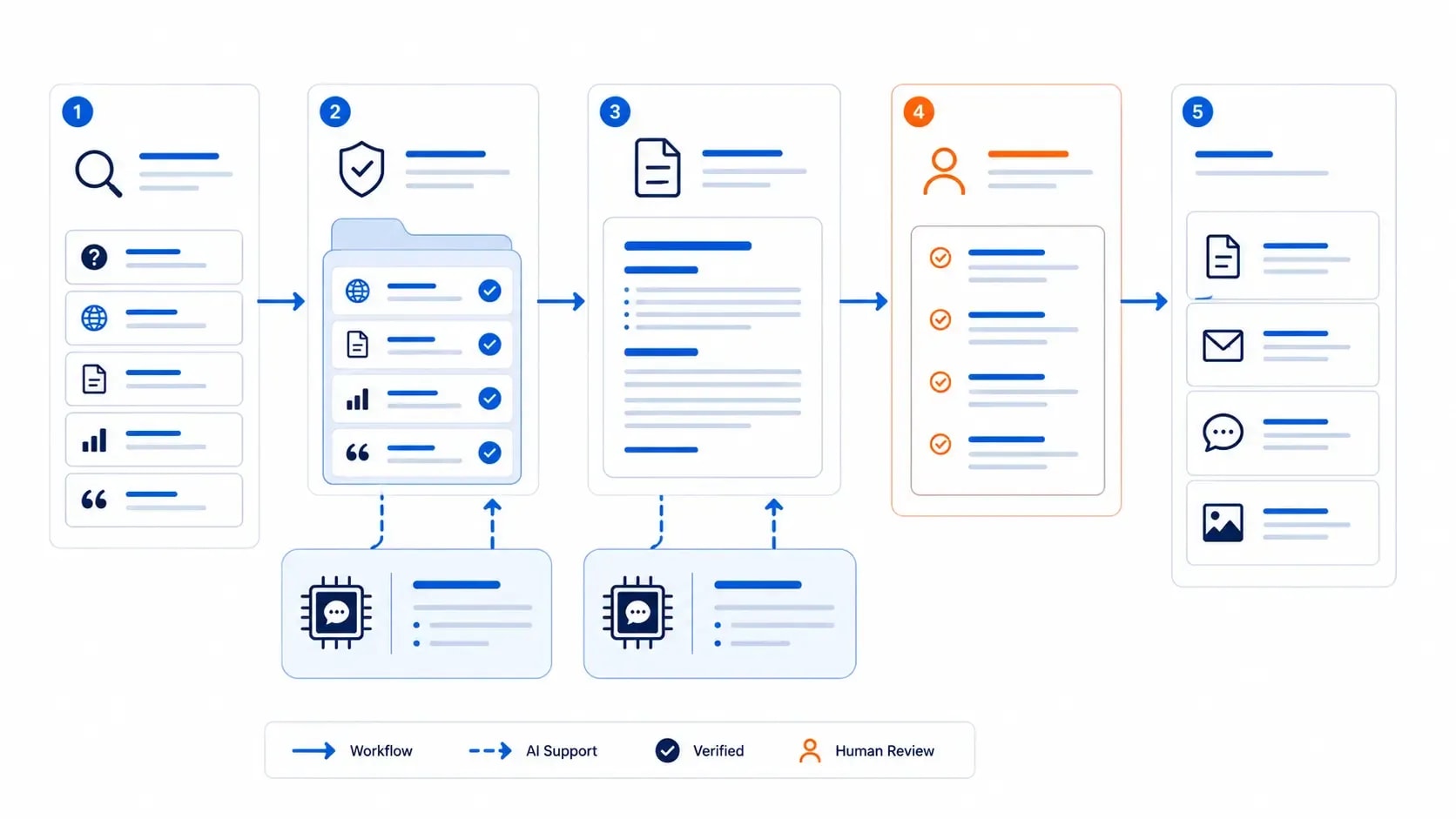
Option 1: ChatGPT for research, Claude for the first draft
- Use ChatGPT to map the reader’s questions and find primary sources.
- Verify and save the approved evidence outside the chat.
- Give Claude the brief, sources, and voice rules.
- Review the draft for factual support and brief compliance.
- Return to ChatGPT only for missing research or visual repurposing.
Option 2: Claude for the angle, ChatGPT for production
- Ask Claude to propose three distinct arguments from the same brief.
- Choose one and explain why it fits the reader.
- Use ChatGPT to build the full outline, source checklist, and related assets.
- Draft section by section.
- Ask Claude for a final repetition and clarity pass with strict preservation rules.
Option 3: One tool only
If one subscription already handles the work, stop there.
Create a project. Add your source hierarchy, brand voice, article template, claims policy, and approved examples. Use a pre-publish checklist. A small practical system beats switching tools because one produced a better paragraph in somebody else’s test.
For more options beyond these two products, see Anobee’s guide to AI writing tools for bloggers. If your workflow starts with organic-search research, these ChatGPT prompts for SEO can help turn a vague request into a bounded task.
How to run your own ChatGPT vs Claude writing test
Test with an assignment you actually repeat. An abstract prompt designed to make one product fail teaches you very little about daily work.
- Choose a recurring writing task.
- Write one brief with audience, goal, structure, length, voice, evidence rules, and exclusions.
- Start fresh or incognito chats so old context does not distort the result.
- Use the closest available model and plan settings, then record them.
- Send the exact same prompt once to each product.
- Do not follow up until both first responses are saved.
- Score brief compliance, factual support, usefulness, voice, structure, and editing time.
- Repeat the test on two different task types before changing your workflow.
Measure the editing work, not the first impression. A polished draft that misses the audience, evidence rules, or requested format has simply hidden the cleanup.
Is Claude better than ChatGPT for writing?
Claude produced the stronger first draft in Anobee’s August 26, 2026 test. Its argument was tighter, and it stayed within the requested length. That result does not extend automatically to every blog, research task, edit, or future model.
ChatGPT was more exhaustive and followed the requested heading structure more literally. It also offers a broader built-in workflow when research, citations, images, and document iteration matter.
Choose by task. Then verify the choice with your own brief.
The bottom line
The test produced a useful answer, just not a permanent winner. ChatGPT made more sense for a broader research and production workflow. Claude gave us the cleaner starting draft.
Models and product features will change. The durable part is the system around them: a clear brief, verified sources, explicit constraints, human judgment, and one final compliance check. Keep the second tool only if it earns its place by reducing the work.
Frequently Asked Questions
Is Claude better than ChatGPT for writing?
Claude is not universally better. In Anobee's single same-brief test, Claude produced the tighter draft, while ChatGPT covered more detail but exceeded the requested length. Your result can change with the model, plan, prompt, source files, and type of writing.
Is ChatGPT or Claude better for blog writing?
ChatGPT is useful when blogging requires research, citations, visual ideation, and iterative editing. Claude is useful for focused drafting and concise restructuring. A practical workflow can use either one for the first draft and the other as a critical editor.
Should I pay for both ChatGPT and Claude?
Start with the free plans and test your recurring tasks. Paying for both makes sense only when each tool saves enough time in a distinct part of your workflow. As verified on August 26, 2026, ChatGPT Plus and Claude Pro each list a US price of $20 per month.
Can ChatGPT and Claude match my writing style?
Both can use persistent guidance and reference material. ChatGPT supports custom instructions and project instructions. Claude supports account instructions, project instructions, and reusable skills. You still need examples, constraints, and human review.
Sources and References

Written by
Bibek Thapa
AI-Powered Digital Growth Strategist
Bibek Thapa works across AI workflows, SEO, AI search optimization, content strategy, website growth, and productivity systems. Anobee documents practical lessons, tools, experiments, and systems for improving digital presence.
- AI workflows
- Digital growth
- SEO
- GEO
- AEO
- Content strategy
- Website growth