AI Tools & Workflows
Can ChatGPT Do SEO? What It Does Well, What It Gets Wrong, and Where a Human Still Decides
By Bibek Thapa · Published · 9 min read
Quick Answer
ChatGPT can do part of SEO. In four runs on anobee.com pages it read titles and meta descriptions correctly, grouped keywords sensibly and found a Payoneer fee rule we had missed. It also guessed the wrong CMS, misjudged page length and put an old date in schema. Use it for drafts and first passes, and check every fact before you publish.

Table of ContentsOn this page
- The four tasks at a glance
- Can ChatGPT do SEO audits?
- Keyword grouping: a useful first pass with careless details
- Content briefs: right numbers, missing context
- Schema markup: valid code, wrong date
- What ChatGPT cannot do for SEO
- How to use ChatGPT for SEO without publishing its mistakes
- Where a human still decides
- Frequently Asked Questions
- Sources and References
Key Takeaways
- ChatGPT read the title, meta description and H1 of a live page correctly, but could not see its structured data.
- Its keyword groups matched four of Anobee's own planned clusters, yet it invented URL folders the site does not use.
- A content brief got Payoneer's fees right and found a Nepal rule Anobee had missed, but left out the key NRB limits.
- The schema it wrote was valid JSON with the wrong modified date, and it would have duplicated markup already on the page.
- Treat every ChatGPT SEO answer as a draft: check facts, dates and site details against the live page before you act.
Can ChatGPT do SEO? Partly. It can read a public page, group keywords, draft a brief and write schema code, and some of that work is quick and useful. It also makes mistakes that look like facts: a wrong date, an invented URL folder, a guess about how the site is built. Anobee gave it four real SEO jobs on its own pages. Every run produced at least one error that would have gone live if nobody had checked.
How these runs were done: on 20 October 2026, Anobee ran four prompts in ChatGPT on the Free plan, with web search. Each prompt ran once, in a new chat. The pages were real anobee.com articles, so every answer could be checked against the live HTML and the site's own content calendar. Four runs are a small sample. They show the kinds of errors to expect, not how often ChatGPT makes them.
The four tasks at a glance
| Task | Page or data | What ChatGPT got right | What it got wrong |
|---|---|---|---|
| SEO audit | How to get cited by ChatGPT | Title, meta description, H1; a fair point on missing first-hand evidence | Could not see the JSON-LD, missed FAQPage, estimated 4,000 to 5,000 words, assumed WordPress |
| Keyword grouping | 20 keywords from Anobee's calendar | Four groups matched Anobee's own planned clusters | Said 7 pages, then listed 9; invented /finance/ and /analytics/ folders |
| Content brief | "payoneer account nepal" | Fees of 1.2% to 4% and 29.95 USD; found a Nepal rule Anobee had missed | Left out the NRB limits freelancers need; named no real internal links |
| Schema | ChatGPT prompts for SEO | Valid JSON, sensible types, no invented publish date | Wrong dateModified; told us to paste it into WordPress, which would duplicate existing markup |

Can ChatGPT do SEO audits?
It can do a surface audit of a public page, and it was honest about its limits. Asked to audit Anobee's guide on getting cited by ChatGPT, it worked for about 17 seconds and returned the exact title tag, meta description and H1. Its first recommendation was a good one. The article admits it has no documented citation test, and ChatGPT ranked that as the biggest gap.

Underneath, the details were weaker:
- Length: it estimated 4,000 to 5,000 words. The whole article, including the FAQ and references, comes to about 3,100.
- Structured data: it could not see the JSON-LD, said so, and guessed Article or BlogPosting plus BreadcrumbList. The page also carries FAQPage markup, which it missed.
- Platform: it told us to check "your WordPress source" and plugins. Anobee does not run on WordPress, so those steps would send a reader to the wrong place.
So can ChatGPT do SEO audits? It can review what a visitor sees and suggest where to look. A crawler, Search Console and the page source still have to do the rest, because ChatGPT does not reliably see what those tools see.
Keyword grouping: a useful first pass with careless details
Anobee gave it 20 keywords from its own content calendar: Payoneer, Microsoft Clarity and GA4 terms mixed together. ChatGPT put "is payoneer legit", "is payoneer safe" and "is payoneer trustworthy" on one page. It paired "wise vs payoneer" with "payoneer vs paypal" and kept Clarity's pricing questions apart from its performance questions. Those four groups match clusters Anobee had already planned by hand.

Two problems would have caused trouble if copied straight into a plan. The answer opened with "7 dedicated pages across 2 topic clusters" and then listed 9 pages across 3. It also proposed URLs such as /finance/is-payoneer-legit/ and /analytics/microsoft-clarity-pricing/, although Anobee has no finance or analytics folder. It never checked which pages the site already has, even though the prompt named the site.
Some of its other choices were judgement calls rather than errors, such as giving Clarity's cookie question its own page. That is where a person who knows the site has to decide.
Content briefs: right numbers, missing context
For "payoneer account nepal", ChatGPT produced a full brief with an outline, keywords and a list of facts the writer must check. The fee figures were right. Payoneer lists 1.2% to 4% to withdraw with currency conversion, and a 29.95 USD annual account fee when an account receives less than 6,000 USD in 12 months.
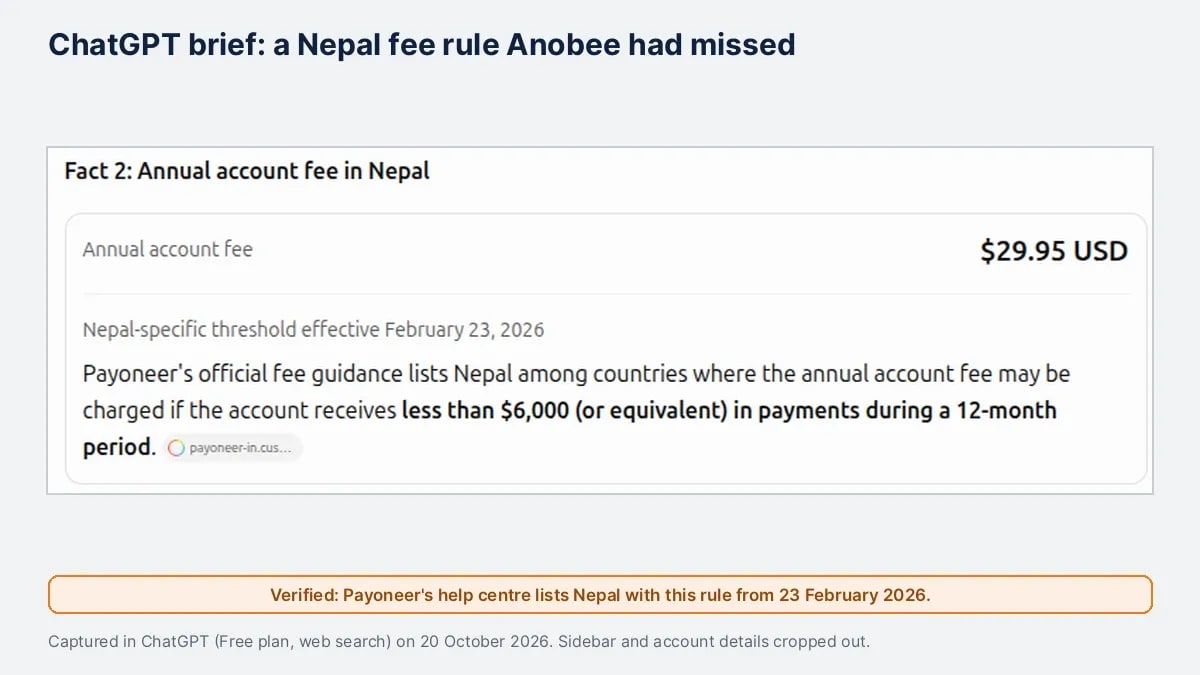
It also found something Anobee's own article on Payoneer in Nepal had missed. Payoneer's help centre lists Nepal by name among the countries where the 6,000 USD rule has applied since 23 February 2026 [4]. Anobee checked that page after the run, and the row is there.
The gaps were in context. The brief told the writer to read Nepal Rastra Bank circulars without naming the two rules a freelancer most needs. Those are the USD 25,000 a year allowed for IT services and the USD 1,500 cash holding limit. It also suggested internal links to "a future or existing" fee guide instead of naming real Anobee pages. A brief like this saves time on structure, but the facts that make the article useful still came from a person reading the sources.
Schema markup: valid code, wrong date
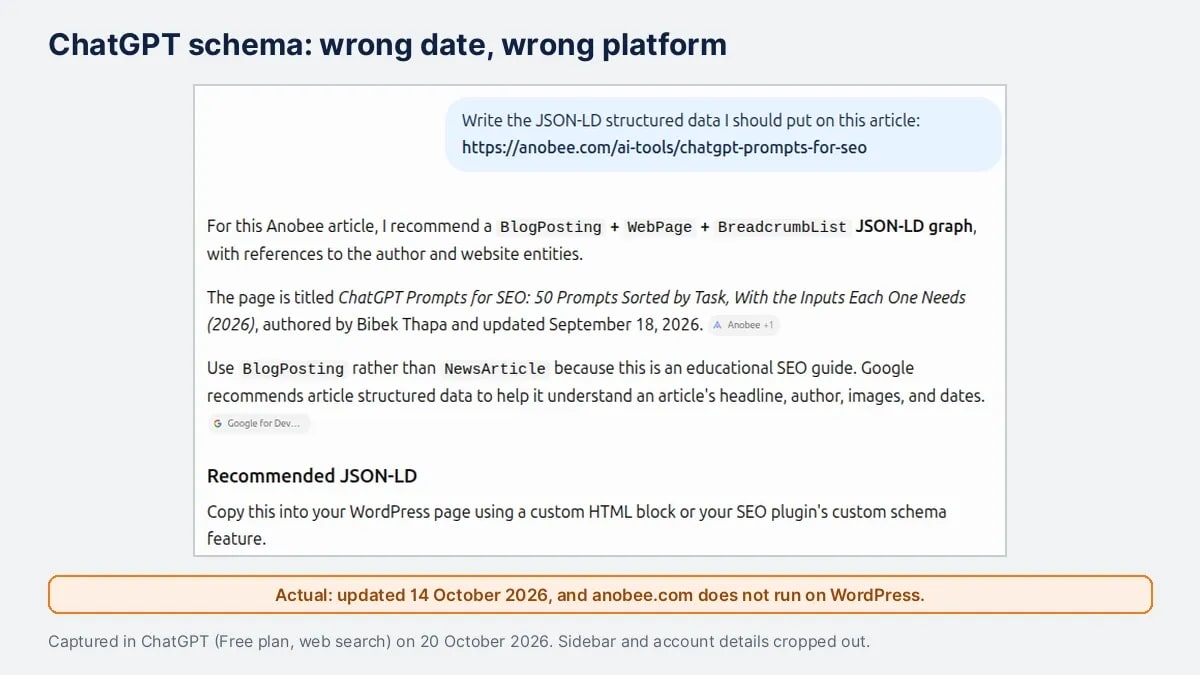
Asked for JSON-LD for Anobee's ChatGPT prompts for SEO page, ChatGPT wrote a clean graph with WebSite, Person, WebPage, BlogPosting and BreadcrumbList. It did not invent a publish date, and it advised against adding FAQPage just to chase rich results. That advice fits Google's own record: FAQ rich results stopped appearing in Google Search from 7 May 2026 [3].
Its code still needed fixing:
- The date: it set
dateModifiedto 18 September 2026. The page shows "Updated Oct 14, 2026", and so does its existing markup. Google's structured data guidelines say markup must be a true representation of the page and up to date [2]. - The description: it rewrote the page description instead of using the real one.
- Duplication: it said to paste the code into a WordPress HTML block. The page already outputs BlogPosting, BreadcrumbList and FAQPage, so adding this would have put two conflicting article graphs on one page.
Valid JSON is not the same as correct schema. Check every value against the visible page before you use it.
What ChatGPT cannot do for SEO
Across the four runs, the failures followed a pattern. ChatGPT works from what it can fetch and what it assumes, and it does not know your site the way your own tools do.
- It does not have your data. Search Console clicks, impressions and indexing reports stay out of reach unless you paste them in.
- It does not see the whole page. In the audit it could not read the JSON-LD. A look at the page source shows it in seconds.
- It fills gaps with common assumptions. WordPress, a
/finance/folder and a September date were all plausible guesses, and all wrong. - It reports uncertainty unevenly. It doubted its own meta description, which was exact, and stated the wrong schema date as fact.
Every answer also ends with ChatGPT's own line: "ChatGPT can make mistakes. Check important info." Google says much the same about AI output. It asks publishers to fact-check and review AI-generated content before publishing, including titles, meta descriptions, structured data and alt text [1].
How to use ChatGPT for SEO without publishing its mistakes
Using ChatGPT for SEO works best when its answer is the start of the job. Before you act on one, run these checks:
- Open the live page. Compare every title, description, heading and date ChatGPT quotes with what the page and its source actually show.
- Check the platform and URLs. Remove any advice that assumes a CMS, plugin or folder your site does not use.
- Count the output. If it says 7 pages, count them. Internal contradictions are easy to miss in a long answer.
- Trace every number to its source. Fees, limits and dates should come from the official page, not from the chat.
- Map suggestions to real pages. Before you accept a new page or internal link, search your own sitemap for a page that already covers it.
For the prompts themselves, with the inputs each one needs and the check to run afterwards, use Anobee's ChatGPT prompts for SEO library.
Where a human still decides
So can ChatGPT do SEO? In these runs it did the mechanical half of each job reasonably well. It could not make the decisions. Which keywords deserve their own page on this site? Which facts matter to a Nepali freelancer? Would new schema clash with what the page already outputs? Those calls need someone who knows the site, its history and its readers.
Google's people-first guidance asks the same of publishers. It suggests explaining how content was made, including any use of automation or AI, where readers would reasonably want to know [5]. If ChatGPT drafted part of a page, someone still has to decide what is true, what is useful and what goes live. If you also want ChatGPT to cite your pages, Anobee's guide on how to get cited by ChatGPT covers that separate question.
Frequently Asked Questions
Can ChatGPT do SEO optimization on its own?
No. It can draft titles, meta descriptions, outlines, keyword groups and schema, and it can read a public page. It cannot see your Search Console data, cannot publish changes and made factual mistakes in every one of Anobee's four test runs.
Can ChatGPT do an SEO audit?
It can do a surface review. In Anobee's run it read the title, meta description and H1 correctly and raised a fair point about missing first-hand evidence. It could not see the page's JSON-LD, overestimated the length and assumed the site ran on WordPress.
Is the free ChatGPT plan enough for SEO tasks?
Anobee ran all four tasks on the Free plan with web search, and each one finished. Paid plans raise usage limits, but no plan removes the need to check the answers against the live page.
Does Google penalise content written with ChatGPT?
Google's guidance says generative AI can help research and structure original content, but mass-producing pages without added value may break its scaled content abuse policy. It asks publishers to fact-check AI output before publishing.
Sources and References
- Google Search Central, Guidance on using generative AI content on your website ↩
- Google Search Central, General structured data guidelines ↩
- Google Search Central, Latest Google Search documentation updates (FAQ rich result removal) ↩
- Payoneer Help Center, Annual account fee ↩
- Google Search Central, Creating helpful, reliable, people-first content ↩
Was this guide helpful?
Your answer helps Anobee improve future updates.

Written by
Bibek Thapa
AI-Powered Digital Growth Strategist
Bibek Thapa works across AI workflows, SEO, AI search optimization, content strategy, website growth, and productivity systems at Anobee.
- AI workflows
- Digital growth
- SEO
- GEO
- AEO
- Content strategy
- Website growth