

AI powered digital growth means structuring your blog so it ranks in Google and gets pulled into AI answers on ChatGPT, Perplexity, and Gemini. The fastest route is the ANOBEE GEO Framework: answer-first writing, entity depth, original data, clean schema, and off-site citation seeding. Small blogs can win this even without big domain authority.
Key Takeaways
- GEO is not a replacement for SEO. It’s SEO with an extra layer aimed at how AI models select sources to quote.
- Roughly a quarter of URLs cited by AI answer engines have zero Google top-10 visibility for the same query. Citation and ranking are related but not identical games.
- The single highest-leverage move for a beginner blog is restructuring existing pages to answer the query in the first two or three sentences, before any preamble.
- Original data (even something as small as a personal case study) beats generic advice almost every time when an AI model is choosing what to cite.
- Fixing brand entity signals, like a correct Organization schema, matters more than most beginners assume. AI models cross-reference structured data to confirm who’s actually behind a piece of content.
What “AI Powered Digital Growth” Actually Means in 2026
A year ago, most beginner bloggers treated “SEO” as one thing and “getting mentioned by ChatGPT” as some separate, vaguely mysterious side quest. That gap has mostly closed. Google’s own AI Optimization Guide, published in June 2026, says it outright: helping your content perform well in AI-powered search is largely the same job as helping it rank well in traditional search. Same fundamentals, same helpful-content bar, same technical hygiene.
What’s changed is the distribution channel. A reader typing a question into Google in 2023 got ten blue links. That same reader in 2026 might get an AI Overview box with a synthesized answer and three or four cited sources sitting above the traditional results. They might not be using Google at all. They might be asking ChatGPT, or pasting the question into Perplexity, or letting Gemini answer it inside their inbox.
AI powered digital growth is the practice of writing content that performs in both worlds at once. Not two separate strategies bolted together. One approach, built around clarity, specificity, and structure, that happens to satisfy a human reader, a Google crawler, and a language model’s retrieval system simultaneously.
For a beginner-to-intermediate blogger, that’s good news. You don’t need to learn an entirely new discipline. You need to get sharper at the one you already have.
The shift is easiest to see in how traffic itself is changing shape. A page that used to get a hundred clicks from an informational query might now get seventy, because thirty of those readers got their answer straight from an AI Overview box and never scrolled down to the blue links. That sounds like a loss, and for pure pageview counts, it is. But those same thirty readers are, in a real sense, still consuming your content. It’s just being delivered through a different window. If your page is the one the AI Overview cites, your brand name is sitting right there in the answer, in front of someone who may never have clicked through in the old model either.
This matters more for a beginner blog than it does for an established publisher with millions of monthly visits. A big publisher can absorb a ten percent click-through dip and barely notice. A blog doing a few thousand sessions a month feels every percentage point. Which is exactly why getting the structural fundamentals right early, rather than bolting them on after the fact, saves months of wasted publishing.
Key Insight: AI powered digital growth isn’t a new skill set bolted onto SEO. It’s SEO done with more precision, aimed at a wider set of readers, some of them human and some of them machines summarizing for humans.
SEO vs GEO vs AEO: One Framework, Not Three Disciplines
You’ll see three acronyms thrown around: SEO, GEO (generative engine optimization), and AEO (answer engine optimization). Plenty of “expert” content in 2025 tried to sell these as three separate skill trees, each requiring its own course, its own tools, its own consultant.
That framing hasn’t aged well. Here’s the more useful way to think about it:
- SEO gets your page crawled, indexed, and ranked.
- AEO structures your content so a direct question gets a direct, extractable answer.
- GEO extends that structure so generative AI models, which retrieve and synthesize rather than just link, are willing to cite your page as a source.
They stack. A page with weak SEO (blocked by robots.txt, slow to load, thin content) will rarely get the chance to be cited by an AI model in the first place, because most AI systems still lean heavily on the same index Google uses to find candidate sources. Perplexity, in particular, tracks Google rankings closely. If you’re not ranking, you’re less likely to be retrieved, let alone cited. For a deeper look at how retrieval actually works on that platform, see our guide to Perplexity’s citation logic.
So the practical takeaway for a beginner blog: don’t create a separate “AEO content” folder and a separate “GEO content” folder. Write one good article, structured so a human skimming it, a crawler indexing it, and a model summarizing it all get what they need from the same paragraphs.
There’s a second reason the three-separate-disciplines framing falls apart under scrutiny: the platforms themselves don’t actually work in isolation. Perplexity leans heavily on Google’s own index for candidate pages, then applies its own citation logic on top. Google’s AI Overviews draw from the same crawl and ranking systems as ordinary search results, just filtered through a summarization layer. ChatGPT’s search feature, when it browses live, uses Bing’s index for a meaningful share of queries, with signs in 2026 of broader crawl coverage beyond that. None of these systems invented a parallel internet to search. They’re all reading the same web, just deciding differently which pages are worth quoting.
That’s useful to know because it means the old advice (“write for humans, not search engines”) was never actually bad advice. It was just incomplete. The update for 2026 is: write for humans, structure for machines, and stop assuming those two goals are in tension. They rarely are.
Key Insight: Treating SEO, AEO, and GEO as three separate workstreams wastes time you don’t have. They’re one job with three audiences.
The ANOBEE GEO Framework: 5 Steps to AI Citation
This is the framework behind everything published on this site. Five steps, run in order, applied to a single article or across an entire content cluster.
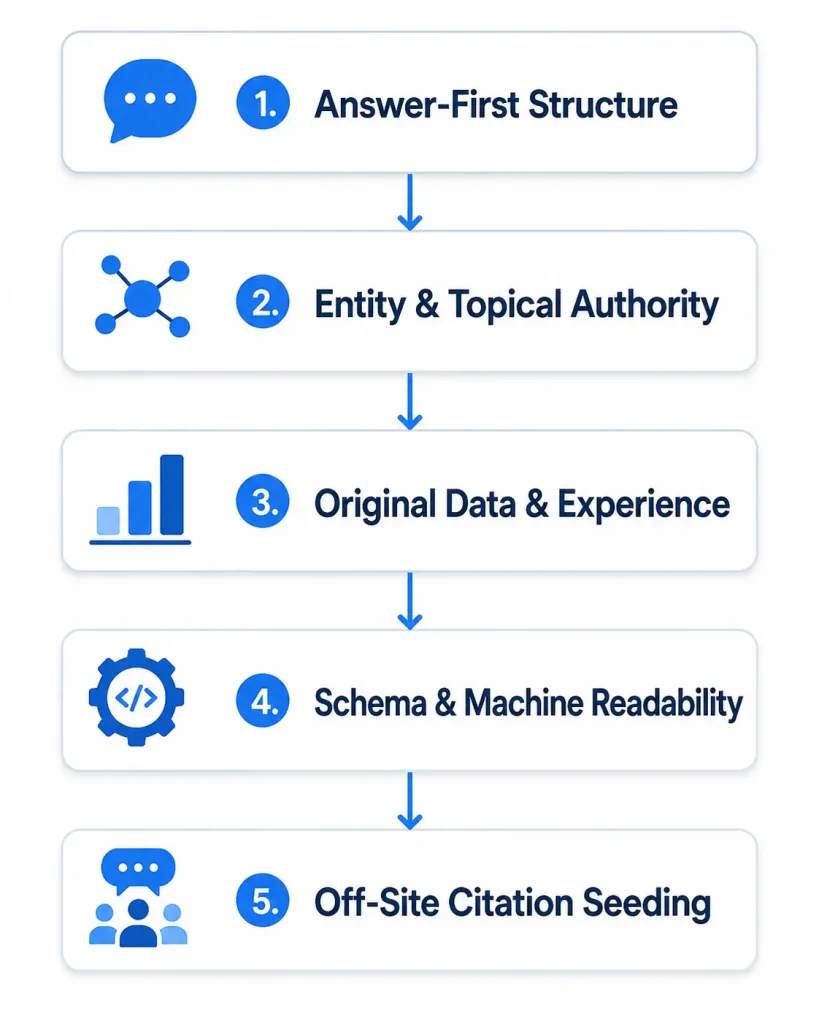
Step 1: Answer-First Structure
Most beginner blog posts still open with a paragraph of throat-clearing. Something like “In the ever-changing world of digital marketing, bloggers face many challenges…” That paragraph does nothing for a reader and nothing for an AI model looking for an extractable answer.
Instead, the first thirty to fifty words of any piece should answer the core question directly, in plain language, using the primary keyword naturally. If someone asked you the question out loud at a coffee shop, what would you say in the first two sentences? Write that. Everything else in the article supports and expands on it.
This single change is the fastest fix available to a beginner blog with existing content. You don’t need new topics. You need to rewrite the first fifty words of your best-performing pages so they lead with the answer instead of building up to it.
A useful test: read your opening paragraph out loud and ask whether it would survive being pasted, on its own, into a chat window as the entire answer to the reader’s question. If it wouldn’t stand alone, it’s not doing the job. Headings help here too. Every H2 and H3 in a piece should be shaped as a question, a definition, or a clear list header, since that structure maps directly onto how a retrieval system chunks a page into extractable passages.
Step 2: Entity & Topical Authority
An “entity” in SEO terms is a recognizable thing: a person, a tool, a concept, a company. Google and AI models both build internal maps of which entities relate to which other entities. A blog that mentions “ChatGPT,” “Google AI Overviews,” “E-E-A-T,” and “Perplexity” consistently across a cluster of related articles builds a stronger topical signal than one great article surrounded by unrelated content.
For a small blog, this means picking a handful of topics you can actually cover in depth and linking them together deliberately, rather than publishing on whatever keyword tool spits out next. Eight to twelve tightly interlinked articles on one topic usually outperform fifty scattered posts with no relationship to each other. Our guide to entity SEO covers this in more depth if you want to build out a full cluster.
Think of it as building a small neighborhood instead of scattering houses across a city. A pillar page on “AI powered digital growth” that links out to dedicated pieces on AI Overviews, entity SEO, and ChatGPT citation tactics, all linking back to the pillar and to each other, sends a much clearer topical signal than the same four articles published in isolation with no connective tissue between them. Internal linking here isn’t just a ranking tactic. It’s literally how you tell a crawler, and by extension a model, which pages belong to the same conceptual cluster.
Step 3: Original Data & Firsthand Experience
This is the step most beginner content skips entirely, and it’s the one with the highest payoff. AI models are trained to prefer specific, sourced claims over generic advice, because generic advice is available from a thousand other pages and doesn’t add anything a model can point to.
When I started tracking anobee.com’s own appearance in Google AI Overviews in June 2026, I noticed something I hadn’t expected: the site was already showing up for branded “anobee” queries without any deliberate optimization for it. No schema fix, no citation campaign, nothing planned. Just the accumulated effect of consistent publishing and a clear author byline on every post. That one observation became the seed for this entire framework, because it proved something theoretical suddenly felt real: a beginner-tier site with under a hundred articles can get pulled into an AI Overview citation panel.
If your site has no original data yet, the cheapest way to create some is a documented before-and-after: a technical fix you made, a traffic number you tracked, a specific mistake you corrected and what changed afterward. It doesn’t need to be a formal study. It needs to be true, dated, and specific.
A word of caution: this only works if the numbers are real. It’s tempting, especially when a piece is thin on personal experience, to round up or invent a plausible-sounding statistic. Don’t. AI models are increasingly good at cross-checking claims against other sources, and a fabricated number that gets contradicted elsewhere on the web does more damage to your entity’s trustworthiness than having no statistic at all. If you don’t have a number yet, say so honestly and describe the qualitative change instead.
Step 4: Schema & Machine Readability
Structured data (schema markup) doesn’t guarantee a rich result or an AI citation on its own, but it removes ambiguity. FAQ schema tells a crawler exactly which text block answers which question. Organization schema tells a crawler and a language model who’s actually behind the content, which matters more than most beginners assume.
A broken Organization schema, one where the url field points to an old or unrelated domain, actively works against you here. If your structured data says your organization’s URL is a domain you no longer use, both Google’s Knowledge Graph and AI models cross-referencing that data may treat it as two separate, unrelated entities. That fragments whatever brand trust you’ve built instead of consolidating it. Checking this one field is a five-minute fix with outsized impact.
Beyond Organization schema, the other two worth prioritizing at beginner stage are Article schema (confirms authorship, publish date, and headline) and FAQPage schema (turns your FAQ section into machine-parseable question-answer pairs). Both are supported natively by most WordPress SEO plugins, so this rarely requires touching code directly. What it does require is checking the output with Google’s Rich Results Test after publishing, rather than assuming the plugin got every field right on the first try. Plugins default sensibly, but they don’t know your specific brand details, and a stale field left over from a domain migration or a theme change is one of the most common, least visible sources of schema errors on small sites.
Step 5: Off-Site Citation Seeding
The last step is the one people skip because it feels less like “content work” and more like community participation. Research consistently shows a large share of AI citations trace back to earned third-party mentions rather than owned content: an actually useful Reddit answer, a Quora response, a mention on a forum thread. This is because platforms like Reddit and Quora carry a strange, outsized weight in how models retrieve and rank sources.
The tactic here isn’t to spam links. It’s to answer real questions on Reddit or Quora using whatever expertise you actually have, occasionally linking to a deeper resource when it’s directly relevant, and let the mention itself do the work. A single well-placed, helpful Reddit answer referencing your article by name can do more for AI citation than another five blog posts.
There’s a rhythm to doing this well without it feeling like marketing. Spend most weeks just answering questions with no link at all, purely because the answer is useful. Only link back when a thread really calls for more depth than a comment can hold, and even then, mention the source by name in the sentence itself rather than dropping a bare URL. “I wrote up the full comparison table on this if it helps” reads as a person sharing work. A comment that’s ninety percent link and ten percent text reads as spam, to both moderators and to any model weighing how real the mention looks.
Key Insight: The five steps build on each other. Skipping the answer-first structure in Step 1 undermines everything that follows, because a model can’t extract what isn’t clearly stated.
Case Study: How Anobee.com Started Appearing in AI Overviews
Here’s the honest version of how this happened, without dressing it up.
Anobee.com wasn’t built with GEO in mind from day one. It started as a fairly typical SEO and digital marketing blog. Somewhere around the middle of 2026, while doing a routine brand search to check where the site ranked for its own name, Google’s AI Overview box showed up with a synthesized answer about the site, sourced directly from one of its own pages. There was no campaign behind it, no paid placement, nothing planned. The AI Overview just surfaced the content because it answered the query cleanly.
That single, unplanned data point became the most useful piece of evidence in this entire framework. It confirmed something that’s easy to doubt when you’re running a small site: you don’t need Ahrefs-level domain authority to show up in an AI citation panel. You need content structured clearly enough, and an entity signal clean enough, that a model retrieving candidates for that query finds your page a reasonable one to quote.
The follow-up work since that observation has been methodical rather than dramatic: fixing the Organization schema issue described above, adding first-person experience paragraphs to the site’s highest-traffic articles, and building out interlinked clusters around topics the site already had some authority in, rather than chasing new ones. None of this is glamorous. All of it is measurable.
What’s actually paid off is treating this like an ongoing experiment rather than a one-time project. A simple weekly habit, running the same handful of brand and category queries through ChatGPT, Claude, Gemini, and Perplexity and logging what comes back, turns “are we getting cited yet” from a vague hope into a number you can actually track over time. Most weeks, nothing changes. That’s fine. The point is catching the week something does change, and being able to trace it back to whichever fix or article went live shortly before.
The next milestone on this particular site is a sixty to ninety day follow-up report once the schema fix and the refreshed articles have had time to be recrawled and reconsidered by each platform. Publishing that follow-up, with the honest numbers, is itself another piece of original data for the next article in the cluster.
Key Insight: A single unintentional AI Overview citation, tracked honestly and acted on, is worth more strategic clarity than a dozen theoretical “GEO best practice” listicles.
Common Beginner Mistakes That Block AI Citation
A few patterns show up again and again in beginner-tier content that never gets picked up by AI answer engines:
- Burying the answer. Three paragraphs of context before the actual point. Models (and impatient humans) don’t wait around for paragraph four.
- Generic advice with no specifics. “Optimize your content for search intent” says nothing a model can cite with confidence. Specific numbers, specific tools, specific dates carry weight.
- Broken or inconsistent entity signals. A byline on one page, no byline on another, an Organization schema pointing to the wrong domain. Inconsistency reads as untrustworthy to both Google and AI crawlers.
- Ignoring community platforms entirely. Treating Reddit and Quora as beneath a “professional” content strategy, when they’re some of the most heavily weighted sources in AI training and retrieval data.
Fixing even two of these on your top five articles usually moves the needle faster than publishing five brand-new pieces.
There’s also a subtler mistake worth naming: treating every piece of content as if it needs to chase an AI Overview citation. It doesn’t. Plenty of good blog content, especially commercial or transactional pages where a reader wants to click through and compare options, is better off optimized purely for click-through rather than for zero-click extraction. Trying to force an AI-citation structure onto a page whose real job is converting a reader into a click can actually hurt conversion, because it front-loads the entire answer before the reader has any reason to keep reading. Match the structure to the intent of the specific page, not to a blanket rule applied across the whole site.
Is GEO replacing SEO?
No. GEO builds directly on SEO fundamentals. Ranking reasonably well is still a prerequisite for most AI citations, since models frequently draw from the same index Google uses.
How long does GEO take to show results?
Most beginner sites that make consistent structural changes start seeing early citation signals within sixty to ninety days, though this varies by topic competitiveness and how often the model refreshes its retrieval index.
Do I need special tools for GEO?
Not at the beginner stage. Free tools plus manually querying ChatGPT, Claude, Perplexity, and Gemini with your target keywords covers most of what a small blog needs to track progress.
Does GEO work for small blogs with no big backlink profile?
Yes. Citation research suggests a meaningful share of AI-cited URLs have zero Google top-10 visibility for the same query, meaning smaller, specific pages can get cited directly even without dominant domain authority.
What’s the single fastest fix for a beginner blog?
Rewrite the opening fifty words of your best-performing existing articles so they answer the core question immediately, instead of building up to it through several paragraphs of introduction.
Should I stop using the terms SEO, AEO, and GEO in my content?
No. They’re useful for matching how your audience actually searches and talks about the topic. Just don’t treat them as three separate technical workstreams requiring separate strategies.
Do I need to rewrite every old article to fit this framework?
No. Start with your five to ten highest-traffic existing pages. Rewriting the opening, tightening the entity signals, and adding one firsthand paragraph to those pages will outperform applying a shallow version of the framework across your entire archive at once.