

Quick Answer: Perplexity SEO is the practice of optimizing your content to be cited inside Perplexity AI’s answers. Unlike Google, Perplexity does not rank pages in a list. It generates one synthesized answer and credits 3 to 4 source pages. To get cited, your content needs to be crawlable, answer the exact query in the first 100 words, and use structured formatting that Perplexity’s AI model can extract.
Getting traffic from Google is something most SEO beginners understand. You rank on page one and people click through. Perplexity SEO works on different logic entirely, and most beginners have no idea it exists.
Perplexity AI processed 780 million queries in May 2025 alone and now handles over 30 million daily searches. The audience is not random either. 80% are college graduates, 65% are high-income professionals, and 30% are senior company leaders. If you write about SEO, digital marketing, or AI tools, that is exactly who you want reading your content.
The problem is that most beginners have no idea what perplexity seo actually means or how it works. This guide explains the concept and walks through seven specific steps you can apply to your site starting today. No big domain required, no agency budget needed.
What Is Perplexity SEO?
Perplexity SEO is the process of making your content easy for Perplexity AI to find and cite in its answers.
Here is the core difference from Google. When you search on Google, you get ten links and choose which one to click. When you search on Perplexity, you get one synthesized answer with three to five inline source citations attached. There are no positions to win. Your page is either cited or it is not.
That changes everything about how you optimize.
Key Insight: Traditional SEO is about earning a position in a list of links. Perplexity SEO is about being one of three or four sources cited in a single generated answer. That is a fundamentally different thing to optimize for.
How Perplexity Actually Works
Perplexity runs on something called RAG, which stands for retrieval-augmented generation. For every query a user types, Perplexity runs a live web search, crawls roughly 10 candidate pages, scores them using its own ranking signals, and then feeds the top sources into its Sonar language model to generate a cited answer.
This matters because Perplexity is not working from a fixed training dataset. It reads your page fresh every time someone asks a relevant question. If your page is not crawlable at that moment, you have zero chance of being cited, no matter how good the content is.
The Sonar model then evaluates which pages answer the query most clearly and directly. Pages that make it easiest for the model to pull a clean passage are the ones that get cited.
Key Insight: Perplexity reads your page live for every query. Content that is fresh and well-structured can earn Perplexity citations faster than Google rankings ever appeared.
Why Google Rankings Don’t Guarantee Perplexity Citations
Get this one wrong and the rest of the work won’t matter.
Practitioners testing this across multiple niches have found pages ranked number two on Google that never appear in Perplexity, while a lower-authority site with better structured formatting gets cited instead. The pattern is consistent enough that it shows up repeatedly in citation research.
The reason comes down to what each system is actually rewarding. Google wants the page a user will click. Perplexity wants the passage an AI model can lift cleanly into a cited answer. Those are not the same thing, and the winning page in each case can be completely different.
There is, however, significant overlap. A 2026 study by Onely found an 82% correlation between Perplexity citations and Google AI Overview citations. Content that already earns Google AI Overview placement is doing most of what Perplexity needs. A few extra structural changes close the gap.
Key Insight: Ranking number one on Google is a useful baseline, but not a citation guarantee on Perplexity. Content strong enough to earn Google AI Overview citations will, in most cases, also earn Perplexity citations once the formatting is sorted.
The 6 Perplexity Ranking Factors That Actually Matter
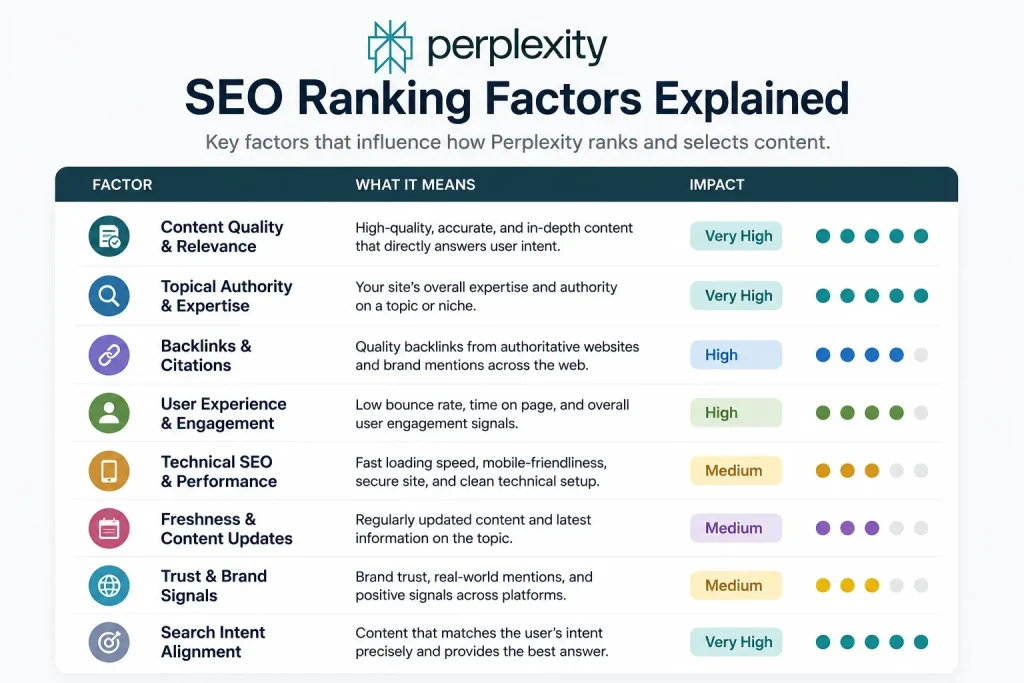
Multiple large-scale citation studies point to the same core signals. Here are the six factors with approximate weightings based on published data:
| Ranking Factor | Approx. Weight | What It Means |
|---|---|---|
| Content Relevance | ~30% | Content must directly answer the specific query |
| Structural Extractability | ~20% | Headings, Q&A format, tables, bullet lists |
| Domain Authority | ~15% | Trust floor; new sites can still get cited with stronger content |
| Content Freshness | ~15% | Recently updated pages get a recency boost |
| Source Diversity Signals | ~10% | Being mentioned on trusted third-party domains helps |
| Structured Data | ~10% | FAQPage, HowTo, Article schema as a confidence boost |
Two things stand out from this table. First, backlinks barely affect Perplexity citations directly. Traditional link building helps domain authority as a signal, but it is far from the main driver. Second, freshness carries more weight in Perplexity than in Google. Updating an existing post can generate new citations faster than publishing a brand-new article.
Key Insight: A well-formatted post on a new site can outperform a vague post on a high-authority domain. Structure and freshness do more work here than domain authority does.
The FETCH Framework: A Beginner’s Perplexity SEO System
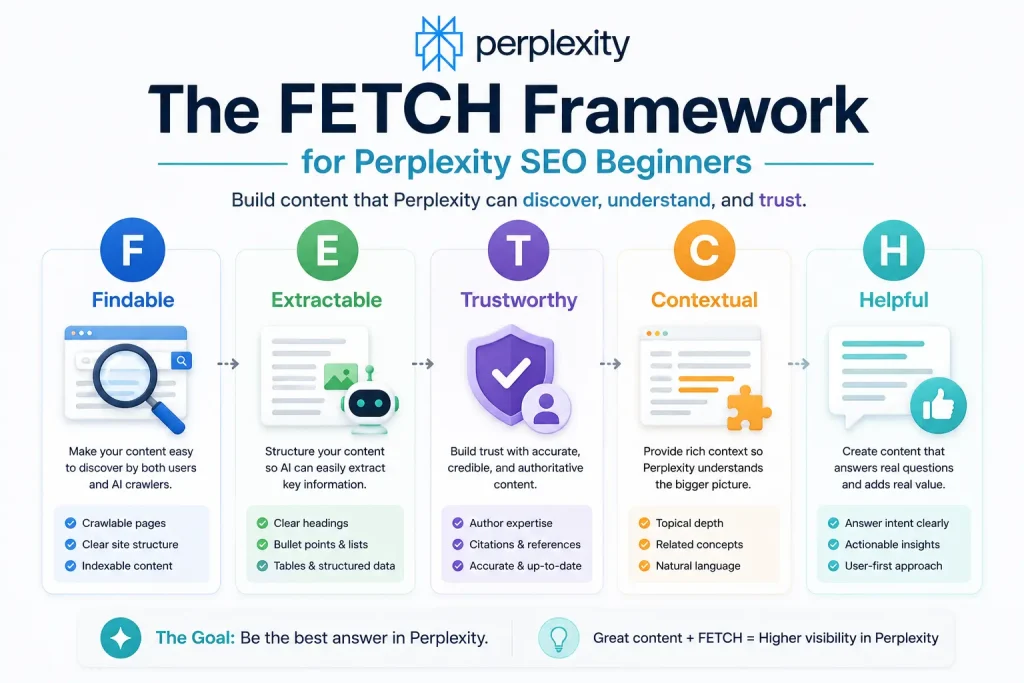
To make perplexity seo practical for beginners, I developed a five-part system called the FETCH Framework. Each letter maps to one area of optimization you can work through in order.
F: Fresh. Update your content regularly and display a visible “Last updated” date. Perplexity re-indexes fast. Monthly updates on fast-moving topics keep you in contention.
E: Extractable. Structure your content with short headings, Q&A blocks, comparison tables, and numbered steps. Make it easy for Perplexity’s model to lift a clean passage.
T: Trustworthy. Every post needs E-E-A-T signals: your name as author, a link to your author bio, first-person experience with specific dates and tools, and at least one external link to an authority source.
C: Crawlable. PerplexityBot must be able to reach your pages. If it is blocked in your robots.txt or your server is slow, nothing else you do matters.
H: Hyper-relevant answer first. Put the direct answer to the query within the first 100 words. Perplexity is literal in how it extracts content. It looks for passages that mirror the user’s question.
Apply FETCH to every new post before publishing. Then go back to your best existing articles and update them using the same checklist.
7 Steps to Rank in Perplexity Answers
Step 1: Make Your Site Crawlable for PerplexityBot
PerplexityBot is Perplexity’s web crawler. If it cannot access your pages, no other optimization will help.
Go to yourdomain.com/robots.txt and check that PerplexityBot, GPTBot, ClaudeBot, and Google-Extended are not listed under Disallow rules. In WordPress with RankMath installed, navigate to RankMath, then General Settings, then Edit Robots.txt. Review the rules and remove any blanket AI-crawler blocks.
Also check page speed. Perplexity may skip slow-loading sites during live retrieval. Run your pages through Google PageSpeed Insights and aim for under 3 seconds on mobile.
Verification: After updating, fetch your robots.txt URL and confirm there are no Disallow rules for PerplexityBot.
7 Steps to Rank in Perplexity Answers
Step 1: Make Your Site Crawlable for PerplexityBot
PerplexityBot is Perplexity’s web crawler. If it cannot access your pages, no other optimization will help.
Go to yourdomain.com/robots.txt and check that PerplexityBot, GPTBot, ClaudeBot, and Google-Extended are not listed under Disallow rules. In WordPress with RankMath installed, navigate to RankMath, then General Settings, then Edit Robots.txt. Review the rules and remove any blanket AI-crawler blocks.
Also check page speed. Perplexity may skip slow-loading sites during live retrieval. Run your pages through Google PageSpeed Insights and aim for under 3 seconds on mobile.
Verification: After updating, fetch your robots.txt URL and confirm there are no Disallow rules for PerplexityBot.
Step 2: Answer the Question in the First 100 Words
This single change has more impact on Perplexity citations than almost anything else. Perplexity favors pages that answer the query directly at the top, not after three paragraphs of setup.
Structure your introduction this way: state what the article covers, then provide the direct answer in 40 to 60 words. This is also where your focus keyword should appear naturally.
Research tracking citations across 83,670 data points found that Q&A-formatted content achieves a 55% Top-3 citation rate versus a 31% average for standard content. The difference comes down to how quickly the model finds what it is looking for.
For your blog: Add a bold “Quick Answer:” block above your first paragraph on any post where you want Perplexity citations. Write it as one short paragraph, 40 to 60 words, with the focus keyword included.
Step 3: Structure Your Content for AI Extraction
Perplexity’s Sonar model extracts content at the passage level. It looks for discrete text chunks that cleanly answer a specific question. Your formatting choices directly affect how easy that extraction is.
Use these formats in every post:
- Short H2/H3 headings that are question-shaped or definition-shaped
- Q&A blocks below each heading
- Comparison tables for side-by-side information
- Numbered steps for any process
- Bullet lists for factors, features, or tips
- A Key Takeaways section near the top of the article
Avoid dense paragraphs with no clear extraction point. Walls of text force the model to paraphrase your content, which reduces citation accuracy and dilutes your message.
Practitioner testing documented by ZipTie.dev showed that pages that restructured their introductions into clear one-paragraph answers and added comparison tables started appearing in AI citations within 4 to 6 weeks.
Step 4: Build E-E-A-T Signals Into Every Post
Perplexity’s trust evaluation closely follows Google’s E-E-A-T guidelines. Anonymous content with no author attribution rarely gets cited. Content with visible authorship and a real firsthand perspective does consistently better.
For every post, run this checklist before publishing:
- [ ] Your name listed as author with a visible byline
- [ ] Byline links to your About page
- [ ] At least one first-person paragraph in the body with a specific date, tool used, and result
- [ ] At least one external link to an authority source (Google documentation, Moz, Ahrefs, Semrush blog)
- [ ] All statistics sourced or explicitly attributed to personal testing
Data from Seer Interactive’s study of 10,000 Perplexity queries shows content with relevant quotes and statistics earned a 40% visibility boost over content without them. Original firsthand observations (“I tested this on my site in June 2026 and saw X”) qualify as exactly the kind of data Perplexity prefers to cite.
Step 5: Keep Your Content Fresh
Perplexity’s re-indexing speed is one of its defining features. Changes to your published content can be reflected in citations within hours, not the weeks typical of Google’s crawl cycle.
For SEO and AI topics specifically, update key articles monthly. A meaningful update includes at least one of these:
- A new statistic or data point from a recent study
- Updated tool screenshots or UI references
- A new FAQ question based on what readers are actually asking
- A revised section with outdated information corrected
Show a visible “Last updated” date at the top of your posts. Perplexity factors freshness into its scoring, and a clearly dated recent update is a direct signal.
In Perplexity citation studies covering fast-moving AI topics, smaller blogs with content updated within the last few weeks routinely displaced legacy publishers that had older, higher-authority pages. Freshness was the deciding factor.
Step 6: Build Topical Authority With a Content Cluster
Perplexity’s search team has described their index as built around quality and truthfulness using a power-law distribution. In plain terms: they index heavily in topic areas where they see strong, consistent signals from a domain.
For a beginner blog, this means writing multiple articles that cover different angles of the same topic. One article on perplexity seo, one on Google AI Overviews, one on generative engine optimization, one on answer engine optimization. Each one reinforces the others. Together they signal that your site is a trustworthy source on AI search topics.
Internal links between articles strengthen the cluster signal. In RankMath, use the Link Suggestions tab in the editor to find relevant internal link opportunities from your existing content. Aim for at least 2 internal links per article with descriptive anchor text that includes related keywords.
Step 7: Track Your Perplexity Citations in GA4
Unlike ChatGPT, Perplexity sends trackable referral traffic. You can measure your citation performance directly in Google Analytics 4.
How to find Perplexity traffic in GA4:
- Open GA4 and click Reports
- Go to Acquisition, then Traffic Acquisition
- Change the primary dimension to Session Source
- Filter by “perplexity.ai” as the referral source
This shows you which pages Perplexity users land on after clicking citations. Over time, you will see a clear pattern of which content types get cited and which do not.
Manual testing: Type your target queries directly into Perplexity.ai and check whether your domain appears as a cited source. Track this in a simple spreadsheet: query, whether your site appeared, and which competitor appeared instead. That spreadsheet is your Perplexity SEO audit.
What Google AI Overviews Taught Me About Perplexity SEO
I want to share something that happened on anobee.com that changed how I think about AI search engines.
At some point while running anobee.com, I searched for “anobee” on Google and found my site appearing inside the AI Overview panel at the top of the results. I had not intentionally optimized for Google AI Overviews. I had not done anything targeting that format specifically. The citation just appeared.
When I checked again in July 2026 while researching this article, it was still there. I verified this using Google Search on my regular browser with RankMath’s SEO overview open on the same screen.
What that experience told me is this: the fundamentals I was already applying (a clear author bio, first-person content, structured headings in RankMath, outbound links to Google documentation) were enough to earn an AI citation on a domain still in its early months.
Perplexity operates on the same core logic. The 82% overlap between Perplexity and Google AI Overview citations confirms it. Content that earns one is already 80% of the way to earning the other.
Most beginner sites write fine content. The problem is usually how it’s structured. Good content formatted as a wall of text gets overlooked. The same content with a Quick Answer block, a Key Takeaways list, Q&A headings, and a FAQ section gets cited. That structural work takes about 20 minutes per post. That 20 minutes is often the difference between cited and not cited.
If you are just starting out and your domain authority is low, do not let that stop you. Start with the FETCH Framework. Apply it to your next post before publishing, then go back to your best existing articles and update them. Perplexity rewards fresh, well-structured, experience-backed content from any domain size.
Key Insight: Well-structured content with real firsthand experience behind it is enough to earn Perplexity citations, even on a brand-new domain. You do not need a high-authority site or thousands of backlinks.
Key Takeaways
- Perplexity SEO means optimizing to be cited in AI-generated answers, not ranked in a list
- Perplexity visits roughly 10 pages per query but cites only 3 to 4; structure determines who gets in
- 82% of Perplexity citations overlap with Google AI Overview citations; strong Google SEO helps both platforms
- Q&A formatted content achieves a 55% Top-3 citation rate versus a 31% average
- Use the FETCH Framework: Fresh content, Extractable structure, Trustworthy signals, Crawlable site, Hyper-relevant answer first
- Track Perplexity referral traffic in GA4 under the “perplexity.ai” referral source
What is Perplexity SEO?
Perplexity SEO is the practice of optimizing your content to get cited as a source in Perplexity AI’s generated answers. Unlike Google, which shows ranked links, Perplexity generates one synthesized answer and credits 3 to 4 sources. Your goal is to become one of those sources by writing structured, answer-first, trustworthy content.
Does Perplexity use Google rankings to choose sources?
Not directly. Perplexity has its own index and scoring signals. However, a 2026 study by Onely found an 82% overlap between Perplexity citations and Google AI Overview citations. Strong Google SEO provides a trust baseline, but you still need to structure content specifically for Perplexity’s extraction model.
Can a new blog get cited in Perplexity AI?
Yes. Domain authority accounts for only about 15% of Perplexity’s scoring. A new site with well-structured, freshly published, answer-first content can get cited faster than traditional Google rankings appear. anobee.com appeared in Google AI Overviews within its first months of operation without intentional AIO optimization.
How do I track Perplexity traffic in Google Analytics?
In GA4, go to Reports, then Acquisition, then Traffic Acquisition and look for “perplexity.ai” as a referral source. Unlike ChatGPT, Perplexity sends trackable referral traffic, so you can see exactly which pages are driving clicks from Perplexity citations.
How often should I update content for Perplexity SEO?
For SEO and AI topics, update monthly. Perplexity re-indexes content faster than Google; changes can appear in citations within hours. Smaller blogs with recently updated content routinely outperform legacy publishers on time-sensitive queries in Perplexity, even at lower domain authority.
Do I need schema markup for Perplexity SEO?
Schema markup helps as a confidence boost. Pages with FAQPage, HowTo, and Article schema outperformed similar pages without markup in citation studies, even when the visible content was nearly identical. RankMath users can enable Article schema for every post and FAQPage schema for any post with a question-and-answer section.
This article was drafted with AI assistance and reviewed, verified, and edited by Bibek Thapa. All firsthand observations come from Bibek’s direct experience running anobee.com.