SEO & AI Search
6 Best SEO Content Checker Tools (2026): Scores, NLP & Pricing
By Bibek Thapa · Updated · 18 min read
Quick Answer
The best SEO content checker depends on your workflow. Surfer suits SERP-driven optimization, Clearscope fits editorial teams, Frase combines SEO and GEO, NEURONwriter is a budget-friendly option, MarketMuse supports content strategy and topical coverage, and Rank Math works well for WordPress. Use content scores as guidance, not as Google ranking signals.

Table of ContentsOn this page
- SEO content checker: the short answer
- What does an SEO content checker actually check?
- SEO content checker vs SEO content analysis tool
- Best SEO content checker tools at a glance
- 6 Best SEO Content Checker Tools Reviewed
- Which SEO content checker is best for articles?
- What is the best SEO content scoring tool?
- Which tool is best for finding missing entities and topics?
- SEO content score vs content quality score
- Can SEO content checkers help with AI search optimization?
- Free vs paid SEO content checker tools
- How to use an SEO content checker without keyword stuffing
- Common SEO content checker mistakes
- How to choose the right SEO content analysis tool
- The bottom line
- Frequently Asked Questions
- Sources and References
Key Takeaways
- Choose an SEO content checker by workflow, not by the highest score or the longest feature list.
- A useful checker should help with search intent, content coverage, semantic relevance, article structure and measurable gaps, not just keyword density.
- Content scores are proprietary tool metrics; they are not Google ranking scores and should never be optimized at the expense of clarity.
- Use dedicated content optimizers for competitive SERPs and simpler WordPress checkers for basic on-page quality control.
- For AI search, choose tools beyond SEO scores with entity coverage, page audits, AI visibility, and GEO-focused workflows.
An SEO content checker can tell you that a draft is missing important topics, that competing pages cover an idea you skipped, or that your on-page structure needs work. What it cannot tell you is whether the article deserves to rank.
That distinction matters.
A content score is useful when it reveals a real gap. It becomes harmful when the score turns into the goal and the article starts reading like a checklist of recommended phrases.
The best SEO content checker tools in 2026 are therefore not the tools with the loudest score. They are the ones that help you make better editorial decisions: understand search intent, compare the live SERP, find missing topics and entities, improve article structure, strengthen internal linking and decide what actually needs to change.
This guide compares six tools that approach that job differently. Pricing and plan details were checked against official vendor pages on September 14, 2026. Plans change frequently, so verify the vendor page before buying.
SEO content checker: the short answer
If you want one quick recommendation, choose the tool that matches the job:
- Surfer: a strong all-round choice for SERP-driven content optimization and teams that want SEO plus AI-search features.
- Clearscope: a good fit for editorial teams that prefer focused content grading and a cleaner optimization workflow.
- Frase: useful when you want research, SEO/GEO scoring, content auditing and AI visibility in one workflow.
- NEURONwriter: a lower-cost option for freelancers and smaller teams that still want semantic analysis and content scoring.
- MarketMuse: better when the problem is broader topical coverage and content strategy across a site.
- Rank Math: a practical WordPress-first option for basic on-page checks, schema and publishing QA.
For a competitive article, a dedicated content analysis tool usually gives you more useful information than a simple plugin checklist. For a small WordPress site targeting easier queries, a basic checker plus Search Console may be enough.
What does an SEO content checker actually check?
The phrase SEO content checker covers several different types of software. Some tools analyze one article. Some compare the article with competing pages. Others score basic on-page elements inside WordPress.
The most useful tools check several layers rather than one.

Search intent and SERP alignment
Before you optimize wording, confirm that the page type matches the query.
If Google is consistently showing comparison pages for a query, a short definition article may struggle even if every recommended term is present. A good SEO content analysis tool helps you inspect the pages that already rank and understand the format, depth and subtopics that searchers appear to expect.
The tool does not replace manual SERP review. It makes that review faster.
Content score or grade
Many tools convert their analysis into a score, percentage or letter grade.
That number is a proprietary optimization metric, not a Google ranking score.
Surfer's Content Score, Clearscope's grades, Frase's scores, NEURONwriter's optimization score and Rank Math's on-page score all use different inputs. You should use the score to answer a practical question:
What useful coverage or on-page element am I missing?
Do not use it to ask:
How do I force this article from 78 to 100?
The second question often leads to keyword stuffing, unnecessary sections and worse writing.
Semantic terms, entities and topic coverage
Modern content optimization is broader than repeating the primary keyword.
A semantic content analysis tool may surface related concepts, entities, attributes and subtopics that appear across relevant competing pages. Those suggestions can reveal genuine omissions.
For example, an article about SEO content checkers may be incomplete if it compares pricing but never explains:
- content scoring
- search intent
- SERP analysis
- NLP or semantic recommendations
- topic gaps
- internal links
- article structure
- content quality
- AI-search or GEO features
The goal is not to insert every term. The goal is to make sure the reader gets a complete answer.
Article structure and headings
An article SEO checker may review title usage, heading hierarchy, paragraph structure, links, media and other on-page elements.
Dedicated optimization tools go further by comparing your structure with the competitive SERP. WordPress plugins such as Rank Math are more focused on page-level checks inside the editor.
Both can be useful, but they solve different problems.
Internal links and content gaps
Internal linking helps search engines and readers understand how pages relate.
Some content platforms suggest internal links or surface gaps between existing pages and the topic being optimized. Broader strategy tools can also show where your site has weak topical coverage and needs a separate supporting article rather than another paragraph forced into the same URL.
If you are building topic clusters, see Anobee's guide to topical authority for the architecture behind that process.
Content quality
This is the part no SEO content score can fully automate.
A tool can detect structural gaps. It can compare topics. It can flag weak on-page elements. It may even provide readability or style feedback.
But it cannot reliably decide whether your article contains:
- first-hand experience
- original examples
- correct facts
- useful judgment
- a defensible recommendation
- a trustworthy explanation
- a distinctive point of view
Google's people-first content guidance tells publishers to create content primarily to benefit people rather than manipulate search rankings [1]. Use optimization software as an editorial aid, not as the author.
SEO content checker vs SEO content analysis tool
People often use SEO content checker, SEO content analysis tool, content SEO tool and SEO writing checker as if they mean the same thing.
There is overlap, but the depth varies.

| Tool type | What it usually checks | Best use |
|---|---|---|
| Basic SEO checker | Title, keyword use, headings, links, metadata | Pre-publish on-page QA |
| Article SEO checker | Page structure, readability, keyword targeting | Improving one article |
| SERP-based content optimizer | Competitor topics, semantic coverage, content score | Competitive informational and commercial content |
| Content strategy platform | Site-wide gaps, topic planning, inventory | Building topical authority across many pages |
| AI/GEO content platform | SEO plus AI visibility, GEO scoring or prompt tracking | Search + answer-engine workflows |
A freelancer writing one article a week may not need a site-wide strategy platform. A publisher managing hundreds of URLs may outgrow a simple WordPress score quickly.
That is why "best" only makes sense after the use case is clear.
Best SEO content checker tools at a glance

| Tool | Best for | Content score | SERP / semantic analysis | AI-search features | Entry pricing checked Sep 2026 |
|---|---|---|---|---|---|
| Surfer | SERP-driven optimization and teams | Yes | Strong | Yes | Discovery from $49/month on annual billing |
| Clearscope | Editorial teams and focused grading | Yes | Strong | AI-search visibility features | Essentials $129/month |
| Frase | SEO + GEO content workflow | Yes | Yes | Yes | Starter $49 monthly or $39/month billed yearly |
| NEURONwriter | Freelancers and lower-cost optimization | Yes | Yes | AI-monitored questions | Bronze $23 monthly or $19/month billed yearly |
| MarketMuse | Site-wide content strategy and topical planning | Yes / strategy metrics | Strong topical analysis | Strategy-focused | Free plan; paid plans listed by tier |
| Rank Math | WordPress on-page checking | Yes | Basic compared with dedicated tools | AI-related add-ons/features | Free; PRO currently €7.99/month billed annually |
Pricing is not the only cost. Also consider document limits, users, tracked pages, AI prompts, sites, integrations and how many articles you publish each month.
6 Best SEO Content Checker Tools Reviewed
The tools below are reviewed by use case, content-analysis depth, workflow fit and current pricing.
1. Surfer
Best for: SEO teams, agencies and publishers that want SERP-driven optimization with AI-search features.
Surfer is one of the clearest examples of a dedicated SEO content checker rather than a basic on-page checklist.
Its workflow is built around creating or optimizing documents against search data, then using a Content Score to identify missing coverage and opportunities. Current plans also extend beyond classic content optimization into page tracking, AI visibility and, on higher tiers, content ideas, coverage gaps, internal linking and cannibalization analysis [2].
What Surfer does well
- SERP-driven optimization for individual articles
- real-time content scoring
- semantic and topical recommendations
- content auditing
- WordPress and Google Docs integrations on relevant plans
- AI visibility tracking on higher plans
- internal-linking and coverage features on higher plans
Where Surfer can go wrong
The danger is treating Content Score as the objective.
If a recommendation improves topical completeness, use it. If it forces a strange phrase into a paragraph that already answers the question clearly, skip it.
A high score should be the result of a complete article, not the reason the article exists.
Surfer pricing in 2026
Surfer's official pricing currently lists Discovery at $49/month on annual billing, Standard at $99/month, Pro at $182/month, and higher plans for larger teams [2].
Pricing and included limits differ by plan, so calculate cost around your actual document volume and AI-tracking needs.
Who should choose Surfer?
Choose Surfer if you publish consistently and want one platform centered on competitive content optimization.
Skip it if you only need a basic pre-publish SEO checklist. A full content optimizer is expensive if you use it twice a month.
2. Clearscope
Best for: Content teams that want focused optimization, straightforward grading and shared editorial workflows.
Clearscope is built around content optimization without requiring writers to manage an overloaded interface.
Its current Essentials plan includes tracked prompts, pages, Topic Explorations and monthly Drafts, while Business expands those limits. Both listed plans include unlimited users, which can matter when editors, writers and SEO specialists share the same workflow [3].
What Clearscope does well
- simple content grading
- topic exploration
- collaborative use with unlimited users on listed plans
- page and prompt tracking
- a workflow that fits editorial teams
Where Clearscope fits less well
Clearscope starts at a higher price than several alternatives.
That can be reasonable for a team sharing the platform, but it is harder to justify for a solo blogger who publishes only a handful of pages each month.
It is also important not to interpret a strong grade as proof that the writing is persuasive, original or factually strong.
Clearscope pricing in 2026
Clearscope currently lists:
- Essentials: $129/month
- Business: $399/month
- Enterprise: custom
A 14-day free trial is also listed on the pricing page [3].
Who should choose Clearscope?
Choose it when you want a clean optimization system that several writers and editors can use consistently.
If budget is the main constraint, compare Frase or NEURONwriter first.
3. Frase
Best for: Solo creators and teams that want content research, SEO/GEO scoring, auditing and AI-search visibility in the same system.
Frase has changed substantially from the low-cost content brief tool it used to be.
Its current product combines article creation, site auditing, SEO and GEO scores, AI Visibility, Content Guard and publishing integrations. Higher tiers add more sites, seats, audit capacity, tracked AI prompts and reporting [4].
That makes Frase relevant to two types of searcher:
- someone looking for a traditional SEO content analysis tool
- someone looking for a tool that also considers AI-search visibility
What Frase does well
- article research and optimization
- SEO and GEO scores
- site/page auditing
- internal linking on higher plans
- AI visibility tracking
- CMS publishing integrations
- monitoring of published pages
Where Frase needs caution
A broad feature set is useful only if you use it.
If your workflow is simply "write a draft, check semantic coverage, publish," a simpler tool may be easier to operate.
Also remember that GEO scores and AI visibility metrics are diagnostic signals. They cannot guarantee a citation in an AI answer.
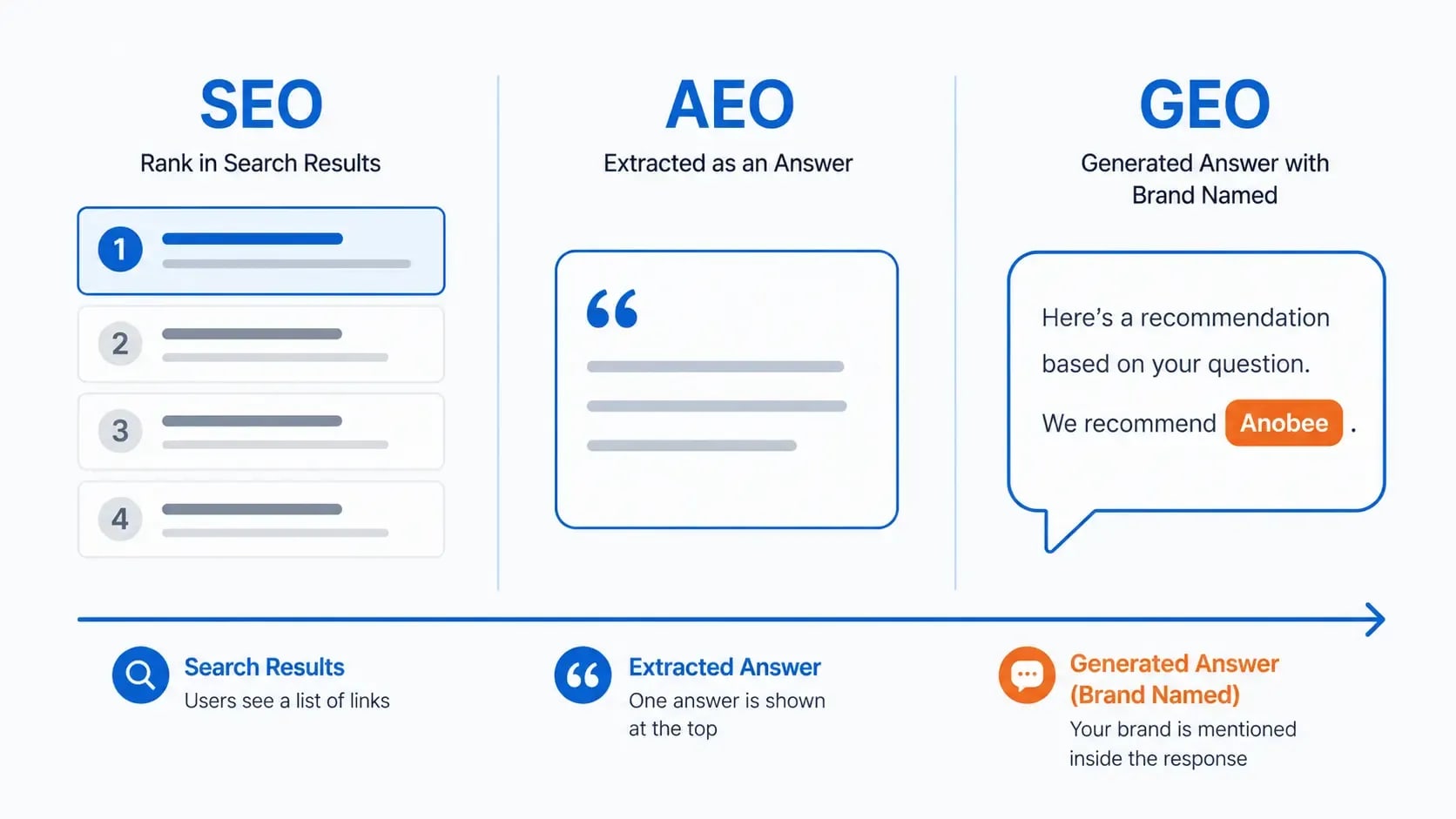
For the broader distinction between traditional search, answer engines and generative search, read Anobee's SEO vs GEO vs AEO guide.
Frase pricing in 2026
Frase currently lists:
- Starter: $49/month, or $39/month billed yearly
- Professional: $129/month, or $103/month billed yearly
- Scale: $299/month, or $239/month billed yearly
- Enterprise: custom
The vendor also lists a seven-day trial without a credit card [4].
Who should choose Frase?
Choose Frase if you want a content workflow that stretches from research and scoring into page monitoring and AI-search visibility.
If all you need is a basic WordPress SEO check, it is more software than necessary.
4. NEURONwriter
Best for: Freelancers, small agencies and budget-conscious SEOs that still want semantic content optimization.
NEURONwriter sits in an attractive middle ground.
It offers content writer analyses, AI credits, content planning and AI-monitored questions across its plans. Higher tiers add features such as advanced templates, integrations, plagiarism checks, API access and broader content-management capabilities [5].
For a freelancer, the most important part is straightforward: you can run a SERP-informed content analysis without paying enterprise-level prices.
What NEURONwriter does well
- content scoring and optimization
- competitive/semantic analysis
- content planning
- WordPress and Google Search Console integrations on higher plans
- AI-monitored questions
- pricing that scales through several tiers
Where NEURONwriter fits less well
More features and controls also mean a busier interface.
If you are giving the tool directly to writers who want a minimal grading experience, Clearscope may feel simpler. If you want broader site monitoring and GEO workflows, Frase may be the better fit.
NEURONwriter pricing in 2026
The official pricing currently lists:
- Bronze: $23/month or $19/month billed yearly
- Silver: $45/month or $37/month billed yearly
- Gold: $69/month or $57/month billed yearly
- Platinum: $93/month or $77/month billed yearly
- Diamond: $117/month or $97/month billed yearly
Limits increase by projects, content analyses, AI-monitored questions and AI credits [5].
Who should choose NEURONwriter?
Choose it if you want dedicated SEO content analysis at a lower entry price and are comfortable with a more feature-heavy workspace.
5. MarketMuse
Best for: Established sites that need to decide what to improve, what to create next and where topical coverage is weak.
MarketMuse is less useful as a simple "check this paragraph" tool and more useful when the real problem is content strategy.
Its current pricing structure includes a Free plan and paid tiers named Optimize, Research and Strategy. The plans increase tracked topics, content briefs and strategy documents [6].
That makes MarketMuse particularly relevant when a page is underperforming because the website lacks supporting topical depth—not because one phrase is missing from the article.
What MarketMuse does well
- content inventory and topic strategy
- broader coverage analysis
- content brief workflows
- prioritization across many pages
- planning supporting content around a pillar
Where MarketMuse fits less well
It can be overkill for a new site with a small content library.
If you have 20 articles and need help optimizing one post, start with a per-page content optimizer. If you have hundreds of URLs and need to decide where authority is thin, a strategy platform becomes more valuable.
MarketMuse pricing in 2026
MarketMuse currently lists a Free tier plus Optimize, Research and Strategy plans on its pricing page. The public page focuses on plan limits rather than displaying a simple monthly dollar figure for each paid tier [6].
Who should choose MarketMuse?
Choose it when your SEO content problem is architectural: weak topic clusters, missing supporting pages, unclear priorities or a large inventory that needs systematic planning.
6. Rank Math
Best for: WordPress publishers who need a practical SEO writing checker inside the CMS.
Rank Math is not a replacement for Surfer, Clearscope or Frase.
It is a WordPress SEO plugin with a built-in SEO score and publishing checks. That makes it useful for confirming basic on-page elements before publication: title usage, metadata, schema, links and other page-level settings.
The current premium product also includes rank tracking, schema tools, Search Console/Analytics integration and additional SEO automation features [7].
What Rank Math does well
- on-page checks directly inside WordPress
- a simple SEO score for publishing QA
- schema controls
- sitemap and metadata management
- rank tracking and analytics features in paid plans
- a capable free version
Where Rank Math is limited
Its content score should not be confused with deep SERP-based semantic analysis.
A page can pass every basic on-page check and still miss search intent, competitive topic coverage or important entities.
If the target query is difficult, use Rank Math as the publishing layer and a dedicated content analysis tool for the article itself.
Rank Math pricing in 2026
Rank Math offers a free plugin. Its current vendor pricing page lists PRO at €7.99/month billed annually for the initial purchase, with separate Business and Agency tiers and different renewal pricing [7].
Who should choose Rank Math?
Choose Rank Math if you publish on WordPress and want an affordable baseline checker.
For a practical setup workflow, see Anobee's Rank Math setup guide.
Which SEO content checker is best for articles?
If your question is specifically "What tool can I use to check article SEO?", narrow the decision to tools that analyze the page itself.
For competitive SEO articles: Surfer
Surfer is a strong fit when the article targets a competitive SERP and you want structured optimization against competing pages.
For editorial teams: Clearscope
Clearscope makes sense when multiple writers need a consistent grading workflow and editors want fewer moving parts.
For SEO + GEO workflows: Frase
Frase is the most interesting option in this list when the article is part of a broader Google plus AI-search workflow.
For lower-cost semantic optimization: NEURONwriter
NEURONwriter gives freelancers and smaller teams a dedicated optimizer at a lower entry price.
For WordPress pre-publish checks: Rank Math
Rank Math is enough when you mainly want to confirm basic on-page implementation inside WordPress.
What is the best SEO content scoring tool?
There is no universal score that tells you whether content will rank.
The useful question is whether the score helps you find something real.
A good content scoring tool should make it easier to notice:
- an important subtopic you skipped
- a mismatch between your article and search intent
- weak semantic coverage
- thin headings or incomplete sections
- missing internal links
- an article that is much narrower than the competitive set
The score becomes misleading when users assume that moving from 75 to 95 creates a proportional ranking improvement.
It does not.
Different tools use different data and weighting. Compare recommendations, not raw numbers across platforms.
Which tool is best for finding missing entities and topics?
For one article, start with a SERP-driven optimizer such as Surfer, Clearscope, Frase or NEURONwriter.
Review the recommendations and ask three questions:
- Is this entity or concept genuinely relevant to the searcher's task?
- Is the topic already explained using different wording?
- Does it deserve a sentence, a section, or a separate article?
That third question is important.
Trying to force every related query into one page can weaken intent.
If the missing topic is large enough to solve a different search job, create supporting content and link it back to the main page instead. MarketMuse becomes more useful when you need to make that decision across an entire site.
SEO content score vs content quality score
These two ideas should not be treated as synonyms.
| SEO content score | Content quality |
|---|---|
| Based on a tool's model | Based on the reader's actual experience and outcome |
| Often compares terms, topics or on-page checks | Includes usefulness, accuracy, originality and clarity |
| Can be automated | Requires editorial judgment |
| Useful for finding gaps | Useful for deciding whether the page deserves to exist |
| Varies by platform | Cannot be reduced to one universal number |
A content quality checker can help with part of the job. It cannot prove that your content is trustworthy or useful.
Before publication, manually verify claims, examples, pricing, recommendations and any statement that could become outdated.
Can SEO content checkers help with AI search optimization?
Some can.
The category is moving from classic content optimization toward broader search visibility.
Surfer now includes AI-visibility features in several plans. Frase combines SEO and GEO scores with AI Visibility. NEURONwriter includes AI-monitored questions. Clearscope's current plans also include tracked prompts.
Those features can help answer questions such as:
- Is the brand appearing for important prompts?
- Which pages need deeper coverage?
- Are competitors being cited where your site is absent?
- Does a page need better entity, product or topic information?
- Which existing URL is the best candidate to improve?
However, no checker can promise a citation.
AI systems use their own retrieval, ranking, source-selection and answer-generation processes. The safest strategy is still to publish pages that are clear, well-supported, entity-rich, technically accessible and genuinely useful.
For a broader tool comparison in this area, see Anobee's best AI SEO tools guide.
Free vs paid SEO content checker tools
Free tools are useful when your problem is simple.
A WordPress publisher can combine:
- Rank Math Free
- Google Search Console
- manual SERP review
- a strong editorial checklist
That may be enough for lower-competition topics.
Paid content optimization tools earn their cost when they reduce research time or reveal information that would take much longer to assemble manually.
Typical paid advantages include:
- deeper competitor analysis
- semantic or entity recommendations
- content scoring
- topic-gap detection
- briefs and research workflows
- page auditing
- internal-link suggestions
- AI-search monitoring or GEO features
Do not pay for a tool because an SEO checklist says you need one.
Pay when the workflow saves enough time or improves enough decisions to justify the subscription.
How to use an SEO content checker without keyword stuffing
The safest workflow separates writing from optimization.

Step 1: confirm search intent manually
Search the target query and inspect what is ranking.
Identify whether the query expects:
- a comparison
- a how-to guide
- a product page
- a definition
- a template
- a tool
- a local result
Do this before chasing a content score.
Step 2: write the useful answer first
Build the page around the user's decision or problem.
Include the evidence, examples, comparisons and explanations needed to solve that problem.
Do not draft from a list of recommended terms.
Step 3: run the content analysis
Now compare the draft with the SERP.
Use the checker to locate missing concepts, weak sections and structural gaps.
Step 4: classify every recommendation
Put recommendations into three groups:
Add: genuinely missing and useful.
Already covered: present using different wording.
Ignore: irrelevant, redundant or likely to make the writing worse.
This simple step prevents optimization software from becoming a keyword-stuffing machine.
Step 5: check article-level SEO
Review:
- title and H1 alignment
- heading structure
- introduction
- internal links
- external references
- image alt text
- schema where appropriate
- canonical URL
- indexability
- metadata
A CMS plugin can help with this layer.
Step 6: add internal links from existing pages
Do not only link out from the new article.
Find older, relevant pages and link into the article using natural anchors.
Examples for this page include:
- SEO content checker tools
- content checker for SEO
- SEO content analysis tools
- article SEO checker
- content scoring tools
- tools for optimizing SEO content
Avoid repeating one exact-match anchor everywhere.
Step 7: publish, measure and refresh
Use Search Console after publication.
Watch which queries gain impressions and which sections Google appears to associate with the page.
If a partially related query starts collecting impressions, decide whether it belongs in the article or deserves supporting content.
That is more reliable than guessing every possible keyword before publishing.
Common SEO content checker mistakes
Chasing the maximum score
A score is a diagnostic tool.
If the article becomes repetitive or awkward while the number rises, the optimization is moving in the wrong direction.
Assuming every suggested term must appear
Semantic recommendations are prompts for review, not mandatory keywords.
Use a term when it helps explain the topic.
Confusing optimization with quality
A technically optimized article can still be generic.
Add real examples, judgment, evidence, original observations and clear recommendations.
Using one page for several different intents
A page about SEO content checker tools should not become a full technical SEO crawler comparison just because "SEO checker" appears in Search Console.
Different search jobs deserve different URLs.
Letting pricing go stale
Tool comparison pages decay quickly.
Add a visible "pricing checked" date and re-check vendor pages during every major refresh.
Ignoring internal authority
A good article can remain weak if the rest of the site barely references it.
Build internal links from relevant SEO, AI-search, WordPress and content-strategy pages.
How to choose the right SEO content analysis tool
Use this decision framework.
You are a solo WordPress blogger
Start with Rank Math Free and Search Console.
Add a dedicated optimizer only when the queries are competitive enough to justify the extra research.
You are a freelance SEO writer
Compare NEURONwriter, Frase and Surfer.
Your choice should depend on client volume, content limits and whether you need AI-search monitoring.
You run an SEO or content agency
Surfer becomes more attractive when several clients need repeatable SERP-driven optimization.
Clearscope is worth considering when a larger editorial team values a simpler shared grading workflow.
You manage an in-house content team
Compare Clearscope, Surfer and Frase based on seats, tracked pages, integrations, publishing workflow and AI-search requirements.
You manage a large content library
MarketMuse is the more relevant tool when your main question is not "how do I improve this article?" but "which pages and topics should we prioritize across the site?"
You need Google and AI-search visibility in one workflow
Compare Frase and Surfer first, then evaluate whether their tracking depth matches the platforms and prompts that matter to your brand.
The bottom line
The best SEO content checker is the one that exposes useful gaps without taking control of the writing.
Use the tool to understand the SERP, test topical completeness, inspect semantic coverage and improve on-page execution. Then use human judgment to decide what the page should actually say.
For most users, the shortlist is straightforward:
- choose Surfer for a strong SERP-driven all-round workflow
- choose Clearscope for editorial simplicity and team use
- choose Frase for SEO, GEO, auditing and AI-search workflows
- choose NEURONwriter for lower-cost semantic optimization
- choose MarketMuse for broader topical strategy
- choose Rank Math for WordPress on-page checks
Do not optimize for a perfect score.
Optimize for a page that answers the query clearly, covers the topic properly, gives the reader something useful and fits naturally into a larger content cluster.
Frequently Asked Questions
What is an SEO content checker?
An SEO content checker reviews a draft or published page for signals such as search-intent alignment, topic coverage, semantic terms, headings, internal links and on-page elements. Advanced tools compare your page with competing search results and generate a proprietary content score or grade.
What is the best SEO content checker tool?
There is no universal winner. Surfer is a strong all-round option for SERP-driven optimization, Clearscope fits editorial teams, Frase combines SEO and GEO workflows, NEURONwriter offers a lower-cost alternative, MarketMuse is stronger for broader content strategy, and Rank Math works well for basic WordPress on-page checks.
What tool can I use to check article SEO?
For a single article, use a tool that checks the page against its target query and competing results. Surfer, Clearscope, Frase and NEURONwriter are designed for deeper article optimization, while Rank Math provides a simpler WordPress-based SEO checklist and score.
What SEO content analysis software offers content quality scoring?
Surfer, Clearscope, Frase, NEURONwriter and Rank Math all provide a score or grade in different forms. The important point is that each platform uses its own methodology, so scores are most useful for finding gaps inside that tool rather than comparing one platform's number directly with another.
Can an SEO content checker measure content quality?
Only partly. A checker can flag missing topics, weak structure, thin coverage or on-page issues, but it cannot fully judge first-hand experience, originality, factual accuracy, usefulness or brand voice. Human editorial review is still required.
Which SEO tool can help find missing entities and topics?
SERP-driven tools such as Surfer, Clearscope, Frase and NEURONwriter can surface related concepts, terms or competitive content gaps. MarketMuse is particularly useful when the problem is broader topical coverage across a site rather than optimization of one article.
What is the difference between an SEO content score and a content quality score?
An SEO content score usually measures how well a page matches a tool's optimization model, while content quality is broader and includes usefulness, accuracy, originality, clarity and trust. A high optimization score does not guarantee a high-quality page or a ranking.
Can SEO content tools help with AI search optimization?
Yes, but the useful features vary. Some platforms now combine classic SEO optimization with GEO scores, AI visibility tracking, prompt monitoring or content-gap workflows for AI answers. Those features can help prioritize improvements, but they do not guarantee citations in ChatGPT, Google AI Overviews, Gemini, Claude or Perplexity.
Sources and References
Was this guide helpful?
Your answer helps Anobee improve future updates.

Written by
Bibek Thapa
AI-Powered Digital Growth Strategist
Bibek Thapa works across AI workflows, SEO, AI search optimization, content strategy, website growth, and productivity systems. Anobee documents practical lessons, tools, experiments, and systems for improving digital presence.
- AI workflows
- Digital growth
- SEO
- GEO
- AEO
- Content strategy
- Website growth