
Freelancing & Online Business
Best Blogging Platforms for Nepal in 2026: 8 Compared
By Bibek Thapa · Updated · 16 min read
Quick verdict
Comparison guideWordPress.org is the strongest all-round blogging platform for a Nepal-based creator who wants long-term ownership, SEO control and several monetization options. Blogger is the practical zero-cost starting point. WordPress.com and Wix reduce technical maintenance. Medium, Ghost, Substack and Hashnode suit narrower workflows, but their domain and payment rules need checking in Nepal.
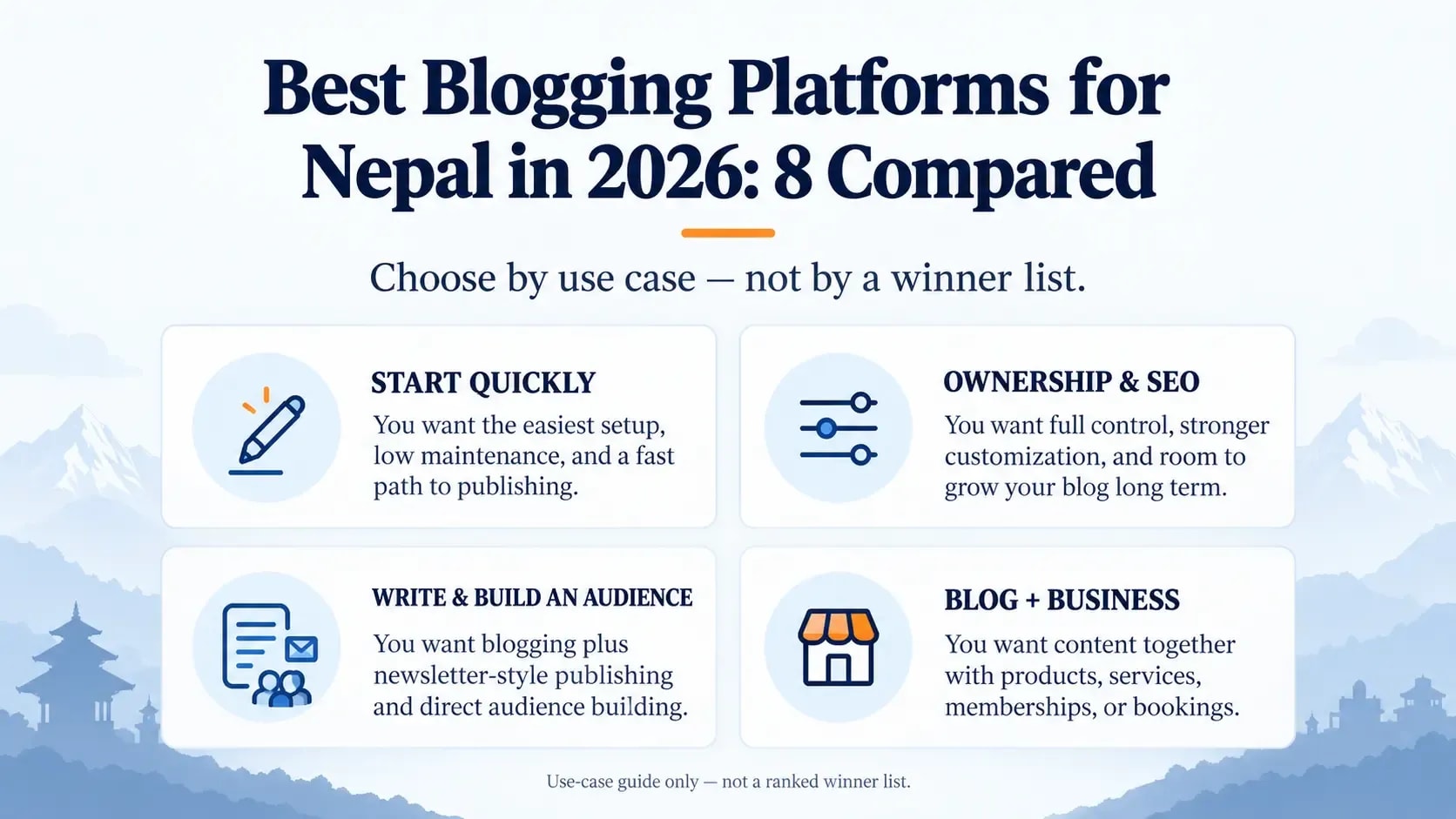
Table of ContentsOn this page
- Blogging platforms for Nepal: quick comparison
- What should a Nepali blogger check first?
- 1. WordPress.org: best overall for long-term control
- 2. Blogger: best free platform for testing the habit
- 3. WordPress.com: best for managed WordPress simplicity
- 4. Wix: best for visual no-code publishing
- 5. Medium: best for reach, not Nepal-based earnings
- 6. Ghost: best for an owned publication and newsletter
- 7. Substack: best for a simple newsletter workflow
- 8. Hashnode: best for developers and technical writers
- Which blogging platforms for Nepal should you choose?
- A practical migration-safe starting plan
- The bottom line
- Frequently Asked Questions
- Sources and References
Key Takeaways
- Choose a platform by the site you want to own and the payment routes you can actually use, not by the longest feature list.
- WordPress.org offers the most control, but you must arrange hosting, a domain, updates, backups and security.
- Blogger remains a useful free test platform and supports custom domains and AdSense, although design and publishing control are limited.
- Medium's Partner Program currently excludes Nepal from its supported payout-country list.
- Ghost and Substack use Stripe for native paid subscriptions; Stripe does not currently list Nepal as a supported payments country.
- Publish a Devanagari test post on desktop and mobile before committing to any theme or platform.
The best choice among blogging platforms for Nepal is not simply the one with the most features. It is the one that fits what you plan to publish, how much maintenance you can handle and how you expect the blog to earn.
That last point matters in Nepal. A platform may advertise paid memberships or a writer programme, yet the connected payout provider may not support a Nepal-based account. Free plans may be easy to start but difficult to move away from. A powerful self-hosted system may provide excellent control while giving you updates and backups to manage.
For most people building a long-term content asset, WordPress.org is the strongest overall choice. Blogger is the clearest zero-cost trial. WordPress.com and Wix reduce the technical work. Medium, Ghost, Substack and Hashnode make more sense for specific publishing models than for every Nepali blogger.
Method note: This comparison was refreshed on September 16, 2026. Anobee checked each platform's official feature, plan, domain and payment documentation. It is a research-based comparison, not a hands-on speed test, revenue test or guarantee that an account will be approved. Prices and country rules can change, so confirm them again before paying or enabling monetization.
Blogging platforms for Nepal: quick comparison
Use this table to narrow the list. Then read the tradeoffs for the two or three options that match your goal.
| Platform | Best fit | Starting cost | Custom domain | SEO and ownership | Nepal monetization reality |
|---|---|---|---|---|---|
| WordPress.org | A long-term independent blog | Software is free; hosting and domain cost extra | Yes | Strong control; you manage the site | Flexible, subject to each payment or ad provider |
| Blogger | Testing blogging with no hosting budget | Free hosting and Blogspot address | Yes; domain purchased separately | Basic but usable control | AdSense supports Nepal payment profiles, subject to approval |
| WordPress.com | Hosted WordPress with less maintenance | Free tier; paid plans available | Paid plan | More managed, with plan-dependent features | Check the payment service used by each feature |
| Wix | Visual, no-code site and blog | Free tier; paid plans available | Paid plan | Convenient design tools; platform-managed | Payment and business features depend on plan and location |
| Medium | Writing for an existing reading network | Free to publish a story | Active membership required | Limited site and analytics control | Partner Program payout eligibility currently excludes Nepal |
| Ghost | Publication plus email newsletter | Self-host or use paid Ghost(Pro) | Yes | Strong publishing and membership tools | Native paid subscriptions use Stripe, which does not list Nepal |
| Substack | Newsletter-led publishing and community | Free to publish | Available with platform conditions | Simple newsletter workflow; less site control | Paid subscriptions use Stripe; Substack also takes 10% |
| Hashnode | Developer and technical writing | Free publication; Pro features available | Pro for new publications | Strong technical workflow and community | Better for reach and portfolio than Nepal-specific payments |
There is no honest universal winner. A student publishing ten practice articles has different needs from a company building a searchable knowledge base. The right decision becomes clearer when you separate five factors: ownership, recurring cost, maintenance, audience discovery and usable monetization.
What should a Nepali blogger check first?
1. Decide whether the blog is an asset or a channel
An owned website is an asset you control: domain, design, analytics, redirects, email capture and monetization. A network such as Medium or Substack is also a distribution channel. It can help readers discover you, but its rules and interface remain under another company.
If search traffic, client enquiries or a business brand matter, use your own domain early. You can still republish selected work elsewhere with the correct canonical setting where the platform supports it.
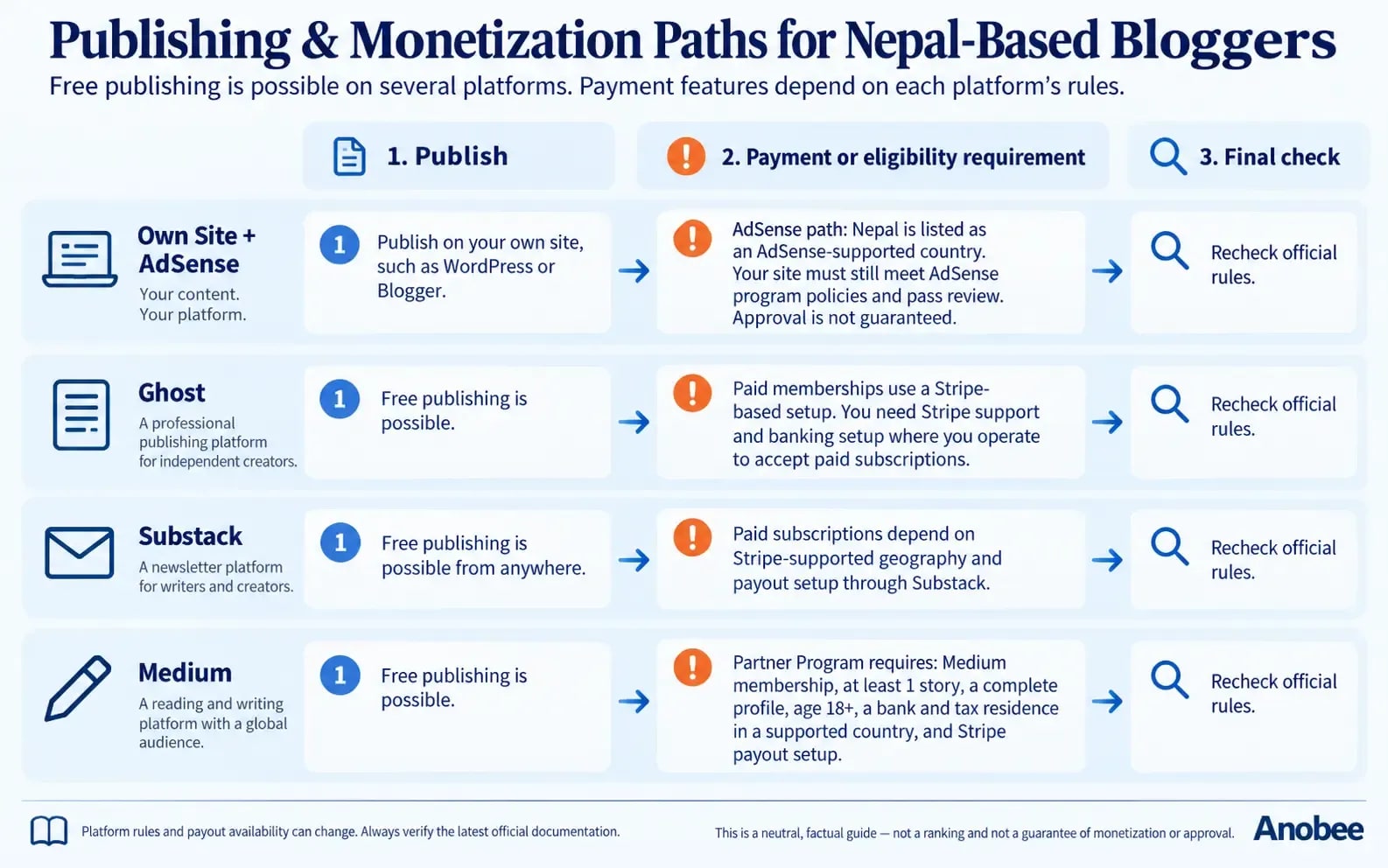
2. Confirm the payment route before choosing monetization
Do not build a paid-membership plan and solve payouts later. Check the platform, its payment processor and your own account eligibility.
Google's current AdSense payment table lists check and wire transfer as available for Nepal payment addresses [1]. That does not guarantee approval or income. It does mean AdSense has a documented Nepal payment route.
Stripe's current global availability page does not list Nepal as a supported country for opening a standard payments account [2]. This affects native paid subscriptions on services that require Stripe, including Ghost and Substack. Never use a false address, borrowed company or another person's identity to bypass a country rule.
3. Test Nepali text on the actual theme
Publishing in Nepali is possible on modern platforms because Devanagari can be stored and displayed as Unicode text. The weak point is often the design, not the alphabet.
Before committing, publish a private or temporary test containing:
- a long Nepali headline;
- several full paragraphs;
- English and Nepali on the same line;
- numerals, punctuation and links;
- bold text, a list and a table;
- mobile screenshots at narrow widths.
Check font availability, line height, line breaks and menu labels. A platform can support the text while a poorly chosen theme still makes it difficult to read.
4. Price the second year, not only the first
Introductory hosting rates and free-domain offers are temporary. Compare renewal prices, storage, backups, email, premium themes and the cost of removing platform branding.
For a self-hosted blog, include the domain and hosting. For a hosted platform, identify the first plan that supports your own domain and the features you need. If you need help choosing and registering the address, use Anobee's guide to buying a domain in Nepal.
5. Check how you can leave
Your first platform does not have to be permanent. It should not trap your work.
Check whether you can export posts, images, redirects and subscriber data. Also check whether the old URLs can redirect when you move. Migration is rarely perfect, but an export route and a domain you control reduce the risk.
1. WordPress.org: best overall for long-term control
WordPress.org is open-source software that you install on hosting you choose. The software itself is free. Running the complete site is not: you normally pay for hosting and a domain, and you are responsible for maintenance.
Among blogging platforms for Nepal, WordPress.org stands out for control. WordPress supports themes, plugins, custom content types, imports and detailed SEO configuration. Its official feature page emphasizes both ownership of your data and the ability to extend the system through plugins and themes [3].
That makes WordPress.org a practical foundation for:
- a blog intended to rank in Google;
- a business or personal brand on its own domain;
- affiliate content with clear disclosures;
- display advertising;
- service pages, lead forms or a portfolio;
- an eventual store, course area or membership system.
The tradeoff is responsibility. Updates, backups, security, performance and plugin compatibility do not manage themselves. A one-click installer reduces setup time, but it does not remove ongoing maintenance.
Choose WordPress.org if: you want a long-term site, expect search visibility to matter and are willing to learn the basic maintenance workflow.
Avoid it for now if: even a small annual cost is impossible or technical maintenance would stop you from publishing.
2. Blogger: best free platform for testing the habit
Blogger gives you hosted publishing and a Blogspot address without buying hosting. Google's product page also confirms that Blogger supports a purchased custom domain and AdSense integration [4]. Its help documentation explains how to connect that domain through DNS records [5].
This makes Blogger useful for a student or first-time writer who needs to answer one question: will I publish consistently?
You can learn article structure, basic on-page SEO, image handling and editorial discipline before taking on hosting costs. If AdSense is part of the plan, remember that the integration is not the same as approval. Your site and account still have to meet Google's policies.
Blogger's limits become clearer as the site grows. Design and content modelling are less flexible than WordPress. Advanced landing pages, editorial workflows and integrations may require workarounds. A later migration is possible, but it creates another project.
Choose Blogger if: your budget is zero and you want a low-risk place to publish your first 10 to 20 useful articles.
Avoid it if: you already know the blog will support a business, complex SEO programme or custom publishing workflow.
3. WordPress.com: best for managed WordPress simplicity
WordPress.com hosts and manages the infrastructure for you. It is a different product from installing WordPress.org on your own hosting.
The free plan can be used without an expiry date, but free sites display WordPress.com advertising. Paid plans add a custom domain and remove those visitor-facing ads. Features, storage and billing terms vary by plan [6].
WordPress.com suits someone who wants the WordPress editor and ecosystem without managing a hosting account. It can also be an easier operational fit for a small team that values support and predictable maintenance.
The important comparison is not “WordPress.com versus free WordPress software.” It is a WordPress.com plan versus the full cost and work of self-hosting. Review the current plan table before assuming a plugin, payment or design feature is included.
Choose WordPress.com if: you want a managed service and can accept plan-based limits.
Avoid it if: you want the widest server, plugin and cost-control options from the start.
4. Wix: best for visual no-code publishing
Wix combines a visual site builder, hosting and blogging tools. Its free tier includes hosting and the drag-and-drop editor. Connecting a custom domain and removing Wix branding requires a paid plan. Wix also states that prices and currencies vary by location and billing period [7].
The appeal is speed of visual assembly. A photographer, consultant, restaurant or portfolio owner can build pages and a blog within the same interface without managing a separate host.
The tradeoff is platform dependence. Your design and feature choices stay inside Wix's system, and moving a mature site elsewhere can take more work than exporting ordinary posts. For a search-led publication, compare template performance, URL controls, structured data, redirects and editorial workflow before paying.
Choose Wix if: the blog supports a visual website and a no-code editor matters more than maximum infrastructure control.
Avoid it if: the publication itself is the main product and you expect extensive content modelling or future migration.
5. Medium: best for reach, not Nepal-based earnings
For writers comparing blogging platforms for Nepal, Medium removes almost all site setup. You create a draft, publish it to your profile and may submit suitable work to publications. The platform can distribute stories through feeds, email and its recommendation system.
This is useful for building a writing portfolio, testing ideas or reaching readers already on Medium. It is less suitable as the only home for a business. Custom-domain support requires an active Medium membership, and Medium does not allow Google Analytics or arbitrary tracking scripts on that setup [8].
The biggest Nepal-specific limitation is payment. Medium's current Partner Program eligibility page lists supported countries for bank and tax residence, and Nepal is not on that list [9]. For a writer based in Nepal, Medium is a reach and portfolio channel. Do not choose it on the assumption that Partner Program earnings will be available.
Choose Medium if: your priority is writing and network distribution rather than owning a configurable site.
Avoid it as your main platform if: you need Nepal-supported native earnings, complete analytics or full control over the reader journey.
6. Ghost: best for an owned publication and newsletter
Ghost is built around web publishing, email newsletters and memberships. You can self-host the open-source software or pay for Ghost(Pro), its managed service. Ghost(Pro) plans are based partly on audience size, and the current plan page includes a custom domain, newsletters and built-in SEO features [10].
Ghost is attractive when the publication and email list are part of one product. Its interface is more focused than a general website builder, and Ghost charges no additional platform transaction fee on paid subscriptions. Payment-processor fees still apply.
For a creator based in Nepal, native paid memberships are the main constraint. Ghost says Stripe is its only natively supported payment provider [11]. Since Stripe does not currently list Nepal for standard payments accounts, confirm a lawful account and payout setup before choosing Ghost for subscription revenue. Ghost documents alternatives such as embedded third-party payment buttons, but those are not the same as its native subscription workflow.
Choose Ghost if: you want an independent publication with email built into the core product and you have confirmed the operating and payment setup.
Avoid it if: your budget is tight, you do not want technical self-hosting and native paid subscriptions are essential but Stripe eligibility is unavailable.
7. Substack: best for a simple newsletter workflow
Substack combines email newsletters, web posts, subscriptions and network discovery. Publishing is free regardless of subscriber count. If you enable paid subscriptions, Substack takes 10% of each transaction and Stripe charges its own processing and billing fees [12].
The simple workflow helps a writer begin collecting email subscribers without assembling several tools. It can suit commentary, analysis, a niche newsletter or a creator who already has an audience.
The payment issue remains. A Nepal-based creator should separate free publishing from paid subscriptions. Substack's payment setup uses Stripe. Because Nepal is not currently listed on Stripe's global availability page, do not plan a paid newsletter until you have confirmed that your business and payout arrangement are eligible.
Substack also provides less website control than self-hosted WordPress or Ghost. The value is the combined newsletter and network, not unlimited design flexibility.
Choose Substack if: you want the shortest route to a free newsletter and web archive.
Avoid it as a paid-business foundation if: you have not confirmed Stripe eligibility or do not want a 10% platform fee on subscription transactions.
8. Hashnode: best for developers and technical writers
Hashnode is a publishing network built for developers. Its editor, technical community and Markdown workflow make it useful for tutorials, engineering notes, project explanations and a public learning record.
Older comparisons often say that a custom domain is free. That is no longer a safe claim for a new publication. Hashnode introduced Pro in June 2026, placing custom domains, the GraphQL API, headless mode, GitHub backup, scheduled publishing and several other capabilities in the paid plan. Free accounts are limited to one publication, while qualifying existing setups may be grandfathered [13].
For a Nepali developer, Hashnode can still be a useful discovery and portfolio channel. It is a narrower fit for lifestyle, travel, finance or general-interest blogging because the community context is technical.
Choose Hashnode if: you write for developers and value a technical network more than complete site independence.
Avoid it if: your topic is not technical or a free custom domain is a deciding requirement.
Which blogging platforms for Nepal should you choose?
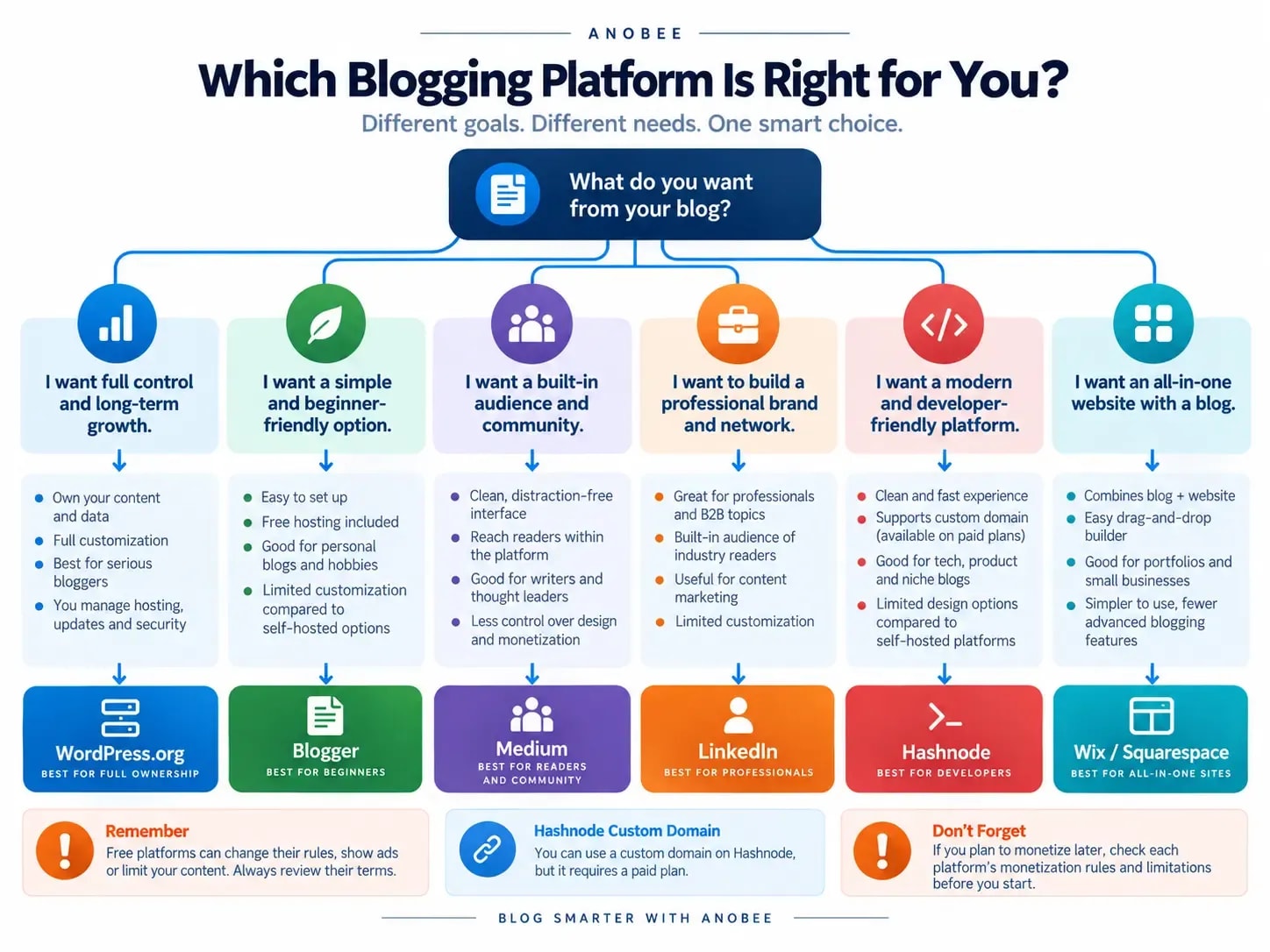
Start with the publishing model, not a brand name.
If your budget is zero
Use Blogger when you want a conventional blog and the option to connect a domain later. Try Medium for a writing portfolio or network reach. Choose Substack when the email list is the central product. Hashnode fits technical writing.
The free choice should help you publish, not delay the decision forever. Set a small target such as 10 useful articles in 90 days. Then review whether you need more control.
If you want Google traffic and a long-term brand
Choose WordPress.org unless you have a strong reason not to. It gives you the clearest path to controlling URLs, templates, internal links, structured data, analytics and conversion pages.
The platform alone does not create rankings. You still need search demand, useful coverage and sound on-page work. Anobee's keyword research guide for a Nepali blog helps you choose topics, while the on-page SEO checklist covers the page-level basics.
If you want the least technical maintenance
Compare WordPress.com and Wix. Both host the site and package several operational tasks into the service. WordPress.com is the more direct route if you want the WordPress publishing model. Wix is stronger when visual page building is the priority.
If newsletters and memberships are central
Compare Ghost and Substack, but check payments first. Substack is quicker to start. Ghost gives you more publication ownership and brand control. Neither decision is complete until the native payout path works for your legal location and account.
If you want to publish in Nepali
Do not choose on a vague “Nepali support” label. Create the same Devanagari test article on your shortlisted platforms. Check it on a low-cost Android phone, a desktop browser and at least one slow connection.
WordPress.org provides the widest theme and font control. Blogger is the practical free alternative. The best result still depends on the exact design you select.
A practical migration-safe starting plan
You do not need to perfect the entire setup before the first article. You do need to avoid choices that make every later step harder.
- Write the goal in one sentence. Decide whether the blog exists for search traffic, a portfolio, email subscribers, community or client enquiries.
- Choose two platforms from the table. Compare only the features connected to that goal.
- Verify the cost and payout route. Check the renewal price, custom-domain requirement and country eligibility on official pages.
- Publish a language and layout test. Include Devanagari, English, a table, links and images.
- Use your own domain when the blog becomes serious. A controlled domain makes future migration and brand building easier.
- Create three cornerstone articles. Answer the most important questions in your niche before chasing daily publishing.
- Set up measurement. Connect the site to Search Console so you can see which queries and pages earn impressions. The Google Search Console setup guide walks through the process.
- Review after 90 days. Check publishing consistency, search visibility, subscriber growth and technical friction. Move only when the current platform is blocking a real goal.
The bottom line
For most serious creators comparing blogging platforms for Nepal, WordPress.org is the best long-term foundation. It asks more from you, but it also gives you the most room to build search traffic, an audience and a business on a domain you control.
Blogger is the sensible no-cost starting point. WordPress.com and Wix reduce maintenance. Medium, Ghost, Substack and Hashnode are valuable when their narrower publishing model matches the job.
Do not let the comparison become another reason not to publish. Pick the smallest platform that can support your next year of work, verify the payment and export rules, and write the first genuinely useful article.
Frequently Asked Questions
Which blogging platform is best in Nepal?
WordPress.org is the best all-round choice for most serious bloggers because it provides strong ownership, SEO and monetization control. Blogger is better for a no-cost trial, while a hosted platform can suit creators who prefer less maintenance.
Can I start a blog for free in Nepal?
Yes. Blogger, WordPress.com, Wix, Medium, Substack and Hashnode offer ways to publish without buying hosting at the start. Free plans usually limit branding, custom domains, design, monetization or advanced features.
Can I write a blog in Nepali language?
Yes. Modern blogging platforms can publish Unicode Devanagari text. The practical differences come from the theme, font, line spacing and mobile layout, so test a full Nepali article before choosing a design.
Is Blogger or WordPress better for a beginner in Nepal?
Blogger is simpler when the budget is zero and you want to test whether you will publish consistently. WordPress.org takes more setup and maintenance, but it is the better foundation when you want full control and expect the blog to grow.
Can Nepali writers earn through Medium?
Nepal is not currently included in Medium's list of countries eligible for Partner Program payouts. A Nepal-based writer can still publish for reach or portfolio building, but should not choose Medium on the assumption that Partner Program earnings will be available.
Do Substack and Ghost paid subscriptions work in Nepal?
Both platforms rely on Stripe for their native paid-subscription workflows, and Stripe does not currently list Nepal as a supported payments country. Creators should confirm account eligibility and a lawful payout route before building a paid-membership plan around either platform.
Sources and References
- Google AdSense Help — Payment Methods by Country ↩
- Stripe — Global Availability ↩
- WordPress.org — Features ↩
- Blogger — Create a Blog ↩
- Blogger Help — Set Up a Custom Domain ↩
- WordPress.com — Plans and Pricing ↩
- Wix — Plans and Pricing ↩
- Medium Help Center — Custom Domains ↩
- Medium Help Center — Partner Program Eligibility ↩
- Ghost — Ghost(Pro) Pricing ↩
- Ghost Help Center — Alternative Payment Gateways ↩
- Substack Help Center — How Much Does Substack Cost? ↩
- Hashnode — Introducing Hashnode Pro ↩
Was this guide helpful?
Your answer helps Anobee improve future updates.

Written by
Bibek Thapa
AI-Powered Digital Growth Strategist
Bibek Thapa works across AI workflows, SEO, AI search optimization, content strategy, website growth, and productivity systems. Anobee documents practical lessons, tools, experiments, and systems for improving digital presence.
- AI workflows
- Digital growth
- SEO
- GEO
- AEO
- Content strategy
- Website growth


